
Epicauta stuarti
LeConte, 1868
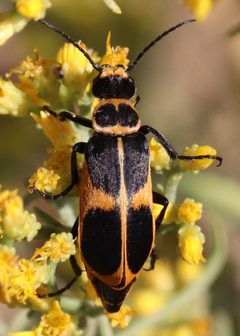
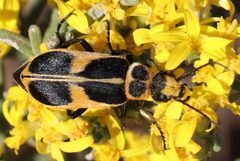
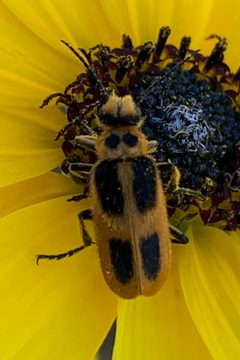
Epicauta stuarti is a blister beetle in the Meloidae, characterized by a black and orange color pattern that participates in a Müllerian mimicry complex with soldier beetles (Cantharidae). The is found in North America, with records from the southwestern United States including Colorado, Oklahoma, and New Mexico. have been observed on flowers of Gutierrezia sarothrae (snakeweed) and are attracted to fermenting liquid baits in trapping studies. Like other Epicauta species, it produces , a potent defensive chemical that causes blistering on skin and is toxic if ingested.
Pronunciation
How to pronounce Epicauta stuarti: /ˌɛpɪˈkaʊtə ˈstjuːɑːrti/
These audio files are automatically generated. While they are not always 100% accurate, they are a good starting point.
Identification
Distinguished from similar-appearing soldier beetles (Chauliognathus spp., Cantharidae) by the soft, flexible characteristic of Meloidae and the broader, more robust body form. The black and orange pattern is nearly identical to that of the Colorado Soldier Beetle (Chauliognathus basalis) and its foothills relative C. deceptus, representing Müllerian mimicry where both chemically defended share warning coloration. Can be separated from other Epicauta species by specific pattern details of the orange markings, though precise diagnostic features require expert examination.
Images
Habitat
Open including shortgrass prairie, sand dune systems, and pinyon-oak-juniper woodlands. Associated with flowering plants, particularly Gutierrezia sarothrae (snakeweed).
Distribution
North America; documented from Colorado, Oklahoma, New Mexico, and adjacent southwestern United States. Records suggest a western distribution with eastern extent into the Great Plains.
Seasonality
active in late summer and early autumn; observed from August through October in field studies. Peak activity coincides with flowering of plants and co-occurrence with soldier beetle in the mimicry complex.
Behavior
have been observed feeding on flowers, particularly Gutierrezia sarothrae. Participates in Müllerian mimicry with soldier beetles (Chauliognathus spp.), sharing aposematic black-and-orange coloration that advertises chemical defenses to . When disturbed, exudes from leg joints and body segments as a defensive secretion.
Ecological Role
Contributes to Müllerian mimicry complex with soldier beetles, reinforcing learning of unpalatability. As a flower visitor, may play a role in pollination, though this has not been quantified. Larval unknown but likely follows the hypermetamorphic pattern typical of Meloidae, with larvae preying on or nest provisions.
Human Relevance
Produces , a potent vesicant (blistering agent) that can cause painful, scarring skin blisters upon contact and is fatal if ingested. Represents a hazard to livestock that might consume the beetles in hay or forage. The mimicry complex involving this has been highlighted in popular entomological literature as an example of convergent defensive signaling.
Similar Taxa
- Chauliognathus basalis (Colorado Soldier Beetle)Shares nearly identical black-and-orange color pattern; distinguished by hardened , more slender body, and Cantharidae characteristics
- Chauliognathus deceptusFoothills and mountain counterpart to C. basalis with similar color pattern; distinguished by same features as C. basalis
- Calopteron terminale (End Band Net-wing Beetle)Occurs in same with similar coloration; distinguished by elytral structure with distinct net-like venation and Lycidae characteristics
- Crossidius discoideusLonghorned beetle (Cerambycidae) with similar color pattern representing ; distinguished by extremely long and hardened
More Details
Mimicry Complex
Epicauta stuarti is a documented participant in a Müllerian mimicry complex involving at least four in three : the blister beetle itself (Meloidae), two soldier beetle species (Cantharidae: Chauliognathus basalis and C. deceptus), and the net-winged beetle Calopteron terminale (Lycidae). All share black-and-orange aposematic coloration and chemical defenses. The longhorned beetle Crossidius discoideus represents in this system, being harmless but gaining protection through resemblance.
Collection Records
Specimens in the J. Pinto Meloidae collection (April 2010) totaled 31 individuals. iNaturalist records (as of source date) numbered 58 observations, with relatively few records suggesting it is genuinely uncommon rather than simply underreported.
Trapping Bycatch
Documented in jug trap studies using fermenting liquid baits (molasses/beer, sweet red wine, ethanol mixtures) intended for Cerambycidae collection, indicating attraction to ethanol and fermentation volatiles.