
Chauliognathus deceptus
Fender, 1951
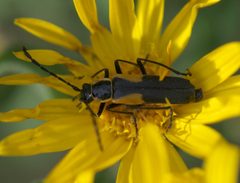
Chauliognathus deceptus is a of soldier beetle in the Cantharidae. It occurs in the foothills and mountains of western North America, where it replaces its close relative C. basalis. display black and orange coloration and possess chemical defenses secreted from abdominal glands. The species participates in Müllerian mimicry with other toxic beetles sharing similar warning coloration.
Pronunciation
How to pronounce Chauliognathus deceptus: /kaʊliːɒɡˈneɪθəs dɪˈsɛptəs/
These audio files are automatically generated. While they are not always 100% accurate, they are a good starting point.
Identification
Similar to Chauliognathus basalis but distinguished by geographic distribution; C. deceptus occurs in foothills and mountains while C. basalis occupies plains . Black and orange color pattern shared with co-occurring toxic beetles including blister beetles (Epicauta stuarti) and net-winged beetles (Calopteron terminale).
Images
Habitat
Foothill and mountain environments in western North America. Replaces C. basalis in these elevated .
Distribution
North America; specifically western foothills and mountainous regions.
Seasonality
Active in autumn.
Behavior
are . Possesses chemical defenses secreted from abdominal glands. Participates in Müllerian mimicry complex with other aposematic beetles.
Ecological Role
Contributes to Müllerian mimicry complex with toxic beetles, reinforcing deterrence through shared warning coloration.
Similar Taxa
- Chauliognathus basalisClose relative with nearly identical appearance; distinguished primarily by preference (plains vs. foothills/mountains)
- Epicauta stuartiBlister beetle sharing black and orange color pattern; both possess chemical defenses, forming Müllerian mimicry pair
- Calopteron terminaleNet-winged beetle with convergent coloration; participates in same mimicry complex
- Crossidius discoideusLonghorned beetle with similar color pattern but harmless; represents Batesian mimic of soldier beetles