
Calopteron terminale
(Say, 1823)
End Band Net-wing, End Band Net-winged Beetle
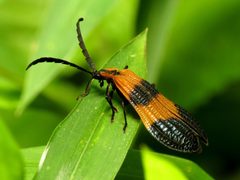
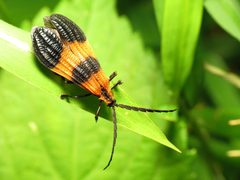
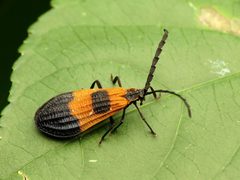
Calopteron terminale is a net-winged beetle in the Lycidae, distinguished from by a transverse depression across the . It is found in eastern North American deciduous woodlands, where are active from July through September. The participates in a Müllerian mimicry complex with similarly colored toxic beetles and . Larvae develop under bark of dead and dying trees, preying on small arthropods.
Pronunciation
How to pronounce Calopteron terminale: //ˌkæləpˈtɛrɒn ˌtɜːrmɪˈneɪliː//
These audio files are automatically generated. While they are not always 100% accurate, they are a good starting point.
Identification
The transverse depression across the is the key diagnostic feature separating Calopteron terminale from other Calopteron . The orange and black coloration is shared with several other (Cantharidae, Meloidae) and some , requiring close examination for positive identification. The soft, reticulate elytra with net-like venation confirm membership in Lycidae.
Images
Habitat
Found in woodlands, particularly in eastern North American deciduous forests. are associated with flowers and vegetation; larvae occur under bark of dead and dying trees.
Distribution
North America; recorded from Canada (Manitoba, New Brunswick, Ontario) and the United States. Most frequently observed in eastern North American deciduous forest regions.
Seasonality
are most frequently observed between July and September, based on iNaturalist observation data.
Diet
feed on nectar and honeydew secreted by aphids and related insects. Larvae prey on small arthropods under bark.
Host Associations
- Solidago chilensis - flower visitationObserved on Chilean goldenrod flowers in Argentina (Chaco Province), though this represents a different from the North American range.
- dead and dying trees - oviposition and larval development deposited on dead and dying trees; larvae develop under bark.
Life Cycle
are deposited on dead and dying trees. Larvae hatch and prey on small arthropods under bark. Specific details of and larval instars not documented.
Behavior
have been observed raising and lowering their in a display . Adults are active during summer months and visit flowers.
Ecological Role
may contribute to pollination through flower visitation. Larvae function as of small arthropods in subcortical . The serves as a model in a Müllerian mimicry complex, where its warning coloration reinforces predator avoidance learning with other toxic species.
Human Relevance
Not documented as economically significant. The is of interest to entomologists studying mimicry complexes and diversity.
Similar Taxa
- Chauliognathus basalisColorado soldier beetle with similar orange and black warning coloration; participates in same Müllerian mimicry complex. Belongs to Cantharidae, with different elytral texture (not reticulate).
- Chauliognathus deceptusFoothills and mountains soldier beetle with similar coloration; also in mimicry complex. Separated by geography and preference.
- Epicauta stuartiBlister beetle with similar black and orange pattern; also toxic and part of same Müllerian mimicry complex. Meloidae, with different body form and .
- Pyromorpha dimidiataOrange-patched smoky moth that mimics Calopteron terminale; both are toxic, forming a Müllerian mimicry pair. Lepidopteran wing structure and distinguish it.
- Lycomorpha pholusBlack-and-yellow lichen moth that participates in the same mimicry complex; distinguished by (appears later in summer) and wing pattern details.
More Details
Mimicry complex
Calopteron terminale is a central participant in a Müllerian mimicry complex involving multiple (Lycidae, Cantharidae, Meloidae, Cerambycidae) and at least two . The shared orange and black warning coloration reinforces avoidance learning across all toxic members. Some participants, such as the longhorned beetle Crossidius discoideus, may represent Batesian mimics if they lack .
Taxonomic uncertainty in Neotropics
The of Calopteron in the Neotropics is poorly known. Observations of Calopteron sp. in northern Argentina suggest potential undescribed species or that may participate in local mimicry rings.