
Crossidius discoideus blandi
Casey, 1893
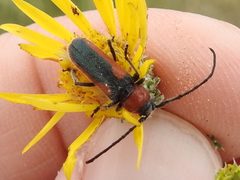
Crossidius discoideus blandi is a of longhorned beetle in the Cerambycidae. exhibit , resembling toxic soldier beetles (Chauliognathus spp.) and blister beetles (Epicauta spp.) with their black and orange coloration. The is associated with flowers of Gutierrezia sarothrae (broom snakeweed), where adults feed on pollen and nectar. Larvae bore in the root crowns of the plant. This subspecies is part of a broader mimicry complex involving multiple families in western North American .
Pronunciation
How to pronounce Crossidius discoideus blandi: //kɹoʊˈsɪdiəs dɪˈskɔɪdiəs ˈblændi//
These audio files are automatically generated. While they are not always 100% accurate, they are a good starting point.
Identification
Distinguished from similar-appearing soldier beetles (Chauliognathus basalis, C. deceptus) and blister beetles (Epicauta spp.) by the presence of long characteristic of cerambycids. Separated from other Crossidius by association with Gutierrezia sarothrae rather than Ericameria nauseosa or Chrysothamnus viscidiflorus, and by geographic distribution. The black and orange elytral pattern differs from the predominantly red or orange coloration of C. coralinus and the more extensively clouded of C. hirtipes .
Images
Appearance
have a black and orange color pattern that mimics toxic soldier beetles. The are predominantly black with orange or reddish markings. are long, typical of cerambycids, and serve as the primary feature distinguishing adults from the soldier beetles they resemble. The overall body form is elongate and somewhat flattened.
Habitat
Associated with supporting Gutierrezia sarothrae (broom snakeweed), including dry grasslands, sagebrush steppe, and open woodlands in western North America. Occurs at middle elevations in canyon and plateau landscapes.
Distribution
Western North America. Documented from southwestern Utah (Leeds Canyon area), northeastern Arizona, and potentially other areas within the range of the plant. The appears to have a more restricted distribution than the nominate form, with records concentrated in the Colorado Plateau region.
Seasonality
active in late summer and early fall, primarily September. Activity coincides with flowering of Gutierrezia sarothrae.
Diet
feed on pollen and nectar of Gutierrezia sarothrae flowers. Larvae bore in root crowns of Gutierrezia sarothrae.
Host Associations
- Gutierrezia sarothrae - food source and larval feed on flowers; larvae bore in root crowns
Life Cycle
Larvae develop in root crowns of Gutierrezia sarothrae. emerge in late summer to early fall, coinciding with plant flowering. Specific details of and stages are not documented.
Behavior
are and found on flowers of the plant. The participates in a Müllerian/ complex, with coloration convergent with toxic soldier beetles and blister beetles that share the same and host plants.
Ecological Role
of Gutierrezia sarothrae. Larval boring in root crowns may contribute to nutrient cycling in plant . As a Batesian mimic, the may influence learning and avoidance directed at the toxic species it resembles.
Human Relevance
No significant economic or medical importance. May be encountered by entomologists and naturalists during late-season collecting in western North American grasslands and canyon .
Similar Taxa
- Chauliognathus basalisColorado soldier beetle with similar black and orange coloration; distinguished by short and different body form
- Chauliognathus deceptusMountain soldier beetle with similar coloration; distinguished by short and preference
- Epicauta stuartiBlister beetle with similar black and orange warning coloration; distinguished by soft and short
- Calopteron terminaleNet-winged beetle with convergent coloration; distinguished by raised elytral display and different
- Crossidius pulchellusSympatric also associated with Gutierrezia sarothrae; distinguished by different elytral color pattern and markings
- Crossidius coralinusLarger with predominantly red or orange and more extensive black markings; associated with Ericameria nauseosa rather than Gutierrezia
More Details
Mimicry Complex
C. discoideus blandi is part of a documented mimicry complex in western North America involving at least four : Cerambycidae (this , Batyle suturalis), Cantharidae (Chauliognathus basalis, C. deceptus), Meloidae (Epicauta stuarti, E. conferta), and Lycidae (Calopteron terminale). The complex represents a mix of Müllerian mimicry (among chemically defended species) and (where C. discoideus and potentially other species gain protection by resembling defended models). All species converge on similar black and orange or black and red color patterns and co-occur on flowers of Gutierrezia sarothrae and related Asteraceae.
Taxonomic Uncertainty
The subspecific status of C. discoideus blandi may warrant re-evaluation. A commenter on a related blog post noted the possibility of an undescribed of C. discoideus from western Fresno County, California, suggesting that the may contain unrecognized cryptic diversity. The subspecies was originally described by Casey in 1893, but modern systematic work on the group is limited.