
Crossidius pulchellus
LeConte, 1861
Beautiful Longhorned Beetle
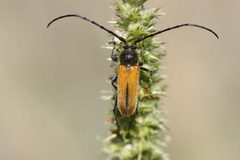
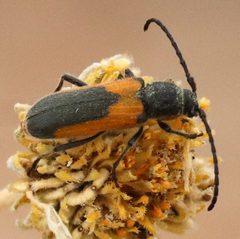
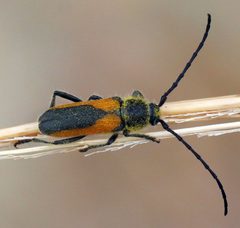
Crossidius pulchellus is a longhorned beetle ( Cerambycidae) first described by John Lawrence LeConte in 1861. Unlike most cerambycids that develop in dead wood, this has evolved a root-boring lifestyle in living shrubs of the family Asteraceae. are strongly associated with flowers of their plants, where they feed, mate, and shelter. The species exhibits the dense vestiture (hair covering) characteristic of the and shows geographic variation across its range in the Great Plains and southern Rocky Mountains.
Pronunciation
How to pronounce Crossidius pulchellus: //ˈkɹɒ.sɨ.di.əs pʊlˈkɛl.ləs//
These audio files are automatically generated. While they are not always 100% accurate, they are a good starting point.
Identification
Distinguished from other Crossidius by combination of geographic range, plant association, and morphological details. Most reliably identified by collection from Gutierrezia sarothrae flowers in the Great Plains region. Separated from C. suturalis by host plant preference (Gutierrezia vs. Isocoma) and subtle morphological differences; from C. discoideus by coloration and pattern. Positive identification often requires examination of genitalia or comparison with series from known localities due to geographic variation and potential hybridization where ranges overlap.
Images
Habitat
Arid and semi-arid grasslands, shortgrass prairie, and open shrublands. Associated with gypsum caprock clay mesas and red clay prairies. found specifically on flowering shrubs, particularly broom snakeweed (Gutierrezia sarothrae) and related Asteraceae. Larval consists of living roots of these plants rather than dead wood.
Distribution
Great Plains of North America from Oklahoma and Kansas westward through the southern Rocky Mountains. Documented from Oklahoma (Major County, Woodward County, Beaver County, Cimarron County), Kansas (Barber County), Arizona, New Mexico, and California. Extends into southern Canada (Alberta).
Seasonality
activity peaks in late summer and early fall (September–October), coinciding with bloom period of plants. Adults have been observed active into mid-October in Oklahoma. timing varies with elevation and latitude; at higher elevations or more northerly latitudes may peak slightly earlier or later.
Diet
feed on pollen and nectar of plant flowers. Larvae bore through and feed on living roots of Asteraceae shrubs, primarily Gutierrezia sarothrae and related .
Host Associations
- Gutierrezia sarothrae - primary Broom snakeweed; feed on flowers, larvae develop in living roots
- Gutierrezia microcephala - Documented in Arizona and New Mexico
- Heterotheca subaxillaris - possible incidental occasionally found on flowers, but primary association is with Gutierrezia
Life Cycle
Complete with larval development in living roots of plants. Unlike most Cerambycidae, larvae do not develop in dead wood. emerge in late summer, coincide with host plant flowering, and appear to spend their entire brief adult lives on or near flowers. Specific details of -laying, larval instars, and are not documented in available sources.
Behavior
are and strongly philopatric to plant flowers. They perch on blossoms, feed on pollen and nectar, and mate on the plants. At night, rather than leaving to seek shelter, they bury themselves deeper among the flowers to await morning warmth. Adults are active during daylight hours and readily observable when host plants are in bloom. has been observed as a spiraling takeoff when disturbed.
Ecological Role
function as of their plants while feeding on floral resources. Larval root-boring may influence plant vigor or of host shrubs, though specific impacts are unstudied. The serves as prey for various including spiders and robber flies.
Human Relevance
Of interest to coleopterists and naturalists due to its distinctive and the taxonomic complexity of the . Not a significant agricultural pest. Collected for scientific study, particularly for investigations of geographic variation and molecular in the genus Crossidius.
Similar Taxa
- Crossidius suturalisOverlaps in range and general appearance; distinguished by primary association with Isocoma tenuisecta flowers rather than Gutierrezia, and subtle morphological differences including pattern of elytral markings
- Crossidius discoideusSympatric in some areas; C. discoideus typically shows more extensive dark coloration on with contrasting orange lateral markings (in blandus), while C. pulchellus tends toward more uniform or differently patterned coloration
- Crossidius coralinusLarger, more boldly colored with bright red and black patterning; occurs on Ericameria nauseosa in more western portions of the range
More Details
Taxonomic Complexity
The Crossidius exhibits extensive geographic variation (polytopism) with numerous described and local morphs. Crossidius pulchellus itself may comprise multiple recognizable geographic variants, though these have not been formally described as subspecies in all cases. Hybridization occurs where ranges overlap, complicating identification.
Root-Boring Adaptation
The shift from ancestral wood-boring to root-boring in living plants represents a major ecological divergence within Cerambycidae. This allows exploitation of a novel resource (living shrub roots) but restricts the to regions where suitable plants occur.
Collecting Methodology
Best collected by visual search of Gutierrezia flowers during peak bloom in late summer and fall. Sweep netting of plants is effective. The has not been documented from ethanol-baited traps or Lindgren funnel traps, suggesting are not attracted to fermentation cues.