
Crossidius suturalis
LeConte, 1858
Species Guides
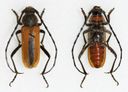
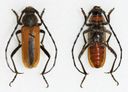
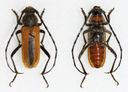
5Crossidius suturalis is a longhorn beetle in the Cerambycidae, described by John Lawrence LeConte in 1858. The species belongs to the tribe Trachyderini, a group of often brightly colored and flower-visiting cerambycids. Field observations indicate it is strongly associated with composite flowers (Asteraceae), particularly Isocoma tenuisecta, and shows in antennal length with males possessing longer than females. Multiple subspecific have been described across its range.
Pronunciation
How to pronounce Crossidius suturalis: //krəˈsɪdiəs sjuːtəˈrɑːlɪs//
These audio files are automatically generated. While they are not always 100% accurate, they are a good starting point.
Identification
Males distinguished from females by significantly longer . Individuals show variable elytral maculation, with some specimens appearing heavily marked. The can be confused with C. hurdi in areas of sympatry; reliable separation requires careful examination of morphological details and may not be possible from field observations alone. Some individuals exhibit orange coloration with dark markings.
Images
Habitat
Arid and semi-arid environments including desert grasslands, dry rocky slopes, and roadsides. Strongly associated with hilltop prairies, limestone bluffs, and dry ridgetop trails where plants occur. Found at elevations ranging from lowland desert to montane slopes.
Distribution
Southwestern United States (Arizona, New Mexico, California) and northern Mexico. Records from Arizona include the Santa Rita Mountains, Chiricahua Mountains, Santa Catalina Mountains, and areas around Willcox and Safford. California occur in southern regions including Lancaster area. Mexican distribution includes Sonora and adjacent states.
Seasonality
activity primarily late summer through early autumn (August–September). appears tied to monsoon rainfall patterns and plant blooming . In Arizona, peak activity observed when Isocoma tenuisecta reaches full bloom.
Diet
feed on pollen and nectar of composite flowers (Asteraceae). Larval relationships unknown but presumed to feed on roots or stems of herbaceous plants based on tribe-level patterns.
Host Associations
- Isocoma tenuisecta - feeding sitePrimary flower ; frequently observed on pre-blooming and blooming plants
- Gutierrezia microcephala - feeding siteSecondary flower ; shared with C. pulchellus
- Ericameria nauseosa - feeding site for related ; occasional use by C. suturalis suspected
Life Cycle
Complete with , larva, pupa, and stages. Larval undescribed. Adults and active on flowers.
Behavior
are flower visitors, often found sitting on composite flower . Males use elongated to detect females. Mating pairs observed on flowers. Adults may be wary and quick to take when disturbed. Shows fidelity to particular host plant patches.
Ecological Role
flower visitation contributes to pollination of composite . As herbivore, likely plays minor role in plant . Serves as prey for spiders, robber flies, and other .
Human Relevance
Subject of entomological collecting for scientific study, particularly for investigations of subspecific variation and molecular . No known agricultural or economic significance.
Similar Taxa
- Crossidius hurdiSympatric in some areas and highly similar in appearance; historically confused in field observations. Separation requires careful morphological examination.
- Crossidius pulchellusOccurs on same plants (Gutierrezia microcephala) and similar size range; distinguished by color pattern and antennal proportions.
- Crossidius coralinusRelated with overlapping distribution in California; distinguished by elytral coloration and plant associations (Ericameria nauseosa).
More Details
Subspecific variation
Multiple subspecific have been described including C. s. intermedius and others, with variation in elytral maculation and body size across the range. The taxonomic status of these forms remains under investigation.
Collecting history
Targeted by collectors for molecular studies due to complex patterns of geographic variation. Type locality information is important for resolving taxonomic questions.