
Crossidius suturalis intermedius
LeConte, 1873
Crossidius suturalis intermedius is a of longhorn beetle in the Cerambycidae, described by LeConte in 1873. It belongs to the highly variable C. suturalis, which occurs across southwestern North America. The subspecies has been collected in association with flowers of Isocoma tenuisecta (burroweed), a composite plant in the Asteraceae family. Field observations indicate it is found in arid and semi-arid of the southwestern United States and adjacent Mexico, with active during late summer and early autumn when plants bloom.
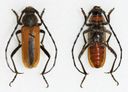
Identification
This can be distinguished from other C. suturalis subspecies by intermediate morphological characteristics, though precise diagnostic features require examination of type material. Males exhibit longer than females, a trait consistent across the . The subspecies shows variable elytral maculation, with some individuals appearing heavily marked. It has been observed sympatrically with C. pulchellus and C. hurdi in some areas, requiring careful examination for positive identification.
Images
Habitat
Arid and semi-arid regions of the southwestern United States and northern Mexico. Specifically associated with dry slopes, roadsides, and washes where the plant Isocoma tenuisecta grows. Found at elevations from low desert to montane foothills, typically in areas with well-drained soils and sparse vegetation.
Distribution
Southwestern United States (Arizona, New Mexico, possibly adjacent areas of Texas and California) and northern Mexico. Records exist from the Sonoran Desert and Chihuahuan Desert regions, including the Santa Rita Mountains of Arizona and areas near the Arizona-New Mexico border.
Seasonality
are active from late August through September, coinciding with the blooming period of Isocoma tenuisecta. Peak activity appears to occur in early September when plants reach full bloom.
Diet
feed on pollen and nectar of composite flowers, specifically Isocoma tenuisecta (burroweed). Larval diet unknown, but presumed to feed on roots or lower stems of herbaceous plants based on related .
Host Associations
- Isocoma tenuisecta - feedingPrimary plant; feed on flowers
Life Cycle
Complete with , larva, pupa, and stages. Larval poorly documented; likely develops in roots or stems of plants. Adults emerge in late summer and are short-lived, focused on and feeding on floral resources.
Behavior
are and strongly associated with flowers of their plant. They have been observed mating on host plant inflorescences. When disturbed, individuals may take and spiral upward. Adults are wary and can be difficult to approach closely for collection.
Ecological Role
serve as of their plant Isocoma tenuisecta. As larvae, they likely function as root or stem herbivores, though their specific impact on plant is unknown. They form part of the diverse associated with late-summer blooming composites in desert .
Human Relevance
Of interest to coleopterists studying the and of the variable Crossidius. The has been targeted in recent collecting efforts to obtain specimens for molecular phylogenetic studies of the C. suturalis .
Similar Taxa
- Crossidius suturalis suturalisNominate ; intermedius was described as intermediate in between this and other forms
- Crossidius hurdiSympatric in some areas; historically confused with C. suturalis intermedius due to variable maculation patterns
- Crossidius pulchellusFound on same plant (Gutierrezia microcephala) in overlapping range; smaller size and different elytral pattern distinguish it