
Tetraopes discoideus
LeConte, 1847
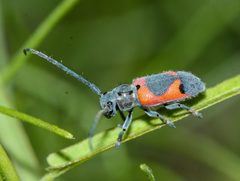
Tetraopes discoideus is a small milkweed longhorn beetle in the Cerambycidae, described by John Lawrence LeConte in 1847. measure 7–9 mm in length, making this notably smaller than . The species is associated with milkweed plants (Asclepias spp.) throughout its range in the southwestern United States and Mexico. Adults have been observed resting, feeding, and mating on milkweed stems and flowers. Larvae develop by feeding on milkweed roots, either tunneling directly into large taproots or living in surrounding soil when roots are small.
Pronunciation
How to pronounce Tetraopes discoideus: /tɛˈtra.oʊˌpiːz dɪsˈkɔɪ.di.us/
These audio files are automatically generated. While they are not always 100% accurate, they are a good starting point.
Identification
are distinguished from other Tetraopes by their small size (7–9 mm versus typically larger ). The compact body and reduced dimensions relative to other members of the are the primary diagnostic features visible in the field.
Images
Habitat
Associated with milkweed stands, particularly in mountainous regions of the southwestern United States. Observed in narrow-leaved milkweed (Asclepias sp.) at the Southwestern Research Station in the Chiricahua Mountains, Arizona.
Distribution
Mexico and the United States. Specific U.S. records include Arizona (Chiricahua Mountains, Santa Rita Mountains area).
Seasonality
are active for approximately one month during summer months. Observations from Arizona span July–August.
Diet
feed on milkweed plants (Asclepias spp.). Larvae feed on milkweed roots.
Host Associations
- Asclepias - primary plantnarrow-leaved milkweed; feed on stems and flowers, larvae feed on roots
Life Cycle
Larvae develop by feeding on milkweed roots. In with small roots, larvae inhabit surrounding soil; in those with large taproots, larvae may tunnel directly into the root. emerge and are active for about one month, during which time they rest, feed, and mate on milkweed plants.
Behavior
are typically found resting on milkweed stems. They are active during daylight hours and do not appear to be attracted to ultraviolet light traps.
Ecological Role
A herbivore of milkweeds (Asclepias), participating in the associated with these chemically defended plants. Larval root-feeding may influence plant , though specific impacts are unstudied.
Similar Taxa
- Tetraopes tetrophthalmuslarger size (typically 12–15 mm), more eastern distribution
- Tetraopes femoratuslarger size, different pronotal pattern
- other Tetraopes speciesT. discoideus is distinguished by being the smallest member of the at 7–9 mm