
Tetraopes femoratus
LeConte, 1847
Red-femured Milkweed Borer
is a longhorned beetle ( Cerambycidae) in the Lamiinae, described by John Lawrence LeConte in 1847. It is one of several North American milkweed borer beetles in the Tetraopes, all of which are specialized feeders on milkweeds (Asclepias spp.). The occurs across western and central North America from Canada to Mexico, with records from the western United States and Great Plains region. are typically encountered in late summer and fall, with September collecting records from Oklahoma and late August observations from sagebrush in Nevada.
Pronunciation
How to pronounce Tetraopes femoratus: //ˌtɛtˈreɪ.oʊˌpiːz fɛmˈɔr.ə.təs//
These audio files are automatically generated. While they are not always 100% accurate, they are a good starting point.
Identification
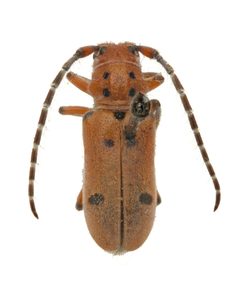
can be distinguished from other North American Tetraopes by the combination of red and specific elytral color patterns. It is most similar to Tetraopes tetrophthalmus (the common milkweed borer of eastern North America), but occurs in different geographic regions and shows differences in markings. The Tetraopes is readily recognized by the four —two on each side of the , with the upper pair smaller and the lower pair larger, a consequence of the pronounced constriction between the eyes and the pronotum that gives these beetles their "tetraopes" (four-eyed).
Images
Appearance
have elongated bodies typical of longhorned beetles, with that are long though not necessarily exceeding body length. The "red-femured" refers to reddish coloration on the (thighs) of the legs. As with other Tetraopes , the body is marked with contrasting patterns of black and red or orange. The (hardened forewings) bear distinctive coloration that helps distinguish this species from .
Habitat
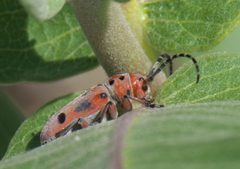
Found in association with milkweed plants, particularly in prairie, sagebrush, and open woodland . In the western United States, has been observed in sagebrush habitat below the eastern slope of the Sierra Nevada. In the Great Plains, occurs in shortgrass prairie and sand dune habitats where milkweeds are present.
Distribution
North America: recorded from western and central United States, southern Canada (Alberta, British Columbia, Manitoba), and Mexico. Specific collecting localities include northwestern Oklahoma, Nevada, and the Great Plains region. The has a transcontinental distribution across western North America.
Seasonality
active in late summer and fall. Collecting records indicate peak activity in August and September. In Oklahoma, observed in late August on Asclepias engelmanniana. In Nevada, searched for but not found on Asclepias speciosa in early September, suggesting possible geographic or temporal variation in activity periods.
Diet
Larvae feed internally in the roots and stems of milkweed plants (Asclepias spp.). feed on milkweed foliage, flowers, and seed pods. Specific plants documented include Asclepias latifolia (broadleaf milkweed), Asclepias engelmanniana (Engelmann's milkweed), and Asclepias speciosa (showy milkweed).
Host Associations
- Asclepias latifolia - larval observed on this in shortgrass prairie
- Asclepias engelmanniana - larval collected on seed pods in late August in Oklahoma
- Asclepias speciosa - probable larval searched for beetles on this in Nevada but none found
Life Cycle
Behavior
are and active during daylight hours. They are strong fliers and readily fly between milkweed plants. When approached, adults may attempt to escape by flying or dropping from plants. Adults have been observed mating on milkweed seed pods. The beetles are aposematically colored, advertising their unpalatability derived from milkweed toxins sequestered from their host plants.
Ecological Role
As a herbivore on milkweeds, participates in the milkweed guild of insects that have evolved to cardenolide toxins. The serves as a model for studying between insects and toxic plants. and larvae may influence milkweed through herbivory, though their impact is typically limited by natural enemy pressure and competition with other milkweed-feeding insects.
Human Relevance
has no significant economic importance. It is occasionally encountered by entomologists and naturalists studying milkweed insects. The , like other milkweed beetles, is protected from vertebrate by sequestered milkweed toxins and serves as an example of aposematic (warning) coloration in insects. It is not considered a pest of ornamental or agricultural milkweeds.
Similar Taxa
- Tetraopes tetrophthalmusSimilar size, coloration, and , but occurs primarily in eastern North America and shows differences in elytral pattern
- Tetraopes basalisAnother western with overlapping range; distinguished by differences in leg and elytral coloration
- Tetraopes varicornisOccurs in southwestern North America; similar milkweed association but differs in antennal and leg coloration
More Details
Toxicity and chemical defense
Like other milkweed-feeding insects, sequesters cardenolide toxins from its Asclepias plants. These cardiac glycosides render the beetles unpalatable to vertebrate , a defense advertised by their conspicuous aposematic coloration. The bright red and black patterns serve as honest signals of chemical defense.
Taxonomic history
The was described by John Lawrence LeConte in 1847, one of the most prolific describers of North American beetles in the 19th century. LeConte described numerous Cerambycidae species and established the taxonomic foundation for much of North American .
Collecting notes
In field collecting, are best sought by sweeping or hand-searching milkweed plants during late summer and early fall. They are most readily found on flowering or fruiting milkweeds. The appears to be less abundant and more patchily distributed than some eastern Tetraopes species, possibly reflecting the more arid it occupies.
Sources and further reading
- BugGuide
- Wikipedia
- GBIF taxonomy match
- iNaturalist taxon
- NCBI Taxonomy
- Catalogue of Life
- September | 2022 | Beetles In The Bush
- August “jug trap” run | Beetles In The Bush
- A rare opportunity to do fall insect collecting in western North America | Beetles In The Bush
- Psychidae | Beetles In The Bush
- September | 2025 | Beetles In The Bush
- Insecta | Beetles In The Bush | Page 5