
Tetraopes tetrophthalmus
(Forster, 1771)
Red Milkweed Beetle
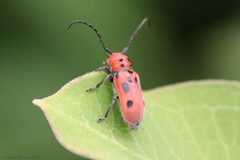
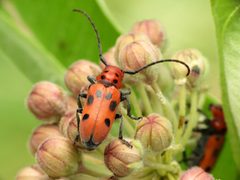
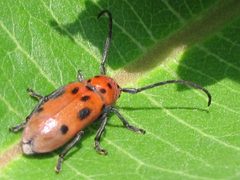
Tetraopes tetrophthalmus, commonly known as the red , is a longhorn beetle (Cerambycidae) specialized on milkweed plants. Both its and names derive from Ancient Greek for "four ," referring to the extreme where antennal bases bisect the . are aposematically colored in red and black, warning of their derived from sequestered cardiac glycosides. The species exhibits specialized including -cutting to disable latex defenses, for mating and territorial contests, and substrate-borne signaling distinct for different social contexts.
Pronunciation
How to pronounce Tetraopes tetrophthalmus: //ˌtɛtrəˈoʊˌpiːz tɛtrɒfˈθalməs//
These audio files are automatically generated. While they are not always 100% accurate, they are a good starting point.
Identification
The combination of bisected (antennal bases dividing each ), bright red-and-black coloration, and association with milkweed plants distinguishes this from all other North American beetles. Within the Tetraopes, T. tetrophthalmus is the most widespread and commonly encountered species, associated primarily with common milkweed (Asclepias syriaca). Other Tetraopes species typically differ in , body proportions, or plant associations: T. pilosus is larger, densely covered with white pubescence, and restricted to sand milkweed (A. arenaria) in the Great Plains; T. quinquemaculatus has different spot patterns and occurs on green milkweed and weed.
Images
Habitat
Primarily associated with milkweed plants in open, sunny including meadows, prairies, roadsides, railroad corridors, and agricultural field margins. occur on above-ground plant parts (leaves, stems, flowers). Larvae inhabit soil around host plant roots, creating galleries between roots and pupating just below the soil surface.
Distribution
Eastern and central North America, from southern Canada (Ontario, Quebec, Manitoba) south through the eastern and central United States. Distribution closely tracks that of its primary plant, common milkweed (Asclepias syriaca).
Seasonality
active primarily June through July, with peak abundance in mid-summer. clutches laid in mid-summer inside stem bases of plants. Larval development occurs in soil through late summer and fall, with and adult the following spring.
Diet
Highly specialized herbivore feeding exclusively on milkweeds (Asclepias). feed on foliage, flowers, and stems. Larvae feed on the outside of living milkweed roots, creating galleries through the soil between root systems. Adults employ -cutting prior to feeding: cutting through leaf midribs to drain latex-filled sap from tissues, thereby avoiding incapacitation by sticky, hardening sap.
Host Associations
- Asclepias syriaca - primary Common milkweed; primary throughout most of range
- Asclepias verticillata - secondary Horsetail milkweed; reported from disturbed sites in Illinois
- Asclepias incarnata - occasional Swamp milkweed; occasionally utilized
Life Cycle
Complete . laid in clutches in mid-summer inside stem bases of plants. Larvae hatch and enter soil, feeding externally on milkweed roots and creating galleries between roots. Larvae are free-living and terricolous, similar to white . occurs in chambers just below the soil surface. emerge in early summer, feed, mate, and oviposit, with one per year.
Behavior
Exhibits -cutting to disable milkweed latex defenses prior to feeding. Communicates using substrate-borne vibrational signals composed of low-frequency rumbles and high-frequency clacks, with signal characteristics differing between male-male contests (shorter, higher frequency) and copulatory courtship (longer, lower frequency). Produces audible squeaks via stridulation when disturbed. When startled, makes shrill noises; makes 'purring' noises during interactions. are and active on plants during daylight hours.
Ecological Role
Specialized herbivore and member of the milkweed Müllerian mimicry complex, sharing aposematic orange-and-black warning coloration with , milkweed bugs, and other milkweed-feeding insects. Sequesters cardiac glycosides from plants for chemical defense against . Larval root-feeding may affect host plant vigor, though densities rarely reach levels causing significant plant mortality.
Human Relevance
Occasional pest of ornamental milkweeds in gardens, though rarely economically significant. Frequently encountered by naturalists and photographers due to bright coloration and activity. Serves as model organism for studies of insect-plant , chemical , and aposematism. sequenced, providing insights into chemosensation, detoxification, and evolution of specialized herbivory.
Similar Taxa
- Tetraopes pilosusLarger, densely white-pubescent restricted to sand milkweed (Asclepias arenaria) in Great Plains sandhills; antennal bases also bisect but overall appearance shaggier
- Tetraopes quinquemaculatusSimilar size and coloration but with different spot patterns; primarily associated with weed (Asclepias tuberosus) and green milkweed (A. viridiflora)
- Labidomera clivicollisSwamp milkweed leaf beetle (Chrysomelidae) shares orange-and-black aposematic coloration and milkweed association, but has rounded leaf- form, clubbed , and lacks bisected
- Oncopeltus fasciatusLarge milkweed bug (Hemiptera) shares red-and-black aposematic coloration and milkweed , but has elongate-oval body, long without bisected , and
More Details
Genomic and sensory biology
sequencing (779 Mb, 13,089 genes) revealed reduced diversity in chemosensory genes compared to cerambycids, with 122 odorant receptors and 162 receptors (69% of the count in Asian longhorned beetle). Elevated numbers of ABC- genes may facilitate cardiac glycoside . These genomic features reflect evolutionary to specialized milkweed herbivory.
Vibrational communication
Uses plant-borne vibrational signals for intraspecific communication, with distinct signal types for male-male territorial contests versus copulatory courtship. Contest signals are shorter with higher fundamental and frequencies; courtship signals are longer with lower frequencies. Context-dependent signaling may facilitate mate access and prolong copulation.
Sources and further reading
- BugGuide
- Wikipedia
- GBIF taxonomy match
- iNaturalist taxon
- NCBI Taxonomy
- Catalogue of Life
- Sand Prairie Conservation Area | Beetles In The Bush
- Kentucky | Beetles In The Bush
- predator avoidance | Beetles In The Bush | Page 2
- Hooray for the red, white, and blue! Milkweed longhorned beetle, Tetraopes tetraophthalmus; dogbane tiger moth, Cycnia tenera; and familiar bluet, Enallagma civile — Bug of the Week
- NOTES ON THE BIONOMICS OF THE MILKWEED BEETLE TETRAOPES TETROPHTHALMUS (FORST.) (CERAMBYCIDAE)
- A Note on Oviposition and Larval Habits of the Milkweed Beetle,Tetraopes tetrophthalmusForst. (Coleoptera: Cerambycidae)
- Vibrational signals differ between contests and copulatory courtship in the red milkweed beetle Tetraopes tetrophthalmus (Coleoptera: Cerambycidae)
- A test of sexual dimorphism in deactivating plant defense and attraction of conspecifics in the four-eyed red milkweed beetle (Tetraopes tetrophthalmus)
- Functional and evolutionary insights into chemosensation and specialized herbivory from the genome of the red milkweed beetle, Tetraopes tetrophthalmus (Cerambycidae: Lamiinae)
- Some consequences for a parasitic herbivore, the milkweed longhorn beetle, Tetraopes tetrophthalmus, of a host-plant shift from Asdepias syriaca to A. verticillata