
Anoplophora glabripennis
(Motschulsky, 1854)
Asian longhorned beetle, starry sky beetle, sky beetle, ALB
Anoplophora glabripennis, commonly known as the Asian longhorned beetle or starry sky , is a highly wood-boring beetle native to eastern China, Japan, and Korea. It has become a devastating pest in North America and Europe, where it attacks and kills a broad range of hardwood trees. The beetle was first detected in the United States in Brooklyn, New York in 1996, likely arriving via solid wood packaging material. efforts have focused on tree removal and destruction, though biocontrol methods including fungi and have been studied as potential management tools.

Pronunciation
How to pronounce Anoplophora glabripennis: /ænəˈplɒfərə ˌɡlæbrɪˈpɛnnɪs/
These audio files are automatically generated. While they are not always 100% accurate, they are a good starting point.
Identification
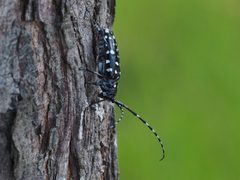
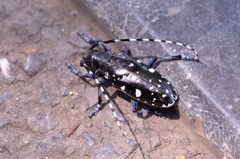
Distinguished from other longhorned beetles by the distinctive white starburst pattern on black . The related citrus longhorned beetle (Anoplophora chinensis) has similar coloration but can be separated by morphological details and geographic origin. Exit holes created by emerging are large (10-15 mm diameter), round, and penetrate through bark into wood. Larval galleries are filled with coarse, sawdust-like mixed with fecal material. The emerald ash borer (Agrilus planipennis) creates similar damage but is smaller and has metallic green coloration.
Images
Habitat
Urban and suburban forests, tree plantations, and natural woodlands with suitable trees. In its native range, it shows preference for stressed, dying, or dead trees; in invaded regions, it readily attacks healthy trees. Climate modeling indicates expanding suitable under warming conditions, with greater adaptability to temperature and precipitation fluctuations than related .
Distribution
Native to eastern China, Japan, and Korea. Introduced to North America (USA: New York, New Jersey, Illinois, Ohio, Massachusetts, California, Washington; Canada: Ontario, British Columbia) and Europe (Austria, Belgium, Czech Republic, France, Germany, Italy, Netherlands, Switzerland, UK, Denmark, Finland, Montenegro, Russia). Multiple introduction events have occurred, with evidence of bridgehead invasion from North America to Europe.
Seasonality
are active during spring and summer. Females require approximately two weeks of feeding on twigs and leaves before developing . Virgin females begin producing sufficient blends at approximately 20 days old, corresponding to timing. Larval development may extend more than one year under bark.
Diet
Larvae feed on phloem and sapwood of trees, tunneling through cambium and vascular tissues, eventually penetrating the woody core. feed on tender tissue in tree , particularly leaves and twigs of host .
Host Associations
- Acer - primary Maples are preferred in North America; significant threat to maple syrup industry
- Populus - primary Main in native China
- Salix - primary Main in native China
- Ulmus - primary Confirmed complete
- Betula - primary Paper birch and related
- Aesculus - primary Horse chestnut/buckeye
- Fraxinus - primary Ash
- Platanus - primary Sycamore
- Cercidiphyllum - primary Katsura tree
- Elaeagnus angustifolia - Has been reported to exhibit resistance mechanisms
- Albizia julibrissin - secondary Limited exit hole records; may be poor or unattractive
- Corylus colurna - secondary Limited records
- Fagus sylvatica - secondary European beech
- Koelreuteria paniculata - secondary Golden raintree
- Malus domestica - secondary Apple; potential fruit tree damage in Japan
- Pyrus bretschneideri - secondary Pear
- Sorbus aucuparia - secondary Mountain ash
Life Cycle
are deposited in ragged egg chewed into bark of trunks and large branches. Larvae hatch and bore through cambium and vascular tissues, feeding on phloem and sapwood; development may exceed one year. Larvae pupate in wood, then emerge through large round exit holes. Adults feed on foliage before mating. Females lay 30-178 eggs in their lifetime.
Behavior
are capable of ; well-fed older beetles (more than five days post-) exhibit maximum flight performance, with some individuals flying up to 8.5 miles in 24 hours, though average flight distance is 1.4 miles. Females deposit sex-specific on tree surfaces to attract males; these trails contain 2-methyldocosane and (Z)-9-tricosene as major components. The attracts males but repels virgin females, possibly reducing mate competition. Mated females continue producing pheromone, facilitating multiple matings. Larvae eject from galleries, creating visible sawdust-like accumulations at tree bases.
Ecological Role
As a primary wood-borer, larvae kill living tissues and create structural damage to trees. In native range, contributes to nutrient cycling by attacking stressed or dead trees; in invaded regions, functions as a destructive pest of healthy urban forests. No documented effects on native cerambycid faunas in invaded areas based on preliminary studies.
Human Relevance
Major economic and ecological threat to urban forests and hardwood industries. Responsible for destruction of tens of thousands of trees in zones. Potential impact estimated at 34.9% loss of urban tree cover if uncontrolled, with economic value exceeding $669 billion. Threatens maple syrup production in northeastern United States. Subject to strict quarantine regulations and programs involving tree removal, chipping, and preventive application. Citizen scientists have played crucial role in detecting new . Biocontrol research has investigated fungi ( and Metarhizium ), (Steinernema carpocapsae and S. feltiae), and bacterial , though these remain backup options rather than primary control methods.
Similar Taxa
- Anoplophora chinensisSimilar size, coloration, and ; both are longhorned beetles from Asia. Distinguished by subtle morphological differences and native ranges (A. chinensis from southern China and Southeast Asia). A. glabripennis has greater chemosensory gene repertoire correlating with broader range.
- Agrilus planipennisBoth are wood-boring beetles causing tree mortality, but A. planipennis (emerald ash borer) is smaller, metallic green, and specifically attacks Fraxinus , creating D-shaped exit holes rather than round ones.
More Details
Genomic adaptations
Possesses expanded chemosensory gene compared to stenophagous wood-boring beetles, including 4 SNMPs and 17 CSPs, correlating with its range. Shows metabolic plasticity with differential expression of ~3600 genes when feeding on wood versus artificial diets, including upregulation of -active , detoxification genes, and immune-related genes for microbial interactions.
Biocontrol potential
Fungal bands containing or Metarhizium have been developed and tested, showing reduced longevity and . can target larvae in tunnels. These methods are more suited to suppression than and remain undeployed in the U.S. due to success of tree-removal strategies.
Detection methods
Loop-mediated isothermal amplification (LAMP) can detect from larval in 30-80 minutes with 100% sensitivity and specificity, enabling early detection before . -based lures are under development for combined use with fungal biocontrol.
Sources and further reading
- BugGuide
- GBIF taxonomy match
- iNaturalist taxon
- NCBI Taxonomy
- Catalogue of Life
- From Honey Bees to Flower Thrips to Asian Longhorned Beetles | Bug Squad
- Starry sky beetle - Asian longhorned beetle, Anoplophora glabripennis — Bug of the Week
- A Fast, Frassy Way to Detect the Asian Longhorned Beetle
- Well-Fed, Older Asian Longhorned Beetles Fly Farther, May Require New Quarantine Zones
- Balancing Eradication and Management: The Role of Biocontrol in Asian Longhorned Beetle Defense
- Asian Longhorned Beetle's Pheromone May Be Used to Manage it
- Anoplophora glabripennis . [Distribution map].
- Anoplophora glabripennis . [Distribution map].
- Anoplophora glabripennis . [Distribution map].
- Anoplophora glabripennis . [Distribution map].
- Host plants of Anoplophora glabripennis, a review
- Invasion du capricorne asiatique Anoplophora glabripennis : génétique, traits d’histoire de vie et écologie
- Response of adultAnoplophora glabripennis(Coleoptera: Cerambycidae) to host-derived isothiocyanates
- Niche change and distribution dynamics of Anoplophora chinensis and Anoplophora glabripennis in China: Implications for pest control
- Review of Host Trees for the Wood-Boring Pests Anoplophora glabripennis and Anoplophora chinensis: An Urban Forest Perspective
- Identification of male produced attractants ofAnoplophora glabripennisand their effect on behavior
- Genomic content of chemosensory genes correlates with host range in wood-boring beetles (Dendroctonus ponderosae, Agrilus planipennis, and Anoplophora glabripennis)
- Genomic content of chemosensory genes correlates with host range in wood-boring beetles (Dendroctonus ponderosae, Agrilus planipennis, and Anoplophora glabripennis)
- Reproductive Behaviors of Anoplophora glabripennis (Coleoptera: Cerambycidae) in the Laboratory
- Silencing the Odorant Co-Receptor (Orco) in Anoplophora Glabripennis Disrupts Responses to Pheromones and Host Volatiles
- Contrasting diets reveal metabolic plasticity in the tree-killing beetle, Anoplophora glabripennis (Cerambycidae: Lamiinae)
- Comparative Metabolic Defense Responses of Three Tree Species to the Supplemental Feeding Behavior of Anoplophora glabripennis.
- Interactions at the Oviposition Scar: Molecular and Metabolic Insights into Elaeagnus angustifolia's Resistance Response to Anoplophora glabripennis.
- Anoplophora glabripennis, an invasive longhorned beetle, has the potential to damage fruit trees in Japan.
- Complex European invasion history of Anoplophora glabripennis (Motschulsky): new insights in its population genomic differentiation using genotype-by-sequencing.