
Anoplophora
Hope, 1839
longhorn beetles, long-horned beetles
Species Guides
1- Anoplophora glabripennis(Asian longhorned beetle)
Anoplophora is a of longhorn beetles (Cerambycidae) native to Asia, containing over 50 . Most species are large, colorful beetles with distinctive markings that have made them popular among collectors and subjects of artwork. The genus includes several economically significant pests, most notably the Asian longhorned beetle (A. glabripennis) and the citrus longhorned beetle (A. chinensis), which have been introduced to North America and Europe where they threaten urban, ornamental, and forest trees.

Pronunciation
How to pronounce Anoplophora: /ænəˈplɒfərə/
These audio files are automatically generated. While they are not always 100% accurate, they are a good starting point.
Identification
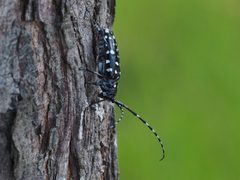
Anoplophora can be distinguished from other longhorn beetles by their combination of large size, extremely long , and often striking coloration. Within the , species identification relies heavily on male genitalia structure. A. glabripennis is recognized by its black body with white starburst spots and banded antennae. A. chinensis is similar but can be distinguished by morphological differences. The two species overlap in distribution in some areas and have been observed to hybridize in Japan.
Images
Habitat
Native to forested and urban areas across Asia. in North America and Europe occur in urban environments, hardwood forests, and areas with suitable trees. A. glabripennis shows preference for trunks and branches 8-14 cm in diameter for oviposition, with -laying concentrated at approximately 3 meters above ground, mostly within the lower 8 meters of the trunk.
Distribution
Native to Asia, including China, Japan, Korea, Taiwan, and other regions. A. glabripennis has been introduced to North America (USA: New York, New Jersey, Illinois, Massachusetts, Ohio, South Carolina, California, Washington; Canada: Ontario, British Columbia) and Europe (Austria, Belgium, Czech Republic, Denmark, France, Germany, Italy, Netherlands, Poland, Switzerland, UK). A. chinensis has been introduced to Europe (France, Germany, Italy, Netherlands, UK) and North America (USA: Georgia, Hawaii, Washington, Wisconsin).
Diet
Larvae feed on phloem and sap-containing wood of trees, tunneling through vascular tissues and woody core. feed on tender tissue in tree during spring and summer. Both A. glabripennis and A. chinensis are highly , attacking numerous hardwood .
Host Associations
- Acer spp. - Primary in North America for A. glabripennis
- Populus spp. - Main in China for A. glabripennis
- Salix spp. - for both A. glabripennis and A. chinensis
- Ulmus spp. - for A. glabripennis
- Aesculus spp. - for A. glabripennis
- Betula spp. - for A. glabripennis
- Citrus spp. - Major for A. chinensis
- Malus domestica - for A. chinensis
Life Cycle
Females chew ragged oviposition pits in bark and deposit 30-178 under the bark. Eggs hatch into roundheaded borer larvae that feed on phloem and vascular tissues, eventually tunneling into the woody core. Larval development may take more than one year. occurs in the wood, with emerging through round exit holes. In South Carolina, where winters are mild, questions remain about whether larvae undergo winter and how many occur annually.
Behavior
are capable of ; well-fed, older beetles have been observed to fly up to 8.5 miles in 24 hours, with an average of 1.4 miles. Mating occurs after adults feed in tree . Females return to trunks and large branches to oviposit. Larval feeding produces (wood debris and ) that can be used to detect . Oviposition pits are 20 times more abundant than adult holes at infestation discovery, making them a more reliable early detection sign.
Ecological Role
As wood-boring insects, larvae act as primary decomposers of living and dead hardwood trees. In their native range, A. glabripennis has been observed to prefer stressed, dying, or dead trees. In invaded regions, they function as destructive pests of healthy urban and forest . Preliminary studies have not detected significant effects on other cerambycid in invaded areas.
Human Relevance
Major economic and environmental pest in North America and Europe. A. glabripennis threatens maple syrup production, urban forests, and hardwood industries; potential loss of 34.9% of urban tree cover valued at over $669 billion if uncontrolled. programs involve tree removal, destruction of material, and application. Subject to regulations in USA and Europe. Popular among collectors due to striking appearance. -level assemblies published in 2026 for research purposes.
Similar Taxa
- Other CerambycidaeAnoplophora distinguished by exceptionally long and distinctive color patterns; many cerambycids have shorter antennae and more subdued coloration
- A. chinensis vs. A. glabripennisClosely related and morphologically similar; distinguished by specific morphological features and preferences, though they can hybridize where ranges overlap
More Details
Genomic Resources
-level assemblies for A. glabripennis and A. malasiaca were published in 2026. Genome sizes are approximately 708-730 Mb, with 95% anchored to 10-15 chromosomes. BUSCO completeness exceeds 99%, with 23,000-23,500 protein-coding genes predicted.
Detection Methods
Loop-mediated isothermal amplification (LAMP) has been developed for rapid -based detection from , with 100% sensitivity and specificity. Visual surveys targeting oviposition pits on trunks and branches 8-14 cm in diameter are recommended for early detection.
Taxonomic History
2002 revision recognized 36 ; at least 9 additional species described since, with several subsumed into Anoplophora, bringing current total to over 50 species.
Sources and further reading
- BugGuide
- Wikipedia
- iNaturalist taxon
- NCBI Taxonomy
- Catalogue of Life
- Starry sky beetle - Asian longhorned beetle, Anoplophora glabripennis — Bug of the Week
- A Fast, Frassy Way to Detect the Asian Longhorned Beetle
- Exciting But Dreadful: New Invasive Forest Pest Arrives in South Carolina
- Well-Fed, Older Asian Longhorned Beetles Fly Farther, May Require New Quarantine Zones
- Researchers Propose Standardized Naming of Lab-Reared Insect Stocks
- Study Pinpoints Best Place to Look to Detect Invasive Beetle Infestations
- Anoplophora glabripennis . [Distribution map].
- Anoplophora glabripennis . [Distribution map].
- Anoplophora chinensis . [Distribution map].
- Anoplophora chinensis . [Distribution map].
- Niche change and distribution dynamics of Anoplophora chinensis and Anoplophora glabripennis in China: Implications for pest control
- Review of Host Trees for the Wood-Boring Pests Anoplophora glabripennis and Anoplophora chinensis: An Urban Forest Perspective
- Invasion du capricorne asiatique Anoplophora glabripennis : génétique, traits d’histoire de vie et écologie
- Response of adultAnoplophora glabripennis(Coleoptera: Cerambycidae) to host-derived isothiocyanates
- Scientific Opinion on a technical file submitted by the Japanese Authorities to support a derogation request from the EU import requirements for bonsai and topiary trees that are host plants ofAnoplophora chinensis
- Mating behavior between alien Asian longhorned beetle Anoplophora glabripennis (Coleoptera: Cerambycidae) and a native related species Anoplophora chinensis in Japan
- Anoplophora glabripennis . [Distribution map].
- Anoplophora glabripennis . [Distribution map].
- Anoplophora malasiaca . [Distribution map].
- Transcriptomic and metabolomic data of Populus deltoides 'Shalinyang' response to feeding of Anoplophora glabripennis adults.
- Development of the Citrus Longhorned Beetle Anoplophora chinensis (Cerambycidae: Coleoptera) on Artificial Diet and Chilling Effect on Their Life Cycle Completion.
- Insect-Resistant Variety Populus deltoides 'Shalinyang' May Decrease Anoplophora glabripennis Females' Fecundity by Suppressing the Serine/Threonine Kinase AglaAkt Gene.
- Chromosome-Scale Reference Genome Assemblies for Two Anoplophora Longhorned Beetle Species (Coleoptera: Cerambycidae).