
Saperda vestita
Say, 1824
Linden Borer
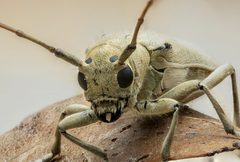
Saperda vestita is a longhorned beetle (Cerambycidae) native to North America, commonly known as the Linden Borer. The was described by Thomas Say in 1824. have been recorded from willow trees, and the species has been the subject of gut microbiome research comparing its bacterial associates to those of other wood-boring beetles.

Pronunciation
How to pronounce Saperda vestita: /sæˈpɛrdə vɛˈstiːtə/
These audio files are automatically generated. While they are not always 100% accurate, they are a good starting point.
Identification
Saperda vestita can be distinguished from related Saperda by careful examination of morphological features. It is smaller than the cottonwood borer (Plectrodera scalator) and lacks that species' striking black-and-white checkered pattern. The red-edged saperda (Saperda lateralis) shows reddish elytral margins not present in S. vestita. Precise identification requires reference to detailed taxonomic keys for the Saperda.
Images
Habitat
Associated with willow trees (Salix sp.) based on collection records. Specific microhabitat preferences within willow stands have not been documented.
Distribution
Canada (Manitoba, New Brunswick, Ontario, Québec) and the United States. GBIF records confirm presence in these provinces and indicate broader North American distribution.
Host Associations
- Salix sp. - larval willow trees; based on collection records from Salix sp.
Behavior
Wood-boring habit; larvae tunnel beneath bark. Gut harbors bacterial including γ-Proteobacteria, Firmicutes, and Bacteroidetes based on culture-independent molecular analysis.
Similar Taxa
- Saperda lateralisBoth are North American Saperda that attack stressed trees; S. lateralis has distinctive red elytral margins and broader range including maples, hickories, elms, basswoods, and oaks
- Saperda candidaRelated roundheaded borer; major pest of Rosaceae trees including apples, pears, crabapples, and hawthorn, whereas S. vestita is associated with willow
- Plectrodera scalatorMuch larger North American cerambycid with conspicuous black-and-white checkered pattern; both are wood-borers but P. scalator specializes on cottonwood (Populus deltoides)
Sources and further reading
- BugGuide
- Wikipedia
- GBIF taxonomy match
- iNaturalist taxon
- NCBI Taxonomy
- Catalogue of Life
- Bug Eric: From My Inbox
- Pensoft Editorial Team | Blog - Part 90
- Drought, borers and dead trees - Roundheaded borers, Cerambycidae — Bug of the Week
- Recent literature – The Coleopterists Bulletin | Beetles In The Bush
- North America’s most recognizable longhorned beetle | Beetles In The Bush
- Bacteria Associated with the Guts of Two Wood-Boring Beetles: <I>Anoplophora glabripennis</I> and <I>Saperda vestita</I> (Cerambycidae)