
Plectrodera
Dejean, 1835
cottonwood borer
Species Guides
1- Plectrodera scalator(Cottonwood Borer)
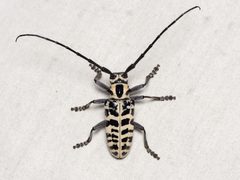
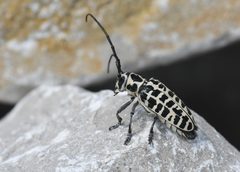
Plectrodera is a of longhorned beetles ( Cerambycidae) containing the single Plectrodera scalator, commonly known as the cottonwood borer. The species is among the largest and most visually distinctive cerambycids in North America, recognized by its striking black-and-white checkered pattern formed by dense mats of white setae on a black body. are associated with cottonwood (Populus deltoides) and are found across the eastern two-thirds of the United States, particularly in the Great Plains.
Pronunciation
How to pronounce Plectrodera: /plɛk.tɹoʊˈdɛɹ.ə/
These audio files are automatically generated. While they are not always 100% accurate, they are a good starting point.
Identification
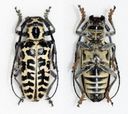
The combination of large size, robust build, and striking black-and-white checkered pattern makes this immediately recognizable among North American longhorned beetles. The pattern of white setae is unique to each individual. Males can be distinguished from females by their smaller, less robust body and longer .
Images
Habitat
Associated with cottonwood trees, particularly in riparian areas and sandy . found on cottonwood saplings and mature trees. Larval habitat in wood of trees.
Distribution
Eastern two-thirds of the United States, especially abundant in the Great Plains where cottonwood is common. Recorded from Kansas, Oklahoma, Texas, Missouri, Illinois, and throughout the range of Populus deltoides.
Seasonality
active in summer, with records from June through August. Peak appears to occur in mid-summer.
Host Associations
- Populus deltoides - larval Eastern cottonwood, primary plant
- Salix - larval Willow, occasional
Life Cycle
Larvae bore in wood of cottonwood and willow. emerge in summer and are found on trees, where they feed and mate.
Behavior
often found in numbers on cottonwood saplings, sometimes preoccupied with feeding and mating to the point of being easily approached. Adults occasionally attracted to ultraviolet light.
Ecological Role
Wood-boring larvae contribute to nutrient cycling in riparian . Native herbivore of cottonwood, co-evolved with .
Human Relevance
Can become a pest in nursery settings. Widely admired by coleopterists for its striking appearance. Subject of tattoo art and popular interest among insect enthusiasts.
Similar Taxa
- Plinthocoelium suaveolensAnother large, colorful North American cerambycid, but distinguished by metallic green coloration and association with bumelia rather than cottonwood
- Crossidius coralinusLarge, colorful longhorn with red/black or orange/black pattern, but coloration is cuticular rather than setal and pattern is not checkered
- Acanthocinus nodosusAnother lamiine with conspicuous pattern that may employ 'conspicuous ', but much smaller and with different pattern
More Details
Individual variation
The pattern of white setae is unique to each individual, analogous to human fingerprints (Yanega 1996)
Taxonomic note
The is , containing only Plectrodera scalator (Fabricius, 1792)
Conservation of coloration
Ethyl acetate recommended as killing agent to preserve coloration; cyanide causes rapid fading