
Scarites
Fabricius, 1775
big-headed ground beetle
Species Guides
6- Scarites lissopterus
- Scarites marinus
- Scarites quadriceps(Big-headed ground beetle)
- Scarites stenops
- Scarites subterraneus(Big-headed Ground Beetle)
- Scarites vicinus(Large-jawed Pedunculate Ground Beetle)
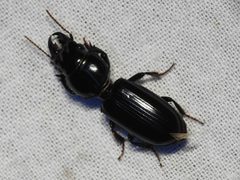
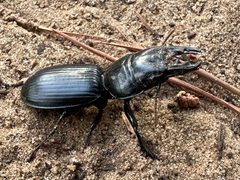
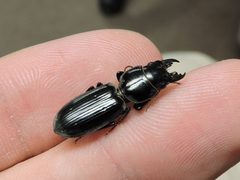
Scarites is a of large ground beetles in the Carabidae, containing over 190 described distributed across the Palearctic, Near East, North America, and North Africa. These beetles are characterized by their disproportionately large , prominent , and elongated, somewhat flattened bodies that superficially resemble tropical stag beetles, though they are not closely related. Both and larvae are active that hunt soil-dwelling . When disturbed, Scarites beetles exhibit —folding their legs and arching their backs to feign death.
Pronunciation
How to pronounce Scarites: /skæˈraɪtiːz/
These audio files are automatically generated. While they are not always 100% accurate, they are a good starting point.
Identification
Scarites beetles are distinguished from other ground beetles by their large, and prominent relative to body size. The body is typically elongated, somewhat flattened, and shiny black or dark brown. They range from 14–30 mm in length. Unlike stag beetles (Lucanidae), which they superficially resemble, Scarites lack the extreme in mandible size and have rather than clubbed antennae. -level identification requires examination of male genitalia and subtle differences in pronotal and elytral .
Images
Habitat
Found in terrestrial with loose substrate, typically under rocks, boards, mulch, or in sandy or moist soil. Often occurs in gardens, flower beds, and along shorelines. In colder climates, beetles burrow into soil to exploit thermally stable refugia during winter.
Distribution
Native to the Palearctic, Near East, North America, and North Africa. In North America, at least seven occur, with S. subterraneus widespread across the eastern and central United States. The is particularly diverse in India, with over 55 described species.
Seasonality
are active from spring through autumn. In temperate regions, they seek refugia in soil or under protective cover as temperatures decline. Autumn observations include occasional home invasions as beetles seek shelter.
Diet
Life Cycle
Both larval and stages are active . Larvae are fast-moving and often observed traversing open ground between patches. Development occurs in soil; specific details of and time vary by and climate.
Behavior
When touched or disturbed, Scarites beetles frequently exhibit (death-feigning), folding their legs tightly against the body and arching the back, often remaining motionless for extended periods. This is an effective anti- defense. Both life stages are rapid runners.
Ecological Role
Important in soil and ground-level . Contribute to of agricultural and garden pests including caterpillars, slugs, and soil-dwelling larvae. Some consume weed seeds, providing additional service. Serve as prey for larger and vertebrates.
Human Relevance
Beneficial to agriculture and horticulture through on pests. Occasionally enters homes in autumn, where they are harmless and easily relocated outdoors. Not a structural or medical pest.
Similar Taxa
- Lucanidae (stag beetles)Superficially similar large and robust build, but stag beetles have clubbed , often show extreme in mandible size, and are not ground-dwelling .
- Calosoma (searcher beetles)Large, fast ground beetles with predatory habits, but Calosoma are more rounded in body shape, often metallic, and several species climb vegetation to hunt caterpillars rather than remaining strictly ground-associated.
- Other Carabidae (ground beetles)Many ground beetles share general body form, but Scarites is distinguished by the disproportionately large and relative to pronotum width, and the characteristic .
Sources and further reading
- BugGuide
- Wikipedia
- GBIF taxonomy match
- iNaturalist taxon
- NCBI Taxonomy
- Catalogue of Life
- An unusual but not unpleasant home invasion by a beneficial beetle: Big-headed ground beetle, Scarites subterraneus — Bug of the Week
- What do insects do in winter, Part 3? Avoiding the big chill: emerald ash borers, Agrilus plannipenis, ground beetles, Carabidae, fall webworms, Hyphantria cunea — Bug of the Week
- Archive — Bug of the Week
- Observations on Behavior in Scarites (Coleoptera: Carabidae: Scaritini)
- Gaeolaelaps scaritessp. nov., a new laelapid mite (Acari: Mesostigmata) associated withScarites terricola(Coleoptera: Carabidae) from Iran
- Illumina Short-Read Sequencing of the Mitogenomes of Novel Scarites subterraneus Isolates Allows for Taxonomic Refinement of the Genus Scarites Fabricius 1775, within the Carabidae Family
- On the distribution of Scarites terricola Bonelli, 1813 (Coleoptera, Carabidae) in the Russian Far East
- Biodiversity of the endangered coastal beetle Scarites laevigatus: is the northern Adriatic population a geographical subspecies or a case of introgressive hybridisation? (Coleoptera: Carabidae)
- Agonistic behaviour of <i>Scarites buparius</i> (Forster, 1771) (Coleoptera: Carabidae) in relation to body size