
Scarites subterraneus
Fabricius, 1775
Big-headed Ground Beetle, Pedunculate Ground Beetle, Tunneling Large Ground Beetle
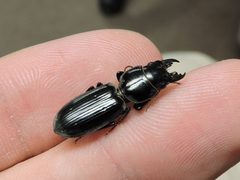
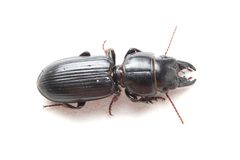
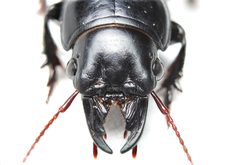
Scarites subterraneus is a large ground beetle in the Carabidae, commonly known as the big-headed ground beetle. measure 15.0–30.0 mm in length and possess distinctive large with two teeth, adapted for capturing and consuming prey. The is native to the Caribbean, Central America, and North America, and has been introduced to Europe. It is primarily , spending daylight hours concealed under logs, rocks, soil, and leaf litter. Molecular studies have identified two : S. subterraneus nebraskensis and S. subterraneus arkansensis.
Pronunciation
How to pronounce Scarites subterraneus: //skəˈraɪtiːz ˌsʌbtəˈreɪniəs//
These audio files are automatically generated. While they are not always 100% accurate, they are a good starting point.
Identification
Distinguished from other ground beetles by the combination of: large body size (15–30 mm), big head with two-toothed , striated , antennomeres 8–10, and (digging-adapted) front legs. The 'playing dead' () when disturbed is a notable behavioral cue. Similar in the Scarites may require examination of genitalic structures or molecular markers for definitive identification.
Images
Appearance
Large, robust with shiny black bearing distinct longitudinal striations (streaks). Body length ranges from 15.0 to 30.0 mm, with some specimens measuring 18.5–20.5 mm. The is proportionally large relative to the body, bearing prominent with two teeth. are segmented and neither clubbed nor elbowed; antennomeres 8–10 are (bead-like). Front are modified for digging. Wings are present. The forebody is loosely attached to the rest of the body, allowing flexibility.
Habitat
Inhabits diverse environments including forests, meadows, and coastal areas. Frequently found in residential settings, both urban and rural. During daylight hours, occupies beneath logs, rocks, soil, leaf litter, bricks, wood, and mulch. Often encountered in garden flower beds and unused firepits. The ' reflects its subterranean tendencies.
Distribution
Native range spans the Caribbean, Central America, and North America. Documented from Canada, Cuba, Mexico, and the United States. Introduced to Europe, with records from England, Belgium, and the Netherlands. Within North America, confirmed from Eastern Nebraska and Northern Arkansas, with proposed S. s. nebraskensis and S. s. arkansensis.
Seasonality
are most active during spring and summer. activity peaks during warmer months. Attracted to artificial lights, frequently observed at porch lights during evening hours.
Diet
Life Cycle
Complete with , larva, pupa, and stages. Larvae are . Specific details of developmental duration and stage not documented in available sources.
Behavior
that emerges at night to hunt. During daylight, remains concealed under cover objects. Exhibits (death-feigning) when disturbed: stiffens body, tucks in limbs, and remains motionless until the perceived threat passes. This persists until the reaches a location offering escape opportunity or the predator departs. Strongly attracted to light sources.
Ecological Role
Functions as an important in soil and ground-level . Both larvae and are predatory, contributing to regulation of pest . Enhances sustainability by reducing populations of agricultural and garden pests. Serves as prey for birds including American Robins, Eastern Bluebirds, Hermit Thrushes, and Northern Cardinals. Contributes to nutrient cycling through and as food for higher .
Human Relevance
Considered beneficial in gardens and agricultural settings due to on pest . Occasionally enters homes, where it is generally regarded as a harmless and potentially helpful visitor. Not a significant pest itself. Subject of biological research including mitogenome sequencing and taxonomic studies. Sometimes encountered by homeowners near porch lights.
Similar Taxa
- Other Scarites speciesShare large and habits; may require molecular or detailed morphological examination for separation
- Cicindela sexguttata (Six-spotted Green Tiger Beetle)Similar ground-dwelling predatory lifestyle and large , but distinguished by metallic green coloration, six white spots on , and activity
- Carabus spp.Large predatory ground beetles with similar size and habits, but typically have more rounded and different mandibular structure
More Details
Molecular Research
First mitogenome sequenced for this in 2022, enabling phylogenetic placement within Carabidae. Two proposed based on specimens from Nebraska and Arkansas: S. s. nebraskensis and S. s. arkansensis. Associated microbiome includes bacterial Providencia, Myroides, Spiroplasma, and a giant Nucleocytoviricota virus.
Cold Tolerance
Overwinters using behavioral , burrowing into soil to exploit warmer subterranean temperatures. This strategy provides thermal from freezing air temperatures, though specific physiological mechanisms remain undocumented for this .
Sources and further reading
- BugGuide
- Wikipedia
- GBIF taxonomy match
- iNaturalist taxon
- NCBI Taxonomy
- Archive — Bug of the Week
- What do insects do in winter, Part 3? Avoiding the big chill: emerald ash borers, Agrilus plannipenis, ground beetles, Carabidae, fall webworms, Hyphantria cunea — Bug of the Week
- Novel research seeking to solve environmental challenges
- Conservation Translocations: It’s Not Just Beavers - Buglife Blog - Buglife
- BioRisk | Blog - Part 2
- Pensoft Editorial Team | Blog - Part 50
- Illumina Short-Read Sequencing of the Mitogenomes of Novel Scarites subterraneus Isolates Allows for Taxonomic Refinement of the Genus Scarites Fabricius 1775, within the Carabidae Family