
Scaritinae
Bonelli, 1810
Pedunculate Ground Beetles
Tribe Guides
5Scaritinae is a large, of ground beetles (Carabidae) containing over 2,400 in more than 140 . Members exhibit considerable ecological diversity, with many species adapted to specialized including caves, riverbanks, and deep soil layers. The subfamily includes tribes such as Scaritini, Clivinini, and Salcediini. Several genera show disjunct distributions that have contributed to biogeographic understanding of continental drift and faunal exchange.
Pronunciation
How to pronounce Scaritinae: //skæˈrɪtɪniː//
These audio files are automatically generated. While they are not always 100% accurate, they are a good starting point.
Identification
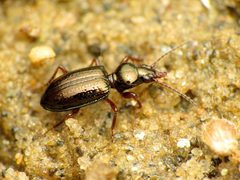
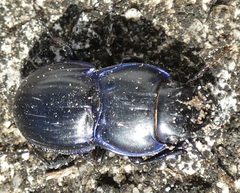
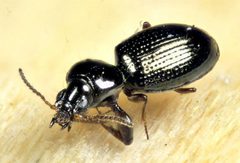
Scaritinae are distinguished from other Carabidae by their pedunculate (stalked) structure of the prothorax, giving a 'waisted' appearance between and . Many have reduced or absent , particularly in cave-dwelling and endogean forms. Body form ranges from small (2–4 mm in Salcedia) to larger robust forms; coloration typically dull brown to black, often with soil or clay adhering to the .
Images
Habitat
Highly variable; includes cave systems (Brazil, China, Croatia), river and lake banks (tropical Africa), deep soil and leaf litter (montane Balkans, Iberian Peninsula), and endogean (subterranean soil) . Many exhibit specialized adaptations to dark, moist environments with stable microclimates.
Distribution
; documented on all continents except Antarctica. Notable concentrations in tropical Africa (including Madagascar), Oriental region (Indian subcontinent, Southeast Asia), Palearctic (Europe, China), and Neotropics (Brazil). Several show disjunct distributions between Equatorial Africa and Indian subcontinent, reflecting historical Gondwanan connections.
Behavior
Many are and attracted to light traps. Cave-dwelling and endogean species exhibit reduced eyesight or anophthalmia, relying on tactile and chemical cues. Specimens frequently carry adhering soil or clay, which may serve as camouflage or moisture retention. Several rare are known from only single specimens, suggesting cryptic habits and low densities.
Human Relevance
Some serve as biogeographic indicators due to their ancient, disjunct distributions. Cave-dwelling Scaritinae contribute to the biodiversity assessment of subterranean and may function as for stability. No economic importance as pests or biocontrol agents has been documented.
Similar Taxa
- Clivinini (historically)Some authors historically placed Salcediini within Clivinini; now recognized as distinct tribe based on morphological and phylogenetic evidence.
- Other Carabidae subfamiliesScaritinae distinguished by pedunculate prothorax; other ground beetles lack this 'waisted' appearance and typically have more exposed, fully developed .
Sources and further reading
- BugGuide
- Wikipedia
- iNaturalist taxon
- NCBI Taxonomy
- Catalogue of Life
- New Records of Ground Beetles Genera (Coleoptera: Carabidae: Scaritinae: Clivinini) from Brazilian Caves
- Rare ground-beetle species of Leleuporella Basilewsky (Coleoptera: Carabidae: Scaritinae: Scaritini) from Indian sub-continent
- A genus in disguise. Revision of the genus Salcedia Fairmaire, 1899 with descriptions of nine new species (Coleoptera, Carabidae, Scaritinae, Salcediini)
- New records and a new species of the cavernicolous genus Guiodytes Tian, 2013 from Guangxi, China (Coleoptera: Carabidae: Scaritinae)
- Two new species of the genus Parareicheia Jeannel, 1957 (Coleoptera: Carabidae: Scaritinae: Clivinini: Reicheiina) from Portugal, with faunistic notes on Anillini
- A new hypogean species of the genus Chaetomargoreicheia Magrini & Bulirsch, 2005 (Carabidae: Scaritinae: Clivinini) from Croatia
- Morphometry and eye morphology of three scaritine ground beetles relate to habitat demands and behavioural traits (Coleoptera, Carabidae, Scaritinae)
- Discovery of Antireicheia in Cameroon with description of four new species and discussion on phylogeny and distribution of endogean Reicheiina (Coleoptera: Carabidae: Scaritinae: Clivinini)