
Promecognathini
LeConte, 1853
Genus Guides
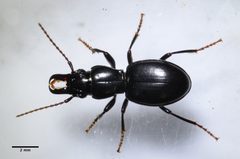
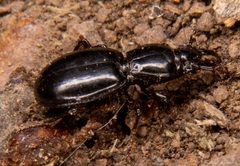
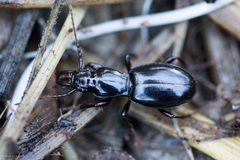
1Promecognathini is a tribe of ground beetles within the Promecognathinae, Carabidae. Established by LeConte in 1853, this tribe contains a small number of including the type genus Promecognathus. Members are specialized carabid beetles with distinctive morphological features. The tribe represents a relatively small but evolutionarily distinct lineage within the Adephaga.
Pronunciation
How to pronounce Promecognathini: //prɒˌmiːkoʊˈnæθɪnaɪ//
These audio files are automatically generated. While they are not always 100% accurate, they are a good starting point.
Identification
Members of Promecognathini can be distinguished from other carabid tribes by their elongate, somewhat flattened body form and the structure of the , which are modified and asymmetrical in some . The is to the , a characteristic feature of the Promecognathinae. are and inserted between the and mandibular base. The pronotum is typically narrower than the at the base. These features, combined with the overall slender habitus, separate them from the more diverse and commonly encountered Carabini and other ground beetle tribes.
Images
Habitat
within Promecognathini are found in moist, forested environments, particularly in association with decaying wood and leaf litter. They inhabit riparian zones and shaded areas with abundant organic matter. Some species have been observed in coastal redwood forests and other temperate woodland of western North America.
Distribution
The tribe is primarily distributed in western North America, ranging from British Columbia through California. The distribution extends into montane regions of the western United States and includes coastal and inland forest . The Promecognathus shows a disjunct distribution pattern with in western North America and additional in eastern Asia, suggesting a relictual biogeographic history.
Seasonality
are active primarily during the spring and early summer months, with peak activity from March through June in most of their range. Activity patterns are influenced by moisture availability and temperature, with reduced surface activity during dry summer periods.
Behavior
Members of this tribe are ground-dwelling beetles that are active nocturnally or during periods. They are capable runners but are more often found in concealed microhabitats such as under bark, in rotting logs, or within deep leaf litter. When disturbed, they may exhibit (death-feigning ) or rapid escape movements.
Ecological Role
As predatory beetles, members of Promecognathini contribute to the regulation of in forest floor . They are part of the complex of ground-dwelling that process energy and nutrients through detrital . Their association with decaying wood suggests a role in the early stages of wood decomposition and nutrient cycling in forest .
Human Relevance
Promecognathini has no direct economic importance to humans. The tribe is of interest to coleopterists and systematists due to its phylogenetic position as a basal lineage within Carabidae and its relictual distribution pattern. are occasionally collected in ecological surveys of forest biodiversity.
Similar Taxa
- CarabiniCarabini is a much larger and more diverse tribe of ground beetles that shares the Carabidae. Promecognathini differs in having the to the , more elongate body form, and asymmetrical in some . Carabini typically have a more robust build and symmetrical mandibles.
- CicindeliniTiger beetles in the tribe Cicindelini are active, visually oriented with large and long legs adapted for rapid pursuit. Promecognathini have smaller eyes relative to size, shorter legs, and are not hunters; they instead occupy concealed microhabitats.
More Details
Phylogenetic Significance
Promecognathini, together with the tribe Melaenini, constitutes the Promecognathinae, which is considered one of the most basal lineages within Carabidae. This phylogenetic position has made the tribe important for understanding the evolutionary origins of ground beetles. Molecular and morphological studies support the placement of Promecognathinae as sister to all other Carabidae or within a basal grade of carabid subfamilies.
Taxonomic History
The tribe was established by John L. LeConte in 1853 based on the Promecognathus. The classification of Promecognathinae has been stable relative to other carabid groups, though the number of included genera has been revised. The Asian genus Coptolabrus has been associated with this group in some treatments, contributing to the disjunct distribution pattern noted in the group.