
Pasimachini
Bonelli, 1810
Genus Guides
1- Pasimachus(Warrior Beetles)
Pasimachini is a tribe of large, robust ground beetles in the Carabidae, Scaritinae. Members are characterized by their heavily sclerotized bodies, (digging) adaptations, and predominantly habits. The tribe contains several distributed primarily in the New World, with often found in sandy or loose soil . Pasimachini beetles are predatory and play a role in soil dynamics through their burrowing activities.
Pronunciation
How to pronounce Pasimachini: /ˈpasɪˌmakɪnaɪ/
These audio files are automatically generated. While they are not always 100% accurate, they are a good starting point.
Identification
Distinguished from other Scaritinae tribes by the combination of: large body size (exceeding most other scaritines), extremely robust and heavily sclerotized build, greatly enlarged fore with rows of spines, and broad, asymmetrical fore tibiae with strong external teeth. Differs from the related tribe Scaritini by larger size, more massive , and more extreme leg modifications. The Pasimachus, containing most , is recognized by the distinctive shape of the fore tibiae and the presence of a characteristic setal pattern on the pronotum.
Images
Appearance
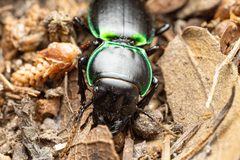
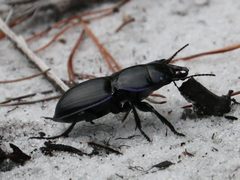
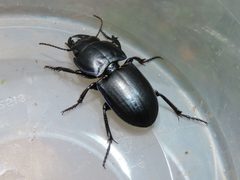
Large, heavily built ground beetles with robust, often somewhat flattened bodies. Length ranges from approximately 15–35 mm. notably thick and hard, with deep, coarse punctation on . large and prominent, often with multiple teeth. Legs short, stout, and strongly modified for digging: fore tibiae broadened and spiny, fore enlarged. short, . Coloration typically black, sometimes with metallic blue or green reflections; some with reddish or yellowish markings on legs or mouthparts.
Habitat
Predominantly sandy or loose soil environments including coastal dunes, riverine sandbars, sandy prairies, pine barrens, and scrublands. Some occur in clay soils or loamy agricultural fields. are generally well-drained and often sparsely vegetated. Many species are associated with early successional or disturbed habitats. Burrows are constructed in friable substrate, often at the base of vegetation or in open ground.
Distribution
Primarily New World distribution, with center of diversity in North America. Extends from southern Canada through the United States, Mexico, Central America, and into northern South America. Some reach the Caribbean. The Pasimachus is largely restricted to North and Central America, while other genera (e.g., Pelecium) have broader Neotropical distributions.
Seasonality
are most active from spring through fall in temperate regions, with peak activity in summer. Activity patterns vary by and latitude; some southern are active year-round. Adults often emerge from burrows at night or during overcast conditions. Larval development occurs primarily in summer months. typically occurs as adults in burrows below the frost line.
Diet
Predatory, feeding on other soil-dwelling including insect larvae, pupae, and soft-bodied arthropods. Prey items include scarab beetle larvae, caterpillars, and other ground-dwelling insects. Some have been observed scavenging on carrion. Specific prey preferences vary by species and .
Life Cycle
Complete (holometabolous). are laid in burrows or chambers constructed in soil. Larvae are soil-dwelling, with three instars; they possess well-developed and are predatory. Larval development period varies with temperature and , typically several weeks to months. occurs in earthen . are long-lived, often surviving multiple years, and may reproduce in successive seasons. time is generally one year, though some larger species may require two years.
Behavior
and . construct and maintain burrows in loose soil, using modified forelegs for excavation. Burrows serve as shelter from desiccation and temperature extremes, and as ambush points for prey capture. Adults are capable of rapid burrowing and can disappear into substrate within seconds when disturbed. ability is reduced or absent in most ; is primarily by . When handled, adults may release defensive secretions from pygidial glands or deliver painful bites with large .
Ecological Role
that regulate of soil-dwelling herbivorous insects, particularly scarab larvae and other root-feeding pests. Their burrowing activities contribute to soil aeration and mixing. Serve as prey for larger vertebrates including birds, mammals, and reptiles. As large, long-lived beetles, they may function as bioindicators of soil quality and stability in sandy .
Human Relevance
Generally beneficial in agricultural and natural systems due to on pest insects. Some have been studied as potential agents for soil-dwelling crop pests. Occasionally considered nuisance pests when abundant in sandy residential areas or recreational beaches. Not known to transmit or damage crops directly. Their large size and defensive capabilities make them notable to collectors and naturalists.
Similar Taxa
- ScaritiniAlso Scaritinae with digging legs, but generally smaller, less heavily built, with less extreme fore femoral enlargement and more symmetrical tibiae.
- Cicindelini (tiger beetles)Fast-running ground beetles that may co-occur in sandy , but have long legs adapted for rather than locomotion, large , and activity.
- CarabiniLarge predatory ground beetles, but lack leg modifications, have more elongate bodies, and are primarily surface-active rather than burrowing.
More Details
Phylogenetic placement
Pasimachini has been historically classified within Scaritinae, though relationships among scaritine tribes remain under study. Molecular phylogenetic analyses suggest Pasimachini is sister to or nested within a clade of New World carabids.
Conservation status
Several with restricted ranges, particularly coastal dune , are of conservation concern due to loss from coastal development and stabilization. The tribe as a whole is not threatened, but local are vulnerable to sand mining, beach , and vegetation.