
Scarites vicinus
Chaudoir, 1843
Large-jawed Pedunculate Ground Beetle
Scarites vicinus is a large ground beetle in the Carabidae , native to North America. It belongs to the quadriceps group and was previously considered a junior synonym of S. quadriceps but has been revalidated as a distinct . Phylogenetic analysis of Cox1 genes identifies S. vicinus as the closest relative to S. subterraneus. It is one of two Scarites species recorded from Nebraska.
Pronunciation
How to pronounce Scarites vicinus: //ˈskaː.rɪ.tɛs vɪˈkiː.nʊs//
These audio files are automatically generated. While they are not always 100% accurate, they are a good starting point.
Identification
Distinguished from Scarites subterraneus by its rounder ( and thorax nearly equal in volume with included), straight rather than V-shaped central thorax line, and absence of a three-lobed head. Separated from other quadriceps group members by thorax proportions and was historically confused with S. quadriceps before revalidation.
Images
Appearance
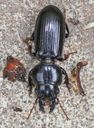
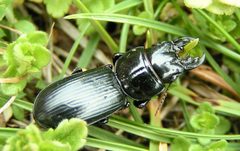
Large, sleek black body measuring 14–30 mm in length. Possesses prominent, large characteristic of the . is distinctly rounder than , with and thorax nearly equal in volume when mandibles are included. The bottom part of the central thorax line forms a straight line rather than a "V" shape. Lacks the three-lobed head structure present in S. subterraneus.
Habitat
Terrestrial. Found beneath surface debris including bricks, wood logs, mulch, and rocks lining garden flower beds. Utilizes soil and subterranean spaces for .
Distribution
Native to North America. Recorded from Canada and the United States. One of two Scarites documented from Nebraska; also present in Eastern Nebraska and Northern Arkansas regions based on phylogenetic study material.
Diet
Behavior
Exhibits (death-feigning) when disturbed or touched: folds legs inward and raises , remaining motionless to avoid .
Ecological Role
in soil and ground-level . Provides biological pest control in garden and agricultural by reducing of snails, slugs, and soil-dwelling herbivorous larvae. Serves as prey for larger predators.
Human Relevance
Beneficial to gardens and agriculture as a agent of pest . No documented negative impacts.
Similar Taxa
- Scarites subterraneusSimilar large black ground beetle with large , but distinguished by three-lobed , V-shaped central line, and proportionally different thorax dimensions.
- Scarites quadricepsHistorically treated as with S. vicinus; S. vicinus was revalidated from synonymy based on morphological and molecular evidence.
More Details
Taxonomic History
Previously treated as a junior synonym of Scarites quadriceps but subsequently revalidated as a distinct . Phylogenetic analysis of Cox1 genes confirms close relationship to S. subterraneus.
Molecular Data
Cox1 gene sequences used in phylogenetic studies place S. vicinus as sister to S. subterraneus. No complete mitogenome or sequences currently available in GenBank for this .
Sources and further reading
- BugGuide
- Wikipedia
- GBIF taxonomy match
- iNaturalist taxon
- NCBI Taxonomy
- Encyrtid Holdings | Entomology Research Museum
- What do insects do in winter, Part 3? Avoiding the big chill: emerald ash borers, Agrilus plannipenis, ground beetles, Carabidae, fall webworms, Hyphantria cunea — Bug of the Week
- Pismire Puzzle | Beetles In The Bush
- Illumina Short-Read Sequencing of the Mitogenomes of Novel Scarites subterraneus Isolates Allows for Taxonomic Refinement of the Genus Scarites Fabricius 1775, within the Carabidae Family