
Laemostenus terricola
(Herbst, 1784)
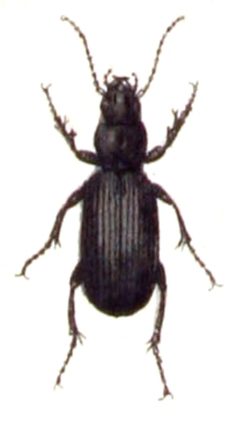
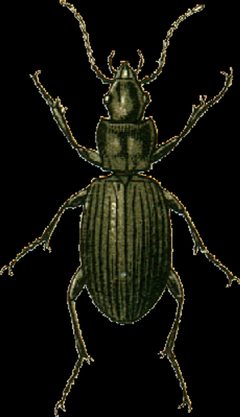
Laemostenus terricola is a cavernicolous ground beetle native to Europe, capable of maintaining substantial in old hedge within intensively cultivated agricultural landscapes. The exhibits eurychronous with year-round surface activity, though peak activity occurs in late summer and early autumn. It shows strong ecological association with rabbit burrows, which serve as important microhabitat features. The species is considered endangered in parts of its range, including Berlin and Germany as a whole.
Pronunciation
How to pronounce Laemostenus terricola: /laɪˈmɔstɛnəs ˈtɛrɪˌkoʊlə/
These audio files are automatically generated. While they are not always 100% accurate, they are a good starting point.
Identification
Distinguished from similar ground beetles by its cavernicolous lifestyle and specific association with burrow systems, particularly those of rabbits. The subgenus Pristonychus (to which L. terricola belongs) can be separated from other Laemostenus subgenera by genitalic and external morphological characters, though precise field identification requires examination.
Images
Habitat
Old hedge within intensively cultivated agricultural landscapes; strongly associated with rabbit burrows, which appear to be a critical microhabitat component. The is cavernicolous, utilizing subterranean spaces. Dead wood and litter amount are not significant factors in habitat suitability.
Distribution
Native to Europe. Documented from Albania, Austria, Belgium, (former) Yugoslavia, and Germany (where it is considered endangered). GBIF records also indicate presence in Canada, likely representing introduced . Study populations have been investigated approximately 30 km west of Bonn, Germany.
Seasonality
Eurychronous with surface activity occurring throughout the year. Larval development takes place during spring and summer. Peak occurrence of (freshly emerged) beetles and maximum activity of mature beetles occurs in the second half of August through September.
Host Associations
- rabbit burrows - associationStrong spatial correlation; catch numbers best correlated to distance from rabbit holes, which provide critical microhabitat structure
Life Cycle
Larval development occurs during spring and summer months. beetles appear primarily in late August and September, coinciding with peak mature activity. The maintains continuous surface activity without restricted seasonal periods.
Behavior
surface activity influenced by nightly cloudiness and air humidity; activity potentially reduced under clear night skies due to increased nocturnal light intensity. Mark-recapture experiments indicate low ability, suggesting limited movement between patches.
Human Relevance
Considered endangered in Berlin and listed on the German Red List, indicating conservation concern due to loss and agricultural intensification. Serves as an for old hedge habitats with intact burrow systems in agricultural landscapes.
Similar Taxa
- Laemostenus complanatusSimilar cavernicolous ground beetle in the same ; separation requires examination of genitalic and external morphological characters
- other Laemostenus (Pristonychus) speciesMembers of the same subgenus share cavernicolous habits; precise identification typically requires taxonomic examination
More Details
Taxonomic note
The Laemostenus terricola terricola was described by Herbst in 1784. The subgenus Pristonychus has been elevated to generic rank by some authors (as Cylindera), though this classification remains debated. The North American subspecies Cylindera terricola kaibabensis (formerly Cicindela kaibabensis) is still treated by some sources as with L. terricola, though this represents a distinct lineage.
Conservation status
Endangered in Berlin and Germany (Red List), reflecting vulnerability of old hedge with rabbit burrow systems to agricultural intensification and habitat fragmentation.