
Laemostenus
Bonelli, 1810
Species Guides
2- Laemostenus complanatus(Cosmopolitan Ground Beetle)
- Laemostenus terricola
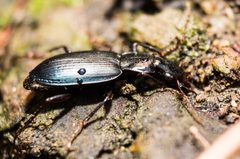
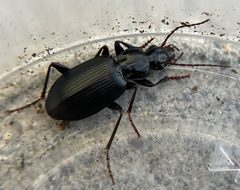
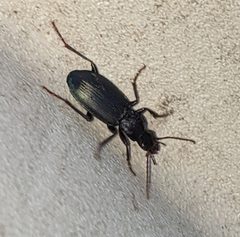
Laemostenus is a of ground beetles (Carabidae) comprising nearly 200 distributed across all continents except Antarctica. Species range from 8 to 28 mm in length. Many exhibit dark coloration with blue or purple metallic sheen, while subterranean and cave-dwelling species show depigmentation, reduced , and lighter coloration. The genus includes both surface-dwelling and hypogean (subterranean) species, with several subgenera recognized.
Pronunciation
How to pronounce Laemostenus: /læˈmɒstɛnəs/
These audio files are automatically generated. While they are not always 100% accurate, they are a good starting point.
Identification
Distinguished from similar ground beetle by combination of size range (8–28 mm), often metallic dark coloration, and genitalic (male shape particularly diagnostic for -level identification). Subterranean species with reduced and depigmentation require careful comparison with surface relatives; genitalic examination typically necessary for definitive identification.
Images
Appearance
Beetles 8–28 mm in length. Body form typical of ground beetles. Coloration variable: many dark with blue or purple metallic sheen; subterranean and cave-dwelling species depigmented with much lighter coloration and reduced .
Habitat
Highly variable across . Includes surface such as old hedgerows in agricultural landscapes, as well as subterranean environments including caves (hypogean) and mesovoid shallow substratum (MSS). Some surface-dwelling species associated with mammal burrows (e.g., rabbit burrows).
Distribution
Present on all continents except Antarctica. Specific records include Europe (Spain, Germany, Turkey, Scandinavia), with showing varying distribution patterns from widespread to highly localized cave endemics.
Seasonality
Surface-dwelling such as Laemostenus terricola show eurychronous activity pattern with year-round surface presence; larval development during spring and summer, peak and mature activity in August–September. Activity influenced by nightly cloudiness and air humidity.
Life Cycle
Larval development during spring and summer in at least some (e.g., L. terricola). beetles and maximum mature activity observed in second half of August and September in studied .
Behavior
Surface activity not restricted to specific periods for some ; activity fluctuations correlate with nightly cloudiness and air humidity. Increased light intensity under clear sky may decrease activity. Mark-recapture experiments indicate low capacity in at least one studied species.
Similar Taxa
- Other Sphodrini generaSimilar body form and size; distinguished by genitalic and specific associations
- Surface-dwelling vs. subterranean Laemostenus speciesSubterranean with reduced and depigmentation may be confused with surface relatives; eye reduction and coloration are key distinguishing features
More Details
Subgeneric classification
The is divided into several subgenera, including Antisphodrus and Pristonychus. Molecular studies indicate low intraspecific genetic variation in some hypogean , supporting synonymization of previously recognized in cases such as L. (Antisphodrus) cazorlensis.
Conservation implications
Cave-dwelling with restricted distributions may be vulnerable due to limited capacity and specificity. The patchy distribution of hypogean environments constrains even at small geographic , though karstic connectivity can maintain connectivity in some cases.
Sources and further reading
- BugGuide
- Wikipedia
- GBIF taxonomy match
- iNaturalist taxon
- NCBI Taxonomy
- Catalogue of Life
- Investigations on the ecology of Laemostenus terricola (Coleoptera, Carabidae) in an agricultural landscape
- When morphology meets genetics: the case of the hypogean Laemostenus cazorlensis (Coleoptera, Carabidae)
- Two new species of the genus Laemostenus Bonelli sg. Antisphodrus Schaufuss from Turkey (Coleoptera: Carabidae: Sphodrini)
- Taxonomic reconsideration of the subspecific complex of Laemostenus (Antisphodrus) cazorlensis (Mateu, 1953) (Coleoptera, Carabidae, Platyninae)
- A new species of Laemostenus Bonelli, 1810 (Coleoptera, Carabidae) from Els Ports Natural Park (Catalonia, northeastern Iberian peninsula)