
Cicindela formosa pigmentosignata
W.Horn, 1930
Reddish-green Sand Tiger Beetle, Big Sand Tiger Beetle (subspecies)
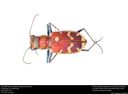
Cicindela formosa pigmentosignata is a striking of the Big Sand Tiger Beetle restricted to sandy areas of open pine forests in eastern Texas, southwestern Arkansas, and northwestern Louisiana. display brilliant violaceous (reddish-purple) with vividly contrasting blue-green legs and sides, and are nearly with reduced maculations. Like other C. formosa subspecies, it exhibits a spring/fall with sexually adults emerging in fall, in burrows, and becoming reproductively active in spring. The subspecies is closely associated with C. scutellaris rugata throughout its range.
Pronunciation
How to pronounce Cicindela formosa pigmentosignata: //sɪˈsɪndələ fɔrˈmoʊsə pɪɡˌmɛntoʊsɪɡˈneɪtə//
These audio files are automatically generated. While they are not always 100% accurate, they are a good starting point.
Identification
Distinguished from nominate C. formosa and other by the unique combination of brilliant violaceous (reddish-purple) with blue-green legs and sides. The nearly elytra separate it from subspecies with more prominent maculations (e.g., C. f. generosa). Distinguished from C. scutellaris rugata, with which it often co-occurs, by larger size, more robust build, and reddish-purple versus blue-green coloration. Distinguished from C. sexguttata by more robust body, less tapered , and in color (C. sexguttata has whitish labrum in both sexes).
Images
Habitat
Deep, dry sandy in open pine forests, including sparsely to moderately vegetated sand exposures, sandy 2-tracks, and road cuts. Found in areas with deep sand deposits fully exposed to sun and lacking standing water. Often associated with post oak savanna and pine-oak woodland transitions in the Post Oak Savannah ecoregion.
Distribution
Restricted to eastern Texas (Henderson and Van Zandt Counties documented), southwestern Arkansas, and northwestern Louisiana. Northeastern limit of distribution approaches but may not reach southwestern Arkansas based on historical records, though recent observations suggest possible range extension.
Seasonality
active in fall (September-October) and spring. Fall-emerging adults are sexually , overwinter in burrows, and become reproductively active following spring . Adults largely disappear during midday heat, retreating to burrows.
Life Cycle
Spring/fall pattern: sexually emerge in fall, pass winter in burrows, and emerge in spring to mate and oviposit. Larvae develop in burrows through summer, with leading to fall adult .
Behavior
are fast-running and rapid-flying, executing long looping escape that end with characteristic bounce and tumble landing. Exhibits thermoregulatory including stilting (elevating body on long legs to reduce heat absorption from sand) and shade-seeking during hotter parts of day. Adults often found in association with C. scutellaris rugata, though with slightly offset .
Ecological Role
Apex in sandy microecosystems. Preys upon small arthropods. Larval burrows may contribute to soil aeration and water infiltration in sandy substrates.
Human Relevance
Subject of interest to tiger collectors and photographers due to striking coloration and restricted range. Collected for scientific study of subspeciation patterns in C. formosa. Occurs in rural cemeteries, which serve as refugia for native sand in otherwise converted agricultural landscapes.
Similar Taxa
- Cicindela formosa generosaEastern with more prominent elytral maculations and less brilliant coloration; occurs further north and east
- Cicindela formosa formosaNominate with red coloration in Great Plains; lacks violaceous and blue-green coloration of pigmentosignata
- Cicindela scutellaris rugataCo-occurs in same but smaller, solid blue-green coloration, more wrinkled pronotum; distinguished by color and body proportions
- Cicindela sexguttata green with similar appearance but less robust, more tapered , and whitish in both sexes
More Details
Taxonomic history
Described by Walther Horn in 1930. One of five currently recognized of C. formosa, representing eastern peripheral isolate of that radiated in central North America.
Conservation notes
dependent on deep sand deposits that are vulnerable to , development, and agricultural conversion. Rural cemeteries provide important refugia.
Sources and further reading
- BugGuide
- GBIF taxonomy match
- iNaturalist taxon
- NCBI Taxonomy
- Catalogue of Life
- Cicindela scutellaris rugata (the “wrinkled tiger beetle”) | Beetles In The Bush
- Coleoptera | Beetles In The Bush | Page 8
- Cicindelidae | Beetles In The Bush | Page 3
- Just repanda… er, wait a minute… | Beetles In The Bush
- Texas | Beetles In The Bush | Page 2