
Cicindela formosa formosa
Say, 1817
big sand tiger beetle
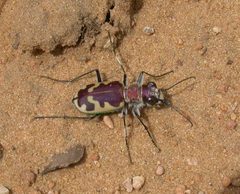
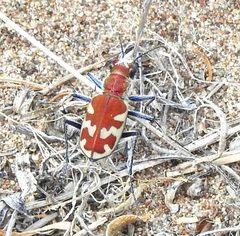
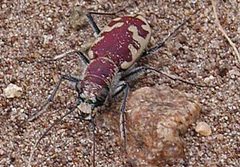
Cicindela formosa formosa is the nominate of the big sand tiger beetle, occurring in the Great Plains region of North America. It is a large, robust tiger adapted to deep, dry sand . exhibit a spring/fall activity pattern, in burrows. The subspecies is distinguished from related by its "C"-shaped humeral markings and bulkier body form compared to similar like C. lengi.
Pronunciation
How to pronounce Cicindela formosa formosa: /sɪˈsɪndələ fɔːrˈmoʊsə fɔːrˈmoʊsə/
These audio files are automatically generated. While they are not always 100% accurate, they are a good starting point.
Identification
Distinguished from the similar C. lengi by: (1) "C"-shaped (curved) humeral markings versus obliquely straight markings in C. lengi; (2) bulkier, less elongate body form; (3) shorter, broader versus longer, narrower labrum in C. lengi; (4) —lands after longer flights with a characteristic bounce and tumble, versus shorter flights with quick landing in C. lengi. Distinguished from C. scutellaris by association and subtle differences in maculation pattern.
Images
Habitat
Deep, dry sand without standing water, including sand dunes, sand flats, sandy roadsides, and dune margins. Occurs in slightly more vegetated habitats than the most barren sand blowouts preferred by C. limbata. Throughout the Nebraska Sandhills and similar sand regions of the Great Plains.
Distribution
Great Plains region of North America, west of Missouri. Occurs in Nebraska, South Dakota, and adjacent states in the central and northern Great Plains. Replaced by other eastward (C. f. generosa in Missouri and further east), northward (C. f. gibsoni in Manitoba), and southward (C. f. rutilovirescens in New Mexico, C. f. pigmentosignata in eastern Texas and adjacent areas).
Seasonality
Spring/fall pattern. emerge in fall, pass winter in burrows, and re-emerge in spring sexually mature and ready to mate and oviposit. Active adults observed primarily during spring and fall months.
Life Cycle
emerge in fall, enter burrows to overwinter, and re-emerge in spring. Mating and oviposition occur in spring. Larval development occurs in burrows in sandy substrate. Exact larval stage duration and timing not documented in sources.
Behavior
Alert and quick to fly when disturbed. Characteristic escape involves long, looping trajectory ending with a bounce and tumble upon landing, after which the typically rights itself and the pursuer. Exhibits thermoregulatory including shade seeking during hot periods and stilting (elevating body on long legs to reduce contact with hot substrate).
Ecological Role
in sandy . Occupies deep sand that support a distinct of tiger including C. scutellaris and C. lengi where ranges overlap.
Human Relevance
Subject of interest for tiger enthusiasts and photographers due to its size, behavioral charisma, and accessibility in sandy roadside . Not documented as economically significant.
Similar Taxa
- Cicindela lengiExtremely similar in coloration and preference; distinguished by obliquely straight (not "C"-shaped) humeral markings, longer narrower body, longer narrower , and shorter with quick landing (no bounce/tumble).
- Cicindela scutellarisCo-occurs throughout most of range with remarkably similar distribution pattern and preference; distinguished by subtle maculation differences and taxonomic assignment to different group.
- Cicindela limbataCo-occurs in sand but prefers more barren sand blowouts; C. formosa occurs in slightly more vegetated sandy habitats.
More Details
Subspecies radiation
The parent C. formosa has radiated into five recognized with distinctive geographic ranges and coloration: C. f. formosa (nominate, Great Plains), C. f. generosa (eastern), C. f. gibsoni (Colorado/Manitoba), C. f. rutilovirescens (New Mexico), and C. f. pigmentosignata (eastern Texas/Arkansas/Louisiana). This pattern parallels that of C. scutellaris, with which it is closely linked in distribution and diversification.
Convergent evolution
Despite remarkable similarity in appearance and to C. lengi, C. formosa belongs to the nominate subgenus Cicindela while C. lengi belongs to subgenus Cicindela (Tribonia). The two are not closely related; their similarity represents convergent to deep sand .