
Cicindela scutellaris rugata
Vaurie, 1950
wrinkled tiger beetle, rugate tiger beetle
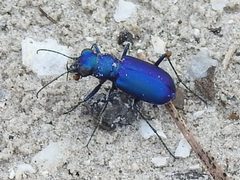
Cicindela scutellaris rugata is a geographically restricted of the Festive Tiger Beetle to northeastern Texas and adjacent regions. exhibit striking solid blue to blue-green metallic coloration without elytral maculations. The subspecies is distinguished from related forms by its more wrinkled pronotum and smoother surface. It inhabits deep, dry sand in open post oak woodland and sandy areas, often found in association with C. formosa pigmentosignata. Like other C. scutellaris subspecies, it exhibits a spring-fall with adults active during cooler periods and seeking from midday heat.
Pronunciation
How to pronounce Cicindela scutellaris rugata: //sɪˈsɪndɪlə ˌskjuːtəˈlɛərɪs ruːˈɡeɪtə//
These audio files are automatically generated. While they are not always 100% accurate, they are a good starting point.
Identification
Distinguished from C. s. unicolor (southeastern U.S.) by more wrinkled pronotum and smoother —C. s. unicolor has smoother pronotum and more wrinkled head. Separated from C. s. flavoviridis (west Texas) by darker blue-green versus yellow-green elytral coloration; both share similar pronotal sculpturing. Differs from C. sexguttata by more robust body with less tapered , and by coloration: C. s. rugata males have white labrum and females dark/black labrum, while both sexes of C. sexguttata have whitish labrum.
Images
Habitat
Deep, dry sand fully exposed to sun without standing water. Occurs in open post oak woodland with sandy substrate, sand bars along creeks, blowouts, dunes, and sparsely vegetated sandy areas. Frequently found in lightly managed rural cemeteries on deep sandy soils characteristic of the northern Texas Post Oak Savannah ecoregion.
Distribution
to northeastern Texas (Henderson, Van Zandt, and adjacent counties) and possibly neighboring areas of Arkansas and Louisiana. Records from the Post Oak Savannah transitional ecoregion.
Seasonality
Spring-fall activity pattern: emerge in fall as sexually , overwinter in burrows, and re-emerge in spring to mate and oviposit. Most active during late morning hours; adults retreat to burrows during afternoon heat. Peak activity September–October based on collecting records.
Life Cycle
Larval development occurs in vertical burrows in sandy soil. emerge in fall, pass winter in burrows, and become reproductively active in spring. laid in spring develop through summer as larvae, with preceding fall adult .
Behavior
are fast-running, visually oriented . Exhibit thermoregulatory including stilting (elevating body on long legs) and shade-seeking during hot periods. Adults largely disappear from surface during afternoon, presumably having dug into burrows to escape heat. Rapid escape when disturbed, often alighting facing the threat to reduce profile.
Ecological Role
of small including ants in sandy open . Larvae are sedentary ambush predators in soil burrows. Co-occurs with and may experience competition or pressure from the larger C. formosa pigmentosignata; temporal separation noted with C. scutellaris occurring slightly earlier in spring and later in fall than C. formosa.
Human Relevance
Subject of interest to entomologists and tiger collectors due to restricted range and distinctive appearance. status potentially vulnerable due to specificity and limited distribution.
Similar Taxa
- Cicindela scutellaris unicolorShiny blue-green without maculations, but has smoother pronotum and more wrinkled ; separated by Mississippi River floodplain
- Cicindela scutellaris flavoviridisShares wrinkled pronotum and smoother but has yellow-green rather than blue-green ; occurs west of C. s. rugata range
- Cicindela sexguttata green forms can appear similar, but less robust with more tapered and different coloration in both sexes
- Cicindela formosa pigmentosignataFrequently co-occurs in same ; larger with reddish-purple and blue-green legs/sides
Sources and further reading
- BugGuide
- GBIF taxonomy match
- iNaturalist taxon
- NCBI Taxonomy
- Catalogue of Life
- Cicindela scutellaris rugata (the “wrinkled tiger beetle”) | Beetles In The Bush
- Cicindela formosa pigmentosignata (the “reddish-green sand tiger beetle”) | Beetles In The Bush
- Coleoptera | Beetles In The Bush | Page 8
- Hymenoptera | Beetles In The Bush | Page 4
- Tigers along the Potomac: Bronzed Tiger Beetle, Cicindela repanda repanda — Bug of the Week
- Bug Eric: Springtime Tiger Beetles