
Cicindela scutellaris flavoviridis
Vaurie, 1950
Chartreuse Tiger Beetle
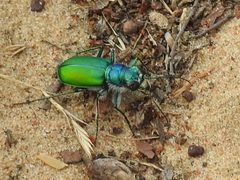
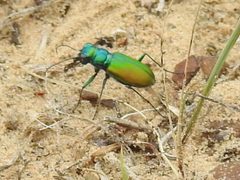
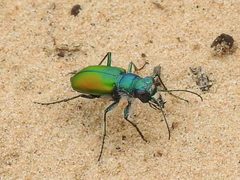
Cicindela scutellaris flavoviridis, commonly known as the Chartreuse Tiger , is a distinctive of the Festive Tiger Beetle to north-central to central Texas. It is characterized by its striking metallic greenish-yellow (chartreuse) coloration with typically , lacking the maculations common in other subspecies. This subspecies occupies deep, dry sand including creek sandbars, dunes, and road cuts. It was described by Vaurie in 1950 and is considered intermediate in between the blue-green C. s. rugata to the east and the more coppery nominate C. scutellaris to the north, with minimal intergradation at range boundaries.
Pronunciation
How to pronounce Cicindela scutellaris flavoviridis: //ˌsɪsɪnˈdiːlə ˌskjuːtɛˈlɛɹɪs ˌfleɪvoʊˈvɪrɪdɪs//
These audio files are automatically generated. While they are not always 100% accurate, they are a good starting point.
Identification
Distinguished from all other C. scutellaris by its unique chartreuse coloration. C. s. rugata to the east is solid blue-green; C. s. unicolor in the southeastern U.S. is also blue-green but with smoother pronotum and more wrinkled ; nominate C. s. scutellaris has coppery-red reflections and more pronounced maculations. Can be confused with forms of C. sexguttata (Six-spotted Tiger ), but that is less robust with more tapered , and both sexes have whitish . The combination of chartreuse color, wrinkled pronotum, smooth head, and sex-limited labrum coloration distinguishes C. s. flavoviridis.
Images
Appearance
exhibit a brilliant metallic greenish-yellow to chartreuse coloration, often described as the most stunning shade of yellow-green among tiger beetles. The are typically , though occasionally display two tiny ivory white spots along the outer edge. The pronotum is more wrinkled and the smoother compared to other C. scutellaris . Males possess a white ; females have a dark to black labrum. The body is robust with a somewhat tapered . Like other tiger beetles, they possess large , long slender legs adapted for rapid running, and prominent sickle-shaped .
Habitat
Deep, dry sand fully exposed to sun and lacking standing water. Specific microhabitats include sandbars along creeks and rivers, dune systems, blowouts, road cuts, and open sandy areas in post oak savanna. Occupies early successional sand deposits where vegetation is sparse to moderately developed. In the type locality area (Cobb Hollow, Montague County, Texas), occurs on deep sand bars alongside small creeks, particularly in localized dry sand areas within broader sandy corridors.
Distribution
to Texas. Occurs in a narrow band from north-central Texas south to central Texas. Northern limit near Forestburg/Montague County area; southern extent in central Texas. Does not intergrade with C. s. rugata to the east; minimal intergradation with C. s. lecontei to the north at range boundaries. Observations concentrated in Montague, Cooke, Denton, Tarrant, and surrounding counties.
Seasonality
Spring-fall with bimodal activity pattern. Adults emerge in fall (September-October), pass winter in burrows, and re-emerge in spring for mating and oviposition. Peak activity in late morning hours; adults retreat to burrows during midday heat. Activity ceases by late afternoon. Specific timing dependent on rainfall patterns and temperature; early season emergence may be delayed in dry years.
Diet
Visual of small including ants and other arthropods. Pursues prey using rapid running interrupted by brief stops to re-focus vision.
Life Cycle
Complete with spring-fall . Sexually emerge in fall, enter in burrows through winter, and emerge in spring reproductively mature. Mating occurs in spring; females oviposit in burrows excavated in sandy substrate. Larvae develop through three instars, each occupying a vertical burrow from which they ambush passing prey. occurs in burrow; summer months spent as larvae and pupae. New adults emerge in fall to complete cycle.
Behavior
utilizing rapid locomotion and excellent vision to detect and pursue prey. Characteristic hunting involves running toward detected movement, stopping to re-focus when prey is lost visually, then resuming pursuit. exhibit thermoregulatory behaviors including stilting (elevating body on long legs to reduce heat absorption) and shade-seeking during peak temperatures. When disturbed, adults make short, looping escape ending with characteristic bounce and tumble landing, immediately resuming running. Burrow-digging behavior for overnight and midday ; adults may dig in rapidly when threatened. Males use toothed to grip female pronotum notches during mating.
Ecological Role
Apex in open sand ; regulates of small arthropods. Larval burrows contribute to soil aeration and nutrient cycling in sandy substrates. Serves as prey for vertebrate predators including birds and lizards. Presence indicates intact, early successional sand habitats with minimal disturbance.
Human Relevance
Subject of ecological and taxonomic research due to restricted range and distinctive . Popular target among tiger collectors and photographers for its striking coloration. for conservation of sand prairie and dune in Texas. No direct economic importance; occasionally encountered in rural cemeteries and sand borrow pits.
Similar Taxa
- Cicindela scutellaris rugataOverlaps in Texas Post Oak Savannah region but distinguished by solid blue-green coloration versus chartreuse; similar wrinkled pronotum and smooth
- Cicindela scutellaris unicolorSoutheastern U.S. with blue-green color; differs in smoother pronotum and more wrinkled
- Cicindela sexguttata forms can resemble C. s. flavoviridis but less robust, more tapered , and both sexes have whitish
- Cicindela scutellaris leconteiNorthern showing minimal intergradation; more coppery-red reflections and pronounced maculations
More Details
Type Locality
Forestburg area, Montague County, Texas; specifically Cobb Hollow, a tributary of the Red River
Conservation Status
Not formally listed; vulnerable to revegetation, , and sand mining. localized and spotty even within suitable habitat.
Etymology
Subspecific epithet 'flavoviridis' from Latin flavus (yellow) and viridis (green), referring to the distinctive chartreuse coloration
Taxonomic History
Described by Patricia Vaurie in 1950 as one of four new ; regarded as intermediate between C. s. rugata and C. s. scutellaris but more closely related to latter based on shared yellow/coppery elytral reflections
Sources and further reading
- BugGuide
- GBIF taxonomy match
- iNaturalist taxon
- NCBI Taxonomy
- Catalogue of Life
- Coleoptera | Beetles In The Bush | Page 8
- Archives | Beetles In The Bush
- Cicindelidae | Beetles In The Bush | Page 2
- Hymenoptera | Beetles In The Bush | Page 4
- Texas | Beetles In The Bush | Page 2
- Bug Eric: Springtime Tiger Beetles