
Cicindela scutellaris lecontei
Haldeman, 1853
LeConte's Tiger Beetle, Festive Tiger Beetle
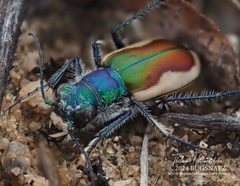
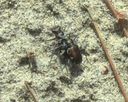
Cicindela scutellaris lecontei is a of festive tiger beetle distributed across the Midwest and northeastern United States. It occupies deep, dry sand without standing water, often co-occurring with Cicindela formosa. This subspecies is characterized by uniform dull maroon to olive green coloration with continuous to near-continuous ivory-colored marginal elytral markings. It intergrades with subspecies unicolor along a broad zone in the upper Mississippi River region and southeastern Missouri.
Pronunciation
How to pronounce Cicindela scutellaris lecontei: /sɪˈsɪndɛlə skuːtəˈlɛərɪs lɛˈkɒntaɪ/
These audio files are automatically generated. While they are not always 100% accurate, they are a good starting point.
Identification
Distinguished from Cicindela sexguttata by more noticeably domed elytral profile, rounded elytral apex, and dark of female (both sexes of C. sexguttata have white labrum). Differs from unicolor by presence of continuous to near-continuous ivory marginal elytral markings and duller maroon-olive coloration rather than uniform shiny blue-green. Intergrade individuals in southeastern Missouri show variable development of white maculations ranging from absent to well-developed "C"-shaped marks.
Images
Habitat
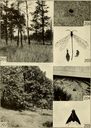
Deep, dry sand without standing water. Occupies sand barrens, sand prairies, and erosional sand ridges. In Missouri, found on Crowley's Ridge, Sikeston Sand Ridge, and other Tertiary sand deposits.
Distribution
Midwestern and northeastern United States. Recorded from northern Missouri along the Missouri and Mississippi Rivers, with extending northward and eastward. Intergrades with unicolor in southeastern Missouri and along upper Mississippi River region.
Similar Taxa
- Cicindela sexguttataSimilar bright green coloration and white maculations, but distinguished by less domed , tapered elytral apex, and white in both sexes.
- Cicindela scutellaris unicolorIntergrades with lecontei; unicolor typically uniform shiny blue-green without marginal maculations, while lecontei shows dull maroon-olive coloration with continuous ivory marginal markings.
- Cicindela scutellaris rugifronsSimilar appearance with bright green coloration and white maculations, but rugifrons restricted to northern Atlantic seaboard and not sympatric with lecontei.
- Cicindela formosaFrequently co-occurs in same dry sand ; larger size distinguishes it from C. scutellaris.
More Details
Subspecific Intergradation
A broad zone of intergradation between lecontei and nominotypical scutellaris occurs along the upper Missouri River. Intergrades between lecontei and unicolor were previously thought restricted to northern Mississippi and Tennessee, but in southeastern Missouri demonstrate this zone extends further north than previously recognized.
Missouri Distribution Gap
Despite suitable dry sand and presence of Cicindela formosa in central and east-central Missouri, C. scutellaris has not been recorded from this 400-mile gap between northern and southeastern Missouri . Reasons for this distributional discontinuity remain unknown.