
Cicindela formosa generosa
Dejean, 1831
Eastern Big Sand Tiger Beetle, Eastern Sand Tiger Beetle
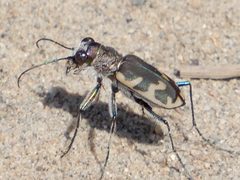
Cicindela formosa generosa, the Eastern Big Sand Tiger Beetle, is a robust, visually striking tiger found in deep, dry sand across the Great Plains and north-central United States. are characterized by dark brown coloration with bold, thick white markings on the that are separate dorsally and joined along the outer edges. The subspecies exhibits distinctive behavioral traits including powerful escape ending in characteristic bounces and tumbles, and a preference for foraging in sparsely vegetated areas rather than completely barren sand. in Missouri sometimes show coppery-red coloration, possibly related to soil chemistry rather than genetic differentiation from the western nominotypical subspecies.

Pronunciation
How to pronounce Cicindela formosa generosa: //sɪˈsɪndələ fɔrˈmoʊsə dʒɛˈnɛrəsoʊ//
These audio files are automatically generated. While they are not always 100% accurate, they are a good starting point.
Identification
Distinguished from other tiger beetles by its large size, robust build, and bold white elytral markings on dark brown background. Separated from the western nominotypical C. formosa formosa by darker coloration (brown vs. bright coppery-red) and less violaceous surfaces. Distinguished from sympatric sand-dwelling such as Cicindela scutellaris by body shape and marking pattern; from Ellipsoptera lepida by dark rather than nearly white coloration; and from Cicindela tranquebarica by larger size and more robust build. The characteristic escape ending in a bounce and tumble is behaviorally distinctive.
Images
Appearance
Large, robust tiger with a chunky body and bulging . coloration is predominantly dark brown with thick, bold white markings on the that are separate dorsally but joined along the outer edges. The white markings provide excellent camouflage against textured sandy substrates. Missouri often show variable suffusion of bright coppery-red coloration, particularly on the eastern side of the state. surfaces are less violaceous than the western nominotypical . are among the largest tiger beetles in their range, with long legs adapted for rapid running.
Habitat
Deep, dry sand including riverine sand deposits, sand prairies, and alluvial sand ridges. In Missouri, occurs along the Missouri and Mississippi Rivers and their larger tributaries, as well as in extensive sand ridges in the southeastern lowlands. Requires sand sufficiently dry and deep to remain loose, typically with low organic content. frequently forage in sparsely vegetated areas surrounding open sand, using vegetation for shade during hot periods. Habitat is ephemeral and vulnerable to revegetation, , and agricultural conversion.
Distribution
Great Plains and north-central United States, extending sporadically into the northeastern U.S. and Canada. Core distribution includes the Midwest, with records from Missouri, Iowa, Illinois, Indiana, Ohio, and surrounding states. In Missouri, found along major river systems and in southeastern sand prairie remnants. The represents the eastern portion of the C. formosa complex, with intergradation or intermediate forms suggested in some areas.
Seasonality
active during warmer months; specific not detailed in sources but typical for temperate tiger beetles with spring through fall activity depending on latitude and local conditions. Activity curtailed by unseasonably warm and humid conditions.
Diet
Predatory, feeding on small arthropods. have been observed capturing prey items including caterpillars offered in captivity. Foraging occurs primarily in sparsely vegetated areas where prey encounter rates are presumably higher than on completely barren sand.
Life Cycle
Complete with , larval, pupal, and stages. Larval not specifically documented for this , but tiger larvae typically construct vertical burrows in soil. Specific developmental timing and stage not detailed in available sources.
Behavior
are wary and exhibit powerful escape when disturbed, flying 20 yards or more and landing with a characteristic bounce and tumble, then immediately facing the pursuer. When approached slowly, adults may resume normal including foraging and thermoregulatory stilting (standing on tiptoe to elevate body above hot sand surface). Adults actively seek shade in vegetation during hottest parts of day. In captivity, individuals have been maintained for at least 10 weeks and will readily seize prey from forceps.
Ecological Role
Apex in dry sand microhabitats, regulating of small arthropods. Serves as prey for larger predators including birds and mammals; remains identifiable in predator scat. Presence indicates intact, deep sand with low organic content. Population persistence depends on habitat patches of sufficient size and connectivity to allow recolonization as local habitat patches succeed or are disturbed.
Human Relevance
Subject of entomological study and nature photography; one photograph of this was selected for the 2013 Entomological Society of America World of Insects Calendar. are threatened by loss due to agricultural conversion, river channelization, levee construction, and natural . Conservation depends on protection of remnant sand prairie habitats, some of which occur on public conservation areas. The ' fidelity to specific habitat conditions makes it a useful indicator of intact sand prairie .
Similar Taxa
- Cicindela formosa formosaWestern nominotypical distinguished by bright coppery-red coloration and more violaceous surfaces; intergrades or intermediate forms may occur in some areas
- Cicindela scutellarisSympatric sand-dwelling tiger with different body shape and elytral markings; generally smaller and with different color pattern
- Ellipsoptera lepidaGhost tiger beetle found in similar deep sand but with nearly pure white coloration and more elongate body form
- Cicindela tranquebaricaOblique-lined tiger beetle is smaller, less robust, and more , occurring on wet sand, mud, clay, and concrete as well as dry sand
Misconceptions
are often presumed to prefer completely barren sand areas because most photographs and collections occur there; however, they actually spend more time foraging in sparsely vegetated surrounding areas, fleeing to open sand only when disturbed by observers.
More Details
Color variation and subspecies validity
The subspecific distinction between dark brown generosa and coppery-red nominotypical formosa has been questioned; some observers suggest color differences may reflect soil chemistry (pH) rather than genetic divergence, noting that Missouri on anthropogenic alkaline sand flats show redder coloration and that the are robust fliers capable of long-distance
Photographic recognition
A 2012 photograph by Ted C. MacRae was selected for the ESA 2013 World of Insects Calendar, recognized for its composition showing and depth with context
Sources and further reading
- BugGuide
- GBIF taxonomy match
- iNaturalist taxon
- NCBI Taxonomy
- Catalogue of Life
- Big, Bold and Beautiful—Redux | Beetles In The Bush
- You messin’ with me? | Beetles In The Bush
- Big, Bold, and Beautiful | Beetles In The Bush
- And the winner is… | Beetles In The Bush
- Cicindelidae | Beetles In The Bush | Page 4
- August | 2017 | Beetles In The Bush