
Scaphinotus ventricosus
(Dejean, 1831)
potbellied snail-eating beetle, pot-bellied snail-eating beetle
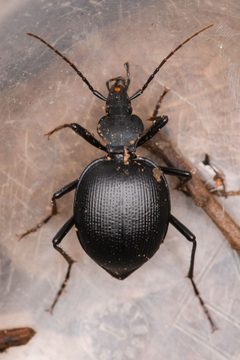
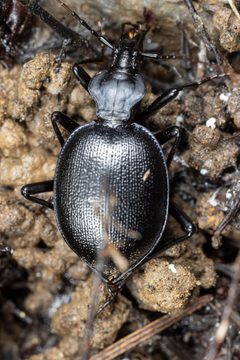
Scaphinotus ventricosus is a of ground beetle in the Carabidae, commonly known as the potbellied snail-eating . It is native to western North America, with documented occurrence in California and Oregon. are distinctive among ground beetles for their brachypterous (short-winged) condition, which renders them flightless. The species exhibits gregarious and . It inhabits deciduous forests and poison-oak thickets, where it presumably feeds on snails as suggested by its and the feeding habits of related species in the .
Pronunciation
How to pronounce Scaphinotus ventricosus: /ˌskæfɪˈnoʊtəs vɛnˈtrɪkoʊsəs/
These audio files are automatically generated. While they are not always 100% accurate, they are a good starting point.
Identification
The combination of brachyptery (short, non-functional wings), robust body with expanded , and occurrence in western North American deciduous forests distinguishes this from most other ground beetles. It can be separated from by geographic range (California and Oregon) and presumably by subtle morphological differences in body proportions and genitalia, though specific diagnostic characters are not detailed in available sources. The 'potbellied snail-eating ' reflects the distinctive abdominal shape.
Images
Appearance
are brachypterous (short-winged), rendering them flightless. The body form is robust with a notably expanded or 'pot-bellied' , reflected in both the specific epithet 'ventricosus' (meaning swollen or distended) and the . As a member of the tribe Cychrini, it likely exhibits the characteristic elongated and adapted for extracting snails from their shells, though specific morphological details for this are not well documented in the provided sources.
Habitat
Deciduous forests and poison-oak thickets in western North America. The is associated with forested environments that provide cover and presumably support of snails, its likely prey.
Distribution
North America: documented from California and Oregon, USA. The has a restricted western distribution within the Pacific coastal region.
Diet
Presumed to feed on snails, based on the and the known feeding of the Scaphinotus, which specializes on molluscan prey. However, direct observation of feeding for this specific is not documented in the provided sources.
Behavior
are gregarious and . The brachypterous condition renders adults flightless, restricting to .
Ecological Role
As a probable of snails, this likely functions as a agent for molluscan in its forest . The Scaphinotus is notable among ground beetles for this specialized feeding .
Similar Taxa
- Other Scaphinotus species share the characteristic elongated and adapted for snail , and many are also brachypterous. Geographic separation is the primary means of distinguishing S. ventricosus from eastern North American such as S. angusticollis and S. elevatus.
- Cychrus speciesMembers of the related Cychrus also exhibit elongated and and are snail , but differ in body form (typically more cylindrical and less 'pot-bellied') and usually have fully developed wings.
More Details
Taxonomic placement
The is classified in the tribe Cychrini within the Carabinae, a group of large ground beetles that includes the 'caterpillar hunters' (Calosoma) and 'snail hunters' (Scaphinotus, Cychrus). Molecular data suggest that this group is closely related to tiger beetles (Cicindelinae).
Wing reduction
The brachypterous condition in S. ventricosus represents an evolutionary reduction in wing size that has occurred independently in multiple lineages of ground beetles. This trait is associated with stable, long-occupied where is unnecessary for , and may correlate with the ' gregarious and specific habitat requirements.
Sources and further reading
- BugGuide
- Wikipedia
- GBIF taxonomy match
- iNaturalist taxon
- NCBI Taxonomy
- Misleading morphology: three European parasitoid wasp “species” are seasonal forms of just one | Blog
- Bug Eric: Wasp Wednesday: Symmorphus
- November | 2012 | Beetles In The Bush | Page 2
- conservation | Beetles In The Bush
- Carabidae | Beetles In The Bush