
Scaphinotus
Dejean, 1826
Snail-eating Beetles
Species Guides
51- Scaphinotus aeneicollis(Coppery-collared Snail-eating Beetle)
- Scaphinotus andrewsii(Andrew's Snail-eating Beetle)
- Scaphinotus angulatus(Angular Snail-eating Beetle)
- Scaphinotus angusticollis(Narrow-collared Snail-eating Beetle)
- Scaphinotus behrensi(Behrens' Snail-eating Beetle)
- Scaphinotus bilobus(Bilobed Snail-eating Beetle)
- Scaphinotus bullatus(Inflated Snail-eating Beetle)
- Scaphinotus cavicollis(Concave-collared Snail-eating Beetle)
- Scaphinotus cordatus(Heart-shaped Thorax Snail-eating Beetle)
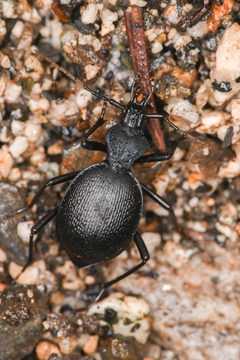
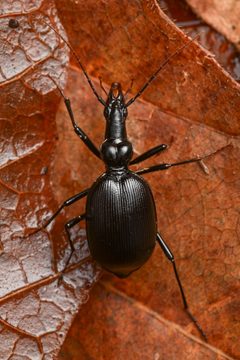
Scaphinotus is a of flightless ground beetles in the Carabidae, comprising approximately 55-60 native exclusively to North America. These beetles are specialized snail , with their distribution and use tightly linked to moist environments where their gastropod prey occur. The genus is notable for its large body size among carabids (typically 15-25 mm), elongated adapted for extracting snails from shells, and complete absence of capability due to reduced hindwings. Research on Scaphinotus angusticollis in managed forests of British Columbia indicates that 30-meter riparian reserves effectively maintain sizes and movement patterns comparable to unharvested forests.
Pronunciation
How to pronounce Scaphinotus: /skæfɪˈnoʊtəs/
These audio files are automatically generated. While they are not always 100% accurate, they are a good starting point.
Identification
Scaphinotus can be distinguished from other large carabid beetles by the combination of: (1) greatly elongated, slender (much longer than in related like Calosoma or Carabus), (2) complete flightlessness with reduced or absent hindwings, (3) association with moist forest , and (4) exclusively North American distribution. Within Carabidae, the genus belongs to the tribe Cychrini, which includes other snail-predating beetles, but Scaphinotus is distinguished by its larger size and more elongate mandibular structure compared to Cychrus. -level identification requires examination of male genitalia and subtle differences in elytral microsculpture and body proportions.
Images
Habitat
Moist coniferous and mixed forests, particularly in riparian zones and areas with high humidity. Strongly associated with supporting terrestrial snail : forest floors with abundant leaf litter, decaying logs, mossy rocks, and seeps. Research on S. angusticollis demonstrates that 30-meter riparian reserves in managed forests support populations comparable to unharvested forests, while clearcut areas show approximately 50% lower abundance. Beetles move twice as far in reserve habitats compared to clearcuts, suggesting differential perception of habitat quality.
Distribution
Exclusive to North America, with distributed across the continent from southern Canada through the United States. Center of diversity appears to be in western North America, particularly in the Pacific Northwest and montane regions. Individual species have more restricted ranges, often associated with specific mountain ranges or forest types.
Seasonality
are active primarily during the warmer months, with peak activity varying by latitude and elevation. In temperate regions, most active from late spring through early autumn. Some may be active year-round in mild coastal climates. Larval development occurs in soil or within decaying wood, with typically in late summer or autumn.
Diet
Specialized of terrestrial gastropods (snails and slugs). The elongated are adapted for reaching into snail shells to extract the soft body. May occasionally consume other soft-bodied , but molluscs constitute the primary food source. Prey size appears correlated with size, with larger Scaphinotus taking correspondingly larger snails.
Life Cycle
Complete with , larva, pupa, and stages. Eggs are laid in soil or under debris on the forest floor. Larvae are predatory, likely feeding on smaller snails or other . Development includes three larval instars. occurs in earthen or within decaying wood. time varies by and climate, with most likely requiring 1-2 years to complete development. Adults are long-lived and may survive multiple seasons.
Behavior
Strictly ground-dwelling and flightless, relying on rapid running for and prey capture. Primarily , spending daylight hours under cover of leaf litter, logs, or rocks. When disturbed, may assume defensive postures but generally rely on speed to escape. Movement patterns differ by type: individuals in riparian reserves move twice as far as those in clearcut habitats, suggesting active habitat assessment and preference for forested conditions. Not known to climb vegetation. patterns unknown but likely influenced by localized snail abundance.
Ecological Role
regulating terrestrial snail in forest . As a large, abundant carabid, contributes to nutrient cycling through and carcass processing. Serves as prey for larger vertebrates including birds, small mammals, and amphibians. Flightless condition makes populations sensitive to fragmentation and forest management practices. for intact, moist forest habitats with healthy mollusc .
Human Relevance
No direct economic importance. Occasionally encountered by foresters and researchers as an indicator of intact riparian . Presence in managed forests has been used to assess effectiveness of riparian reserve buffers. Not considered a pest. Of interest to coleopterists due to specialized and restricted distribution.
Similar Taxa
- CychrusAlso in tribe Cychrini and specialized snail , but smaller with shorter, less elongate and generally more rounded body form. Some Cychrus have wings and can fly.
- CalosomaLarge carabids in same Carabinae, but with shorter, more robust adapted for caterpillar rather than snail extraction. Most Calosoma are winged and capable of .
- CarabusLarge ground beetles with generalized predatory habits, shorter , and typically winged condition. Lack the extreme mandibular elongation and strict association with moist seen in Scaphinotus.
More Details
Conservation relevance
Research on Scaphinotus angusticollis in southwestern British Columbia demonstrates that 30-meter riparian reserves in managed coniferous forests effectively maintain at levels comparable to unharvested forests, with movement patterns also similar to natural conditions. This provides evidence that riparian buffer widths of this magnitude are sufficient for conserving this and potentially other flightless forest floor arthropods.
Morphological specialization
The extreme mandibular elongation in Scaphinotus represents one of the most specialized feeding adaptations among ground beetles, convergent with but more extreme than the condition in related Cychrus. This allows extraction of snails too deep in their shells for other to reach, effectively partitioning the predatory .
Flightlessness and distribution
Complete flightlessness in all Scaphinotus has likely contributed to their pattern across North America, with many species having restricted ranges in specific mountain ranges or forest regions. This also makes them particularly vulnerable to fragmentation and climate-driven range shifts.
Sources and further reading
- BugGuide
- Wikipedia
- iNaturalist taxon
- NCBI Taxonomy
- Catalogue of Life
- November | 2012 | Beetles In The Bush | Page 2
- Black is beautiful! | Beetles In The Bush
- Carabidae | Beetles In The Bush
- Relative abundance and movement of the carabid beetle Scaphinotus angusticollis in managed coniferous riparian forests of southwestern British Columbia