
Cychrus
Fabricius, 1794
Species Guides
2- Cychrus hemphillii(Hemphill's rare snail-eating beetle)
- Cychrus tuberculatus(tuberculate rare snail-eating beetle)
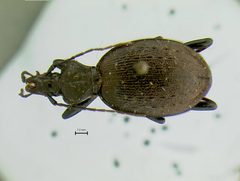
Cychrus is a large of ground beetles in the Carabidae, comprising at least 160 described worldwide. The genus is notable for its specialized snail-eating habits, with elongated and mandibular structures adapted for extracting prey from shells. More than 80% of species occur in China, with additional diversity across Europe and Asia. Members are characterized by their large size (typically 15–25 mm), elongated body form, and distinctive sculptured .
Pronunciation
How to pronounce Cychrus: /ˈsaɪkrəs/
These audio files are automatically generated. While they are not always 100% accurate, they are a good starting point.
Images
Distribution
Worldwide distribution with strong concentration in China (>80% of ); also occurs in Europe and Asia. Specific distribution records include Denmark (DK), Norway (NO), Sweden (SE), and Shennongjia Nature Reserve in Hubei Province, China where two species were recorded at elevations between 1500–2500 m.
Diet
Specialized snail-eating beetles; diet consists of terrestrial snails and other mollusks. The elongated and mandibular structures are morphological adaptations for extracting prey from shells.
Life Cycle
Complete with , larva, pupa, and stages. Pre-imaginal stages described for some including C. schmidti and C. semigranosus. C. schmidti larvae exhibit unique chaetotaxy with long setae covering thoracic and abdominal tergites, unlike other Cychrus species which have completely glabrous tergites.
Behavior
Defensive documented in C. caraboides include stridulation (sound production via elytro-abdominal mechanism), tucking the under the pronotum, arching the body, and spraying defensive secretions from pygidial glands. Stridulation occurs when restrained or attacked and likely functions as an aposematic acoustic warning to vertebrate , covering frequencies from audible to approximately 80 kHz.
Ecological Role
Predatory beetles specializing in mollusk consumption; likely contribute to regulation of terrestrial snail in forest and meadow .
Similar Taxa
- CarabusBoth are large ground beetles in Carabinae, but Carabus are with more robust body forms and lack the extreme elongation and specialized mandibular structures for snail seen in Cychrus.
- CalosomaBoth belong to Carabinae and share large size and predatory habits, but Calosoma are caterpillar hunters with different body proportions and mandibular ; they lack the specialized snail-feeding adaptations of Cychrus.
More Details
Taxonomic position
Molecular data suggest tiger beetles (Cicindelinae) are nested within Carabinae, making Cychrus and related phylogenetically close to tiger beetles despite different ecological specializations.
Morphological specialization
The exhibits extreme morphological for mycophagy (snail-eating), including elongated capsule and slender, curved capable of reaching into snail shells to extract soft tissues.
Sources and further reading
- BugGuide
- Wikipedia
- GBIF taxonomy match
- iNaturalist taxon
- NCBI Taxonomy
- Catalogue of Life
- November | 2012 | Beetles In The Bush | Page 2
- Black is beautiful! | Beetles In The Bush
- Carabidae | Beetles In The Bush
- Pre-imaginal stages of Cychrus schmidti Chaudoir, 1837, and Cychrus semigranosus Palliardi, 1825, with a key to the larvae of the European Cychrus species (Coleoptera: Carabidae)
- Stridulation and defensive behaviour in the ground beetle, Cychrus caraboides (L.)
- Habitat distribution and species diversity of Carabus and Cychrus in She nnongjia Nature Reserve, Hubei Province