
Scaphinotus bilobus
(Say, 1823)
Bilobed Snail-eating Beetle
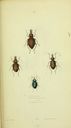
Scaphinotus bilobus, commonly known as the bilobed snail-eating , is a of ground beetle in the Carabidae. It is a brachypterous (short-winged), specialized in feeding on snails. The species occurs across a broad swath of North America, ranging from eastern Canada through the Great Lakes region and into the north-central United States.
Pronunciation
How to pronounce Scaphinotus bilobus: //ˌskæfɪˈnoʊtəs baɪˈloʊbəs//
These audio files are automatically generated. While they are not always 100% accurate, they are a good starting point.
Identification
Can be distinguished from other ground beetles by the combination of brachypterous condition, habits, and association with snail prey. Within the Scaphinotus, identification to level requires examination of genitalic structures and other subtle morphological characters. The species name 'bilobus' suggests a bilobed or two-lobed characteristic that may aid in separation from .
Images
Habitat
Inhabits coniferous and mixed forests, often found along rivers and lakes. The shows preference for moist woodland environments where snails are abundant.
Distribution
North America: Canada (Manitoba, New Brunswick, Nova Scotia, Ontario, Quebec); United States (Illinois, Kansas, Massachusetts, Maine, Michigan, Minnesota, Missouri, Nebraska, New Hampshire, New York, Ohio, Vermont, Wisconsin). The distribution spans the northeastern and north-central United States and adjacent Canadian provinces.
Seasonality
are active nocturnally. Specific seasonal activity patterns are not well-documented, but activity likely corresponds with favorable temperature and moisture conditions for both activity and snail prey availability.
Diet
Preys on snails. The is a specialized molluscivore, using its robust to crush snail shells and extract the soft body.
Behavior
in habit. are flightless due to brachypterous condition, limiting to . The actively hunts snails during nighttime hours.
Ecological Role
in forest floor , specializing in gastropod control. As a snail predator, it may influence local mollusk and serve as a food source for larger predators.
Human Relevance
No significant documented interactions with humans. Not considered a pest . Potential interest for natural history observation and research given its specialized predatory habits.
Similar Taxa
- Other Scaphinotus speciesSimilar and ; require detailed examination for separation
- Cychrus speciesRelated snail-hunting ground beetles with similar mandibular specializations
- Calosoma speciesLarge ground beetles in same but with different prey preferences and typically fully winged
More Details
Taxonomic history
Originally described as Cychrus bilobus by Say in 1823, later transferred to Scaphinotus. The Scaphinotus is part of the tribe Cychrini, a group of specialized snail and slug within the Carabinae.
Conservation status
Not formally assessed; appears to have stable across broad geographic range based on distribution records.
Collection records
iNaturalist shows 6 observations, suggesting it is not frequently encountered or reported by citizen scientists, possibly due to habits and forested preferences.