
Uropygi
Thorell, 1883
whip scorpions, vinegaroons, uropygids
Family Guides
1- Thelyphonidae(whipscorpions)
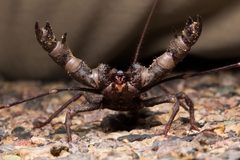
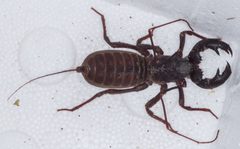
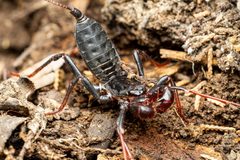
Uropygi is an order of arachnids commonly known as whip scorpions or vinegaroons, characterized by a whip-like on the end and large -like . They lack venom glands but possess defensive glands capable of spraying acetic and caprylic acid, producing a vinegar-like odor. These use only six legs for , with the first two pairs modified as sensory appendages. The order comprises approximately 100 across 18 extant , all placed in the single Thelyphonidae.
Pronunciation
How to pronounce Uropygi: /ˌjuːroʊˈpaɪdʒiː/
These audio files are automatically generated. While they are not always 100% accurate, they are a good starting point.
Identification
Distinguished from true scorpions (Scorpiones) by the absence of a stinger and venom glands, and by the presence of a slender whip-like rather than a segmented tail with terminal stinger. Distinguished from whip spiders (Amblypygi) by the presence of the tail-like flagellum (Amblypygi are "tailless"). Distinguished from Schizomida (short-tailed whipscorpions) by flagellum length and body proportions; Schizomida have a much shorter flagellum and smaller body size. The vinegar-like defensive spray is diagnostic when observed.
Images
Appearance
Body length ranges from 25–85 mm, with most under 30 mm; the largest species, Mastigoproctus, reaches 85 mm. The opisthosoma consists of 12 segments: the first forms a , the next eight have tergites, and the last three are into a ending in a of 30–40 units. Large -like bear an additional prominent spine on each palpal tibia. One pair of is positioned at the front of the , with up to five pairs of lateral eyes on each side. The first two leg pairs are elongated and function as -like sensory organs, leaving six legs for locomotion.
Habitat
Primarily inhabit tropical and subtropical regions, favoring humid, dark microhabitats under logs, rotting wood, rocks, and natural debris. Most dig burrows using their . Some species, such as Mastigoproctus giganteus, occupy more arid environments including hard adobe soils in Arizona and New Mexico, where they utilize shelter sites in soil cracks and rodent burrows.
Distribution
Found in tropical and subtropical areas worldwide, excluding Europe and Australia. In the Americas, ranging from the southern United States through Central and South America. In Asia, distributed from India through Southeast Asia to Japan. Present in the Caribbean. Only a single African is known: Etienneus africanus, to Senegal, The Gambia, and Guinea-Bissau, considered a probable Gondwana relict.
Diet
, feeding primarily on insects, millipedes, scorpions, and terrestrial isopods. Occasionally consume worms and slugs. The giant whip scorpion Mastigoproctus giganteus has been observed preying on small vertebrates. Prey is captured and crushed using specialized teeth on the inner surfaces of on the front appendages.
Life Cycle
Postembryonic development consists of four nymphal stages, with molting occurring approximately once per year. Development to maturity requires approximately four years. The stage does not again. Females extrude up to 40 within a membranous broodsac attached to the genital and fifth opisthosomal segment. During the several-month , the female fasts and arches her opisthosoma upward to prevent broodsac contact with the substrate. Eggs develop into postembryos with visible appendages, then hatch into white young that climb onto the mother's back and attach with specialized suckers. After the first molt, when they resemble miniature adults with bright red palps, young disperse from the maternal burrow. Females may survive up to two additional years after offspring departure. Total adult lifespan reaches up to four years.
Behavior
Strictly , avoiding light. Construct and occupy burrows, transporting prey to these shelters. When threatened, discharge a defensive spray containing acetic acid and caprylic acid from glands near the rear of the , producing a strong vinegar-like odor. Courtship involves complex tactile interactions: males grasp the female's antenniform legs with their , followed by a "mating parade" in which the male deposits a on the substrate and maneuvers the female over it. Males of some use their to push spermatophore components into the female . Multiple sequential matings have been documented in some .
Ecological Role
of soil and litter arthropods, potentially influencing of insects, millipedes, and other in their . Their burrowing activity may contribute to soil aeration and nutrient mixing in tropical and subtropical .
Human Relevance
Occasionally kept in the pet trade, where they are valued for their distinctive appearance and relatively manageable care requirements. Defensive spray, while unpleasant, is not medically significant. Misidentification in social media and popular culture has led to exaggerated fear responses; they are harmless to humans. Educational displays in museums and universities utilize live specimens to demonstrate arachnid diversity and defensive adaptations.
Similar Taxa
- Amblypygi (whip spiders/tailless whip scorpions)Similar large and elongated first leg pairs used as sensory appendages, but lack the entirely; more slender body and typically cave or crevice-dwelling.
- Schizomida (short-tailed whipscorpions)Also possess a , but it is much shorter and less conspicuous; body typically smaller and more compact; often treated as a separate order or as Uropygi sensu lato depending on classification system.
- Scorpiones (true scorpions)Similar overall body plan with large and segmented , but possess a venomous stinger on a segmented tail rather than a non-venomous whip-like ; have venom glands and different defensive strategy.
Misconceptions
Despite suggesting otherwise, Uropygi are not scorpions and possess no venom or stinger. The "whip" is a sensory and defensive structure, not a weapon. They are frequently misidentified as spiders or as dangerous animals in viral social media content; they are harmless to humans and their defensive spray, while malodorous, causes no lasting harm.
More Details
Taxonomic nomenclature
The order has two widely used names: Uropygi (Thorell, 1883), meaning "tail rump" in reference to the -bearing , and Thelyphonida, based on Latreille's Thelyphonus. Usage varies: Uropygi sensu stricto excludes Schizomida, while Uropygi sensu lato includes it. Conversely, Thelyphonida may refer to whip scorpions alone or to the broader clade including Schizomida. The three groups—Amblypygi, Uropygi s.s., and Schizomida—form the Pedipalpi and likely diverged in the late Carboniferous.
Spermatophore complexity
Males produce elaborate with two sperm carriers, each consisting of a base, sperm package with and , and conductor. differ in sperm package and transfer mechanics: some have elongate packages emptied by lateral pushing movements, others have compact packages pushed completely into the and emptied by pressing on the genital .
Sources and further reading
- BugGuide
- Wikipedia
- GBIF taxonomy match
- iNaturalist taxon
- NCBI Taxonomy
- Catalogue of Life
- An Introduction to Dragonflies and Spiders | Bug Squad
- Bohart Open House: Dispelling Myths About Spiders | Bug Squad
- Bug Eric: When "Arachtober" Attacks!
- Bug Eric: Another Viral Internet "Monster"
- Paarungsverhalten und Spermatophorenmorphologie bei Geißelskorpionen:Thelyphonellus amazonicus Butler undTypopeltis crucifer Pocock (Arachnida, Uropygi) Mating behaviour and spermatophore morphology in whip scorpions:Thelyphonellus amazonicus butler andTypopeltis crucifer pocock (Arachnida, uropygi)
- MATING AND MATERIAL BEHAVIOUR IN TELYPHONUS CAUDATUS L. (PEDIPALPI, HOLOPELTIDIA, UROPYGI)
- Mating behavior and spermatophore morphology of the whip scorpion Typopeltis dalyi Pocock, 1900 (Uropygi, Thelyphonida)
- Courtship Behaviour and Sperm Transfer in the Giant Whip Scorpion, Mastigoproctus Giganteus (Lucas) (Uropygi, Thelyphonidae)
- TYPES OF SHELTER SITES USED BY THE GIANT WHIPSCORPION MASTIGOPROCTUS GIGANTEUS (ARACHNIDA, UROPYGI) IN A HABITAT CHARACTERIZED BY HARD ADOBE SOILS
- Notes on the life history and reproductive biology of the Giant whip scorpion, Mastigoproctus giganteus (Uropygi, Thelyphonidae) from Florida