
Mastigoproctus giganteus
(Lucas, 1835)
giant whip scorpion, giant vinegaroon, grampus, Texas giant vinegaroon
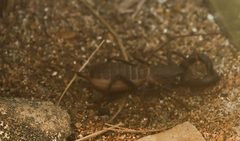
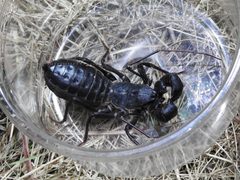
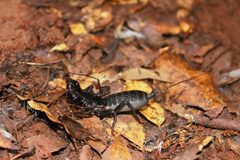
Mastigoproctus giganteus is a large arachnid in the order Uropygi, commonly known as the giant whip scorpion or vinegaroon. It is the only member of Thelyphonidae found in the United States, occurring from the southern U.S. through Mexico. The is and occupies humid microhabitats in arid and semi-arid environments. It is notable for its ability to spray a defensive secretion containing 85% acetic acid, which produces a strong vinegar-like odor. The species is long-lived, with females producing a single of approximately 40 offspring that receive extended maternal care.
Pronunciation
How to pronounce Mastigoproctus giganteus: //ˌmæstɪɡoʊˈprɒktəs ˌdʒɪˈɡæntiəs//
These audio files are automatically generated. While they are not always 100% accurate, they are a good starting point.
Identification
Distinguished from true scorpions by the absence of a stinger and venomous tail; the whip-like is harmless and sensory. Differs from other arachnids by the combination of large and extremely elongated first pair of legs. The only Thelyphonidae in the United States; other whip scorpions in the region belong to different orders (e.g., Amblypygi, the tail-less whip scorpions). The vinegar-like defensive spray is diagnostic when observed.
Images
Habitat
Occupies humid microhabitats within arid and semi-arid regions, including burrows, crevices, and spaces beneath rocks and debris. In hard adobe soils, utilizes pre-existing cracks and shelters rather than excavating burrows. Found at elevations between 1,380–1,800 m in some portions of range. Requires access to moisture to prevent desiccation.
Distribution
Native to southern United States (Arizona, Florida, New Mexico, Oklahoma, Texas) and Mexico. The only of Thelyphonidae occurring in the United States.
Seasonality
activity year-round in suitable conditions; more surface-active following rains. Surface activity reduced during dry periods due to desiccation risk.
Diet
feeding primarily on arthropods including , crickets, millipedes, and other arachnids. Has been recorded consuming small frogs and toads. Uses large to grasp prey while tear and bite.
Life Cycle
Postembryonic development consists of four nymphal stages, with molting occurring approximately once per year; development to maturity requires about four years. do not . Female produces single in lifetime of approximately 40 offspring carried in on surface. Young emerge from brood sac and climb onto mother's dorsum, remaining for extended period with maternal protection and feeding.
Behavior
Strictly that navigates primarily by tactile sensation using antenniform legs, tail, and ; vision is weak. When threatened, sprays defensive secretion containing 85% acetic acid from glands at base of tail. Desiccated individuals exhibit positive response to humid air and burrow into moist substrates against non-horizontal surfaces. Males engage in combat at night for mating access.
Ecological Role
of insects, other arachnids, and small vertebrates; serves as prey for vertebrates including raccoons, coatis, armadillos, skunks, bears, hogs, peccaries, ground birds, lizards, and tarantulas. Intraguild documented with sympatric desert arachnids. Contributes to nutrient cycling through predation on and decomposition of prey remains.
Human Relevance
Considered beneficial in agricultural and residential settings for controlling of stinging scorpions, insects, and spiders. Non-venomous and generally harmless to humans, though defensive spray can irritate mucous , , and open cuts. Popular in pet trade; kept in terrariums with digging substrates and fed insects twice weekly. Handled with care to avoid injury to the arachnid.
Similar Taxa
- Amblypygi (whip spiders/tail-less whip scorpions)Similar elongated antenniform legs but lack the whip-like tail entirely; body more flattened and laterally compressed
- Scorpiones (true scorpions)Possess segmented tail terminating in venomous stinger rather than thin sensory ; typically more slender
- Solifugae (camel spiders/sun spiders)Lack both tail and antenniform legs; possess large and rapid running capability; activity pattern differs
More Details
Water relations
Lacks functional epicuticular wax layer; loses water readily to atmosphere even at high humidity. Behavioral adaptations including activity, humid microhabitat selection, and burrowing compensate for physiological limitations in water conservation.
Reproductive biology
Sperm transfer via complex deposited on substrate; male grasps female antenniform legs with chelae to initiate courtship, followed by vibration, female , and guided passage over spermatophore. Female reproduces once in lifetime, with survivability of young enhanced by extended maternal care.
Sources and further reading
- BugGuide
- Wikipedia
- GBIF taxonomy match
- iNaturalist taxon
- NCBI Taxonomy
- Catalogue of Life
- An Arachnid Kind of Day | Bug Squad
- Hissers: Big, Bold and Beautiful | Bug Squad
- UC Davis Picnic Day: Let's Go on an Insect Scavenger Hunt! | Bug Squad
- Bug Eric: New Mexico Dragonfly Blitz - Day 1
- Bug Eric: April 2010
- Bug Eric: Spider Sunday: Giant Crab Spider
- Courtship Behaviour and Sperm Transfer in the Giant Whip Scorpion, Mastigoproctus Giganteus (Lucas) (Uropygi, Thelyphonidae)
- WATER RELATIONS AND DESICCATION‐AVOIDING BEHAVIOR IN THE VINEGAROON MASTIGOPROCTUS GIGANTEUS (ARACHNIDA: UROPYGI)
- Notes on the life history and reproductive biology of the Giant whip scorpion, Mastigoproctus giganteus (Uropygi, Thelyphonidae) from Florida
- TYPES OF SHELTER SITES USED BY THE GIANT WHIPSCORPION MASTIGOPROCTUS GIGANTEUS (ARACHNIDA, UROPYGI) IN A HABITAT CHARACTERIZED BY HARD ADOBE SOILS
- Microhabitat Utilisation, Diet Composition, Intraguild Predation, and Diel Periodicity in Five Sympatric Species of Desert Arachnids: a Wolf Spider (Hogna carolinensis), Tarantula Spider (Aphonopelma steindachneri), Solifuge (Eremobates palpisetulosus), Giant Whipscorpion (Mastigoproctus giganteus), and Scorpion (Diplocentrus bigbendensis)