
Thelyphonidae
Lucas, 1835
whipscorpions, vinegaroons, whip-scorpions
Genus Guides
1- Mastigoproctus(whip scorpion)
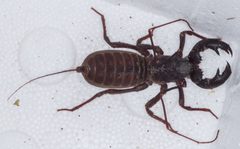
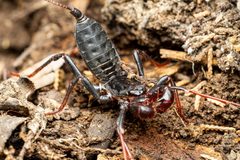
Thelyphonidae is the sole of the arachnid order Uropygi (Thelyphonida), containing approximately 140 described in 25 (16 extant, 9 fossil). Members are commonly known as whipscorpions or vinegaroons due to their whip-like and defensive secretion of acetic acid. The family is divided into four : Hypoctoninae, Mastigoproctinae, Thelyphoninae, and Typopeltinae. Despite their conspicuous appearance and wide tropical distribution, systematic knowledge of the group has advanced slowly.
Pronunciation
How to pronounce Thelyphonidae: //ˌθɛlɪˈfoʊnɪˌdiː//
These audio files are automatically generated. While they are not always 100% accurate, they are a good starting point.
Identification
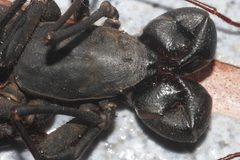
Distinguished from other arachnid orders by the combination of a long, multi-segmented and . Thelyphonidae can be separated from the related order Schizomida (short-tailed whip-scorpions) by flagellum length (long and multi-segmented vs. short and flagelliform). Within the , and are distinguished by characters of pedipalp armature, carination, sternite structure, and female spermathecal .
Images
Habitat
Tropical and subtropical rainforests and savannas. occupy humid microhabitats including leaf litter, soil burrows, rotting logs, and beneath stones. Neotropical Hypoctoninae show disjunct distributions correlated with specific geographic regions.
Distribution
Widely distributed across four continents: North America, South America, Africa, and Asia. Specific regional distributions include: Greater Antilles (Cuba, Hispaniola); northern South America (Guyana, Suriname, French Guiana, northern Brazil, Colombia, Venezuela); West Africa (Senegal, The Gambia, Guinea-Bissau, Burkina Faso); and South and Southeast Asia.
Life Cycle
Postembryonic development in Mastigoproctus giganteus includes four nymphal stages followed by the instar; adults do not moult further. Moulting occurs approximately once per year, with development to maturity requiring about four years. Secondary sexual characters of the appear at the adult stage, including positive allometric growth of the male palpal and patella beginning in the fourth nymphal stage.
Behavior
that use antenniform legs for sensory exploration. When threatened, members expel noxious defensive secretions from repugnatorial glands located on the last abdominal segment; these secretions contain acetic acid and other compounds, producing a vinegar-like odor. Courtship involves elaborate precopulatory rituals including antenniform leg stroking, drumming, and cheliceral rubbing.
Human Relevance
Defensive secretions produce a noticeable vinegar-like odor. Large such as Mastigoproctus giganteus are occasionally kept in captivity by arachnid enthusiasts. Not medically significant to humans.
Similar Taxa
- SchizomidaShort-tailed whip-scorpions with abbreviated, flagelliform versus long, multi-segmented flagellum in Thelyphonidae
- AmblypygiWhip spiders lack the entirely and have more elongated, laterally compressed bodies
More Details
Systematic History
Thelyphonida was long classified as suborder Uropygi within Arachnida, with Thelyphonidae as the sole extant . Recent phylogenetic studies recognize Thelyphonida as a distinct order. Four are currently recognized: Hypoctoninae (Neotropical and Old World), Mastigoproctinae (Americas), Thelyphoninae (Asia), and Typopeltinae (Asia).
Phylogenetic Insights
First morphological phylogenetic analysis of Hypoctoninae revealed Thelyphonellus to be with respect to Ravilops, leading to reclassification of Neotropical and description of two new genera, Wounaan and Yekuana, from Colombia and Venezuela respectively.
Sources and further reading
- BugGuide
- GBIF taxonomy match
- iNaturalist taxon
- NCBI Taxonomy
- Catalogue of Life
- Courtship Behaviour and Sperm Transfer in the Giant Whip Scorpion, Mastigoproctus Giganteus (Lucas) (Uropygi, Thelyphonidae)
- THE TRUE GENERIC IDENTITY OF MASTIGOPROCTUS PELEGRINI ARMAS, 2000: A NEW GENUS OF ANTILLEAN WHIPSCORPIONS (THELYPHONIDA: THELYPHONIDAE)
- Phylogeny of the Neotropical Hypoctonine Whip-Scorpions (Thelyphonida, Thelyphonidae), with Descriptions of Two New Genera and Species
- The Evolution and Distribution of the Indo-Australian Thelyphonidae, with notes on the Distinctive Characters of Various Species
- Notes on the life history and reproductive biology of the Giant whip scorpion, Mastigoproctus giganteus (Uropygi, Thelyphonidae) from Florida