
Schizomida
Petrunkevitch, 1945
short-tailed whip-scorpions, sprickets
Family Guides
1- Hubbardiidae(hubbardiid shorttailed whipscorpion)
Schizomida is an order of small, soft-bodied arachnids commonly known as short-tailed whip- or sprickets. typically measure less than 5 mm in length. The order comprises approximately 300 described across two extant : Hubbardiidae (globally distributed) and Protoschizomidae (restricted to Mexico and Texas). Schizomids are poorly studied relative to other arachnid orders, with E. O. Wilson identifying them as among the groups most in need of taxonomic expertise. They are sister to the order Uropygi, with both orders together forming the clade Thelyphonida.
Pronunciation
How to pronounce Schizomida: //skɪˈzoʊmɪdə//
These audio files are automatically generated. While they are not always 100% accurate, they are a good starting point.
Identification
Schizomids are distinguished from the related order Uropygi (whip scorpions or vinegaroons) by their much shorter (1–4 segments versus 30+ segments in Uropygi) and smaller body size. They differ from Amblypygi (tailless whip scorpions) by the presence of a flagellum and from Palpigradi (micro whip scorpions) by their larger and distinct prosomal segmentation. The divided prosoma with three separate plate regions is diagnostic for the order. The modification of the first two leg pairs into sensory appendages while retaining four legs separates them from Solifugae, which use all eight legs for locomotion.
Images
Appearance
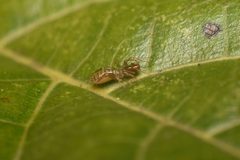
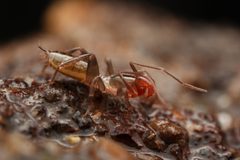
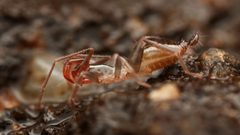
Small, soft-bodied arachnids with body length generally under 5 mm. The prosoma () is divided into three distinct plate-covered regions: the large protopeltidium and paired smaller mesopeltidia and metapeltidia. The opisthosoma () is a smooth oval of 12 segments; the first is reduced to form the , and the last three are constricted into the . A short, whip-like extends from the terminal segment, consisting of 1–4 segments (single-segmented in males, 3–4 segmented in females). No true are present; some retain eyespots capable of detecting light versus dark. The first two pairs of legs are modified into slender, antenniform sensory organs; the remaining four legs are used for , with the hind pair modified for jumping. Large, pincer-like are positioned to the sensory legs. A single pair of book lungs is located on the second abdominal segment.
Habitat
Tropical and subtropical requiring high humidity to prevent desiccation. Primary microhabitats include rainforest leaf litter, particularly the upper organic soil layer; beneath rocks and rotten logs; and caves. Some occupy arboreal habitats, including seasonally flooded forest . Others have been recorded from insect nests: Afrozomus machadoi inhabits mounds, and Stenochrus portoricensis occurs in colonies. Several Californian Hubbardia species occur under snow-covered rocks in winter, representing an unusual temperate extension. Introduced in Europe (Britain, France, Czech Republic, Poland) are restricted to artificial greenhouse environments.
Distribution
Global distribution in tropical and subtropical regions: Southeast Asia, India, Australia, Pacific Islands, Central and South America, and Africa. Temperate extensions include California and Texas. Hubbardiidae is within these limits; Protoschizomidae is to Mexico and Texas. Most have highly restricted ranges, with many known only from their type locality. European records represent introduced confined to greenhouses.
Diet
Active of soil and litter . Documented prey includes isopods, millipedes, , worms, springtails, , booklice, zorapterans, and other schizomids. Prey size ranges from 10% to 100% of predator body size. Prey is located using antenniform sensory legs to assess size and extremities, then seized with . Prey is subdued and often carried to a crevice; dismember prey, tissues are liquefied into chyme, and ingestion occurs via suction.
Behavior
Constantly active foragers that use antenniform legs to examine soil for prey. When threatened, individuals employ a jumping escape response using modified hind legs. Prey capture involves assessment of potential victims with sensory legs prior to attack. Some can survive extended periods without food; Hubbardia pentapeltis has survived five months without food in captivity. Lifespan in captivity is several months, though natural longevity is poorly documented.
Ecological Role
in tropical and subtropical soil and leaf litter . Their small size and high humidity requirements make them indicators of moist, undisturbed microhabitats. Occurrence in caves, mounds, and colonies suggests potential role as or commensals in some systems.
Human Relevance
No direct economic importance. Occasionally introduced to Europe via imported soil for gardens, where they persist in greenhouse environments. Poorly known to science; identified by E. O. Wilson as a priority group for taxonomic research. No known medical or agricultural significance.
Similar Taxa
- Uropygi (Thelyphonida)Similar body plan and shared clade (Thelyphonida), but distinguished by length (30+ segments versus 1–4), larger body size, and defensive vinegar-spraying absent in Schizomida.
- AmblypygiSimilar antenniform first leg pair and , but lack a entirely and have a more flattened body adapted for crevice dwelling.
- PalpigradiSimilar small size and whip-like terminal appendage, but have much more slender and lack the divided prosomal plates characteristic of Schizomida.
More Details
Taxonomic status
The order is not widely studied; approximately 300 described. A full catalogue and generic revision was published by Reddell & Cokendolpher (1995). estimates suggest origin in the late Carboniferous tropics of Pangea, with substantial diversification beginning in the Cretaceous. The oldest fossils are from mid-Cretaceous Burmese amber, assignable to Hubbardiidae.
Respiratory system
Unlike other Tetrapulmonata, schizomids have lost the second pair of book lungs on the third abdominal segment, retaining only the pair on the second segment.
Sources and further reading
- BugGuide
- Wikipedia
- GBIF taxonomy match
- iNaturalist taxon
- NCBI Taxonomy
- Catalogue of Life
- Gotta Love Those Spiders | Bug Squad
- They Created 'New Species' of Spiders | Bug Squad
- Description of Five New Species of Schizomida, Including a Troglophile Species (Schizomida: Hubbardiidae) from Ecuador
- The arachnid order Schizomida in the Brazilian Atlantic Forest: a new species of Rowlandius and new records of Stenochrus portoricensis (Schizomida: Hubbardiidae)
- Origins and Distribution of Two Species Groups of Schizomida, (Arachnida)
- Two new species of Bamazomus Harvey, 1992 from southern China (Schizomida, Hubbardiidae)
- TWO REMARKABLE NEW SPECIES OF HUBBARDIIDAE COOK, 1899 (ARACHNIDA: SCHIZOMIDA) FROM EASTERN CUBA
- TWO NEW GENERA AND A NEW SPECIES OF SCHIZOMIDS (ARACHNIDA: SCHIZOMIDA) FROM ISLA DE PINOS, CUBA