
Hubbardiidae
Cook, 1899
hubbardiid shorttailed whipscorpion, hubbardiid short-tailed whipscorpion
Genus Guides
2- Hubbardia
- Stenochrus(short-tailed whipscorpions)
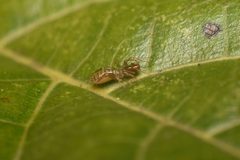
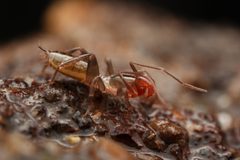
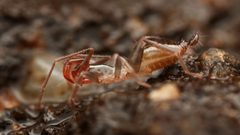
Hubbardiidae is the larger of the two extant in the arachnid order Schizomida, comprising approximately 356 in 69 . Members are superficially spider-like but distinguished by a short, segmented (tail-like structure) and divided into two : Hubbardiinae and Megaschizominae. The family exhibits worldwide distribution with notable diversity in tropical and subtropical regions, including significant cave-adapted and subterranean faunas.
Pronunciation
How to pronounce Hubbardiidae: //hʌˈbɑrdi.aɪˌdiː//
These audio files are automatically generated. While they are not always 100% accurate, they are a good starting point.
Identification
Distinguished from Protoschizomidae (the other extant schizomid ) by features including female genitalia with a and spermathecae with lobes; males possess a dorso-ventrally flattened with processes. The flagellum bears three annuli in females (corrected from earlier descriptions of two). Body plan includes elongated with -specific modifications; Hubbardiinae and Megaschizominae differ in flagellar setae patterns and genital structures.
Images
Habitat
Highly variable: includes surface-dwelling in leaf litter, under stones, and in forested areas; also extensive subterranean and troglophile (cave-associated) faunas in karst and semi-arid regions. Specific microhabitats documented include under leaf-covered stones in forests, abandoned arboreal nests, and hypogean (subterranean) in mining regions.
Distribution
Worldwide distribution with centers of diversity in the Neotropics, Australia (especially Western Australian Pilbara), and tropical Asia. Documented from Cuba (59 , 58 endemics), Ecuador, Colombia, Brazil, Mexico (Chiapas), China (Fujian and Guangdong provinces), and Rica to Venezuela. The introduced species Stenochrus portoricensis has established across southern Central America and South America.
Behavior
Rowlandius potiguar exhibits activity rhythms that have been studied behaviorally; most are cryptic and secretive given their microhabitat preferences. Stenochrus portoricensis has been documented to disperse widely, with and ecological enabling multiple events.
Human Relevance
Several are short-range endemics in regions subject to mining activities, rendering them of high conservation significance. Stenochrus portoricensis has been flagged as potentially due to its widespread distribution and ability.
Similar Taxa
- ProtoschizomidaeThe other extant of Schizomida; distinguished by genital and flagellar , particularly female spermathecal structure and male shape
- Spiders (Araneae)Superficial resemblance due to eight legs and general body form, but schizomids possess a distinctive short and lack and venom delivery structures of spiders
Sources and further reading
- BugGuide
- Wikipedia
- GBIF taxonomy match
- iNaturalist taxon
- NCBI Taxonomy
- Catalogue of Life
- Gotta Love Those Spiders | Bug Squad
- Two new species of Bamazomus Harvey, 1992 from southern China (Schizomida, Hubbardiidae)
- TWO REMARKABLE NEW SPECIES OF HUBBARDIIDAE COOK, 1899 (ARACHNIDA: SCHIZOMIDA) FROM EASTERN CUBA
- Description of Five New Species of Schizomida, Including a Troglophile Species (Schizomida: Hubbardiidae) from Ecuador
- Taxonomic revision of the genus Mayazomus Reddell & Cokendolpher, 1995 (Schizomida: Hubbardiidae), with description of five new species from Chiapas, Mexico
- Aspects of the Behavior and Activity Rhythms of Rowlandius potiguar (Schizomida: Hubbardiidae)
- A new remarkable short-tailed whip-scorpion species of Piaroa (Arachnida, Schizomida, Hubbardiidae) from the Colombian Caribbean region
- Two new species of Piaroa (Arachnida: Schizomida, Hubbardiidae) from Colombia, with comments on the genus taxonomy and the flagellar setae pattern of Hubbardiinae
- The alien species Stenochrus portoricensis (Schizomida: Hubbardiidae): decreasing the Wallacean shortfall in the New World
- The arachnid order Schizomida in the Brazilian Atlantic Forest: a new species of Rowlandius and new records of Stenochrus portoricensis (Schizomida: Hubbardiidae)
- A systematic revision of Draculoides (Schizomida: Hubbardiidae) of the Pilbara, Western Australia, Part I: the Western Pilbara
- First record of the subfamily Megaschizominae Rowland, 1973 from China, with description of a new species of Megaschizomus Lawrence, 1969 (Schizomida: Hubbardiidae)