
Mastigoproctus
Pocock, 1894
whip scorpion, vinegaroon
Species Guides
4- Mastigoproctus cinteotl
- Mastigoproctus floridanus(Florida vinegaroon)
- Mastigoproctus giganteus(giant whip scorpion)
- Mastigoproctus tohono(Tohono whipscorpion)
Mastigoproctus is a of large whip scorpions (vinegaroons) in the Thelyphonidae. These arachnids are characterized by their elongated antenniform front legs, robust , and ability to spray defensive acetic acid. The genus includes approximately 25 accepted distributed across the Americas, from the southwestern United States through Mexico, Central America, the Caribbean, and into northern South America. Despite their intimidating appearance, they are not venomous and lack venom glands entirely.
Pronunciation
How to pronounce Mastigoproctus: /mæˌstɪɡoʊˈproʊktəs/
These audio files are automatically generated. While they are not always 100% accurate, they are a good starting point.
Identification
Distinguished from other uropygian by the combination of robust body form, well-developed armature, and structure of the . The antenniform legs are proportionally long and slender. Males can be distinguished from females by the presence of sclerotized bars within the genital atrium (visible in nymphs from third stage onward) and positive allometric growth of the palpal and patella in . The genus Sheylayongium was recently separated from Mastigoproctus based on reduced pedipalp armature and distinct carination.
Images
Appearance
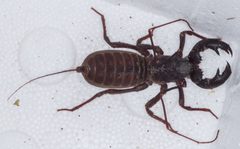
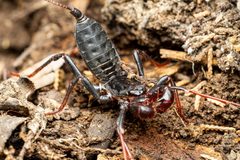
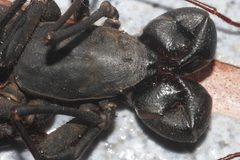
Large, robust arachnids with body lengths up to 9 cm and weights exceeding 30 grams in some . The body is divided into a broad prosoma () and segmented opisthosoma (). The first pair of legs is highly elongated and antenniform, serving as sensory appendages. The are enlarged, , and spined, used for prey capture. The (tail) is flagelliform and multi-segmented. Coloration is typically dark brown to black.
Habitat
Tropical and subtropical forests, deserts, and semi-arid regions. occupy diverse microhabitats including rock crevices, burrows in soil, cavities in walls, and spaces beneath surface objects. In arid environments, they require access to moist substrates for drinking and burrow construction. Hard adobe soils present particular challenges for shelter site selection.
Distribution
Native to the Americas, ranging from the southwestern United States (Arizona, New Mexico, Florida) through Mexico, Central America, the Caribbean (Cuba, Hispaniola, Martinique), and into northern South America (Venezuela, Colombia, Brazil). The shows highest diversity in Mexico and Brazil.
Seasonality
activity year-round in suitable climates. In arid regions, surface activity increases following rainfall. Mating activity has been observed in specific seasons for some , with occurring biennially or less frequently in desert-adapted species.
Diet
, feeding primarily on insects and other small arthropods. Prey is detected and manipulated using the sensitive antenniform front legs, then captured with the .
Life Cycle
Postembryonic development includes four nymphal stages followed by the stage, with adults never molting again. Molting occurs approximately once per year, resulting in a development period of about four years to reach sexual maturity. Females exhibit maternal care, carrying in a sac and subsequently transporting hatched young on their backs for an extended period.
Behavior
that rely heavily on sensory input from antenniform legs for prey detection and environmental navigation. When threatened, they can spray a defensive secretion containing acetic acid and caprylic acid from pygidial glands. Desiccated individuals exhibit positive hygrotaxis (movement toward moisture) and increased burrowing . Courtship involves elaborate male antenniform leg movements, with females following males and repeated tactile contact; males deposit on the substrate and maneuver females over them for sperm transfer.
Ecological Role
of insects and small arthropods in forest floor and desert . Potential intraguild predator or competitor with other large arachnids including tarantulas, wolf spiders, solifuges, and scorpions in sympatric desert .
Human Relevance
Occasionally kept as pets in the animal trade. Featured in educational outreach programs at museums and nature centers. Non-venomous and generally not dangerous to humans, though the defensive acid spray can cause mild skin irritation. Subject of scientific research on arachnid , physiology, and water relations.
Similar Taxa
- SheylayongiumFormerly classified within Mastigoproctus (as M. pelegrini), but distinguished by reduced armature, distinct carination, unusual sternite V modification, and unique female spermathecal structure
- TypopeltisAsian whip ; Mastigoproctus transoceanicus was synonymized with Typopeltis cantonensis, indicating historical taxonomic confusion between New World and Old World genera
- Other Thelyphonidae generaMastigoproctus is distinguished by robust body form, well-developed spination, and structure; exact distinguishing characters vary by comparison
Misconceptions
Widely but incorrectly believed to be venomous; like all whip scorpions, Mastigoproctus completely lacks venom glands and cannot envenomate. The defensive acid spray is frequently mistaken for venom delivery.
More Details
Water Relations
M. giganteus has limited physiological capacity to reduce water loss, with rates increasing linearly with temperature and showing no functional epicuticular wax layer. This physiological limitation is compensated by behavioral adaptations including burrowing in moist substrates and positive hygrotaxis when desiccated.
Taxonomic Note
The has undergone recent revision with the description of Sheylayongium for the Cuban formerly placed in Mastigoproctus, and the synonymization of M. transoceanicus with the Asian Typopeltis cantonensis.
Maternal Investment
Females of at least some (e.g., M. tohono) provide extended maternal care, carrying and then young on their backs, with likely limited to one per reproductive event due to the energetic costs of this investment.
Sources and further reading
- BugGuide
- Wikipedia
- GBIF taxonomy match
- iNaturalist taxon
- NCBI Taxonomy
- Catalogue of Life
- An Arachnid Kind of Day | Bug Squad
- Bug Eric: New Mexico Dragonfly Blitz - Day 1
- Bug Eric: A "SASI" Organization
- Reproduction and life history of the vinegaroon Mastigoproctus tohono
- Courtship Behaviour and Sperm Transfer in the Giant Whip Scorpion, Mastigoproctus Giganteus (Lucas) (Uropygi, Thelyphonidae)
- THE TRUE GENERIC IDENTITY OF MASTIGOPROCTUS PELEGRINI ARMAS, 2000: A NEW GENUS OF ANTILLEAN WHIPSCORPIONS (THELYPHONIDA: THELYPHONIDAE)
- TYPES OF SHELTER SITES USED BY THE GIANT WHIPSCORPION MASTIGOPROCTUS GIGANTEUS (ARACHNIDA, UROPYGI) IN A HABITAT CHARACTERIZED BY HARD ADOBE SOILS
- Notes on the life history and reproductive biology of the Giant whip scorpion, Mastigoproctus giganteus (Uropygi, Thelyphonidae) from Florida
- WATER RELATIONS AND DESICCATION‐AVOIDING BEHAVIOR IN THE VINEGAROON MASTIGOPROCTUS GIGANTEUS (ARACHNIDA: UROPYGI)
- First description of spermatophore morphology and mating behavior in Mastigoproctus proscorpio (Urogpyi) (Latreille, 1806) from Hispaniola, Greater Antilles
- Microhabitat Utilisation, Diet Composition, Intraguild Predation, and Diel Periodicity in Five Sympatric Species of Desert Arachnids: a Wolf Spider (Hogna carolinensis), Tarantula Spider (Aphonopelma steindachneri), Solifuge (Eremobates palpisetulosus), Giant Whipscorpion (Mastigoproctus giganteus), and Scorpion (Diplocentrus bigbendensis)