
Opilio
Herbst, 1798
Species Guides
1Opilio is a of harvestmen (order Opiliones, Phalangiidae) containing over 60 described . The genus name derives from Latin "opilio," meaning shepherd or sheep-master. These arachnids are characterized by long legs and a compact, oval body, with species distributed across the Holarctic region. The type species, Phalangium opilio, is a widespread that has been introduced to North America and other regions.

Pronunciation
How to pronounce Opilio: /oʊˈpɪlioʊ/
These audio files are automatically generated. While they are not always 100% accurate, they are a good starting point.
Identification
Distinguished from other phalangiid by a combination of characters including the structure of the ocularium, , and male genitalia ( structure). The genus Opilio is part of the Opilioninae, tribe Opilionini. -level identification requires examination of fine morphological details, particularly in males. Distinguished from the superficially similar genus Leiobunum by differences in pedipalp structure and body proportions.
Images
Appearance
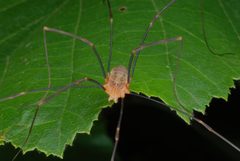
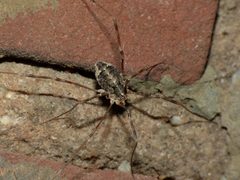
Harvestmen with long, slender legs and a small, oval body. The body is divided into a prosoma () and opisthosoma (), though the waist is not constricted as in spiders. The ocularium ( ) is typically prominent, bearing two eyes. Legs I and II are often held forward and upward, functioning primarily in sensory navigation. Body coloration varies among , with some exhibiting stripes or patterns. Males and females may show in body size and leg proportions.
Habitat
Occurs in diverse terrestrial including forests, grasslands, agricultural fields, and human-modified environments. Many favor wooded or semi-wooded areas with decaying organic matter. The introduced species Phalangium opilio thrives in habitats including crop fields, gardens, and urban green spaces.
Distribution
Primarily Holarctic in distribution, with native in Europe and Asia. The type species Phalangium opilio has been introduced to North America and occurs widely in the United States and Canada. Individual species show varying ranges, with some being restricted to specific mountain systems or regions.
Seasonality
Activity patterns vary by and latitude. In temperate regions, most active during warmer months. Some species show autumn peak activity. The introduced Phalangium opilio in North America is active primarily from spring through fall.
Human Relevance
The introduced Phalangium opilio has been studied as a potential agent in agricultural systems, where it preys on pest insects. The name has etymological significance, derived from Latin usage by classical authors Plautus and Virgil.
Similar Taxa
- LeiobunumSimilar long-legged harvestmen in Sclerosomatidae; distinguished by structure and body proportions
- PhalangiumClosely related in same ; historically conflated with Opilio and distinguished by subtle morphological differences
More Details
Etymology
The name Opilio comes from Latin "opilio," meaning shepherd or sheep-master. The term was used by the Roman playwright Plautus to refer to a type of slave, and by Virgil with the meaning of shepherd.
Taxonomic History
The was established by Herbst in 1798. The type , originally described as Phalangium opilio Linnaeus, 1758, was later placed in Opilio. The number of recognized species has expanded from 35 to over 60 in recent decades.
Sources and further reading
- BugGuide
- Wikipedia
- iNaturalist taxon
- NCBI Taxonomy
- Catalogue of Life
- Opiliones | Blog
- Answer to Super Crop Challenge #1 | Beetles In The Bush
- Cosmetid harvestman with parasitic/phoretic mites in Argentina | Beetles In The Bush
- Phreaky Phalangid | Beetles In The Bush
- Dispersion and assessment of possible distribution of snow crab opilio (Chionoecetes opilio) in the Barents Sea
- Figure 6: Box plots of carapace width (CW) distribution of Chionoecetes opilio of different sexes.
- Influence of light levels and predator characteristics on the functional response of the European harvestman (Opiliones: Phalangiidae).