
Opilio parietinus
(De Geer, 1778)
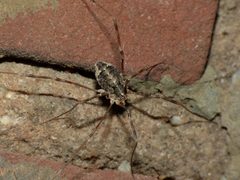
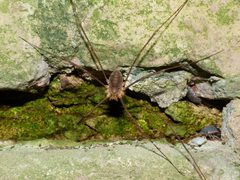
Opilio parietinus is a harvestman native to Europe that has been introduced to North America. It was historically common on house walls in Central Europe but has been largely displaced by the Opilio canestrinii. The species can be distinguished from O. canestrinii by dark spots on its and a generally grayish-green coloration.

Pronunciation
How to pronounce Opilio parietinus: /oʊˈpɪlioʊ pæriˈɛtɪnəs/
These audio files are automatically generated. While they are not always 100% accurate, they are a good starting point.
Identification
Distinguished from the similar Opilio canestrinii by the presence of dark spots on the and a grayish-green rather than brownish coloration. Both share the habit of occurring on vertical surfaces such as house walls.
Images
Appearance
Grayish-green body with dark spots on the (leg bases). Similar in overall form to Opilio canestrinii but distinguished by coloration and coxal markings.
Habitat
Historically found on house walls and other vertical surfaces in human-modified environments in Central Europe. The specific natural preferences are not well documented in available sources.
Distribution
Native to Europe; introduced to North America. Distribution records include Montenegro, the Dodecanese (Greece), and Middle America. The has been largely replaced by Opilio canestrinii across much of its former European range.
Human Relevance
Historically common on house walls in Central Europe, serving as a familiar urban . Its decline due to competition with the Opilio canestrinii represents a notable case of native displacement by a .
Similar Taxa
- Opilio canestriniiVery similar in appearance and habits; distinguished by the absence of dark coxal spots and more brownish coloration. O. canestrinii is an that has largely displaced O. parietinus in Central Europe.
More Details
Conservation note
The replacement of O. parietinus by O. canestrinii in Central Europe represents one of the better-documented cases of competitive exclusion among harvestmen, though the specific mechanisms remain incompletely studied.