
Oxyopidae
Thorell, 1869
Lynx Spiders
Genus Guides
3- Hamataliwa(Crowned Lynx Spiders)
- Oxyopes(Grass Lynx Spiders)
- Peucetia(Green Lynx Spiders)
Oxyopidae, commonly known as lynx spiders, is a of hunting spiders characterized by their spiny legs and active predatory . Most are hunters that rely on vision and agility rather than web-building to capture prey. The family includes notable such as Oxyopes, Peucetia, and Hamataliwa, with Peucetia viridans (green lynx spider) being among the largest North American species. While most lynx spiders are solitary, at least one species, Tapinillus sp., has been documented exhibiting social behavior including cooperative prey capture and communal web maintenance—the first such report for the family.
Pronunciation
How to pronounce Oxyopidae: //ɒkˈsaɪəpɪˌdiː//
These audio files are automatically generated. While they are not always 100% accurate, they are a good starting point.
Identification
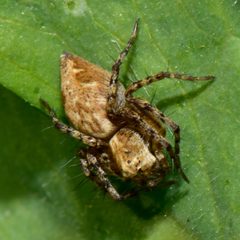
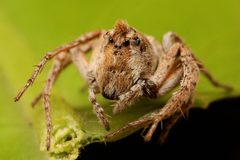
Lynx spiders can be distinguished from similar hunting spiders by several key features: long, slender legs armed with prominent spines; a distinctive arrangement with eight eyes in four rows forming a hexagonal pattern, with the eyes slightly raised giving a 'high forehead' appearance; and generally elongated bodies. They differ from wolf spiders (Lycosidae) by their more upright posture and spiny legs; from jumping spiders (Salticidae) by their eye arrangement and lack of enlarged anterior median eyes; and from crab spiders (Thomisidae) by their more slender build and active hunting rather than ambush posture. The green lynx spider (Peucetia viridans) is notably larger than most lynx spiders and can be recognized by its bright green coloration with red spots and black spines, though southwestern may appear yellowish or brown.
Images
Habitat
Lynx spiders are primarily associated with vegetation, particularly grasses, shrubs, and flowering plants. They frequent flowers where they ambush , and many inhabit fields, forest edges, and arid environments. Peucetia viridans occurs from Maryland to Florida and across the southern United States to California, favoring fields, forest edges, and arid . Oxyopes salticus prefers moist, tall grass meadows and fields dominated by brome grasses rather than shortgrass prairies. Some species are found on specific substrates such as prickly pear cacti (Opuntia spp.), where they benefit from protection from and access to flower-visiting prey.
Distribution
Oxyopidae has a worldwide distribution. The Oxyopes occurs throughout the Americas, from the United States through Central and South America and the Caribbean, with Oxyopes salticus documented from the continental Americas and Caribbean islands including Bahamas, Cuba, Dominican Republic, Jamaica, and Saint Kitts. Peucetia viridans ranges across the southern United States from Maryland to California. The is also documented from Bangladesh, India (Western Ghats), China, and the Galápagos Islands (Oxyopes incantatus). GBIF records indicate presence in Denmark, Norway, and Sweden.
Diet
Lynx spiders are active that feed primarily on insects. Peucetia viridans preys on bees, , and caterpillars, and has been observed engaging in . Oxyopes salticus has been documented feeding on agricultural pests including Tarnished Plant Bug (Lygus lineolaris), Rapid Plant Bug (Adelphocoris rapidus), Cotton Fleahopper (Pseudatomoscilis seriatus), Tobacco Budworm (Heliothis virescens), and Cotton Bollworm (Helicoverpa armigera), as well as mosquitoes (Aedes sp.).
Behavior
Most lynx spiders are solitary, hunters that rely on active pursuit and ambush rather than web-building. They exhibit two primary hunting strategies: waiting motionless for prey or actively stalking and pouncing. Peucetia viridans is capable of running and jumping with agility exceeded only by jumping spiders. Females of this construct 'nursery webs' around sacs, and mothers vigorously defend offspring from including other spiders, ants, and beetles. A unique defensive has been documented in P. viridans: females spit venom from their fangs to repel perceived threats. Mating in P. viridans involves by males, multiple copulatory insertions, and post-copulatory mate guarding. The most notable behavioral exception in the is Tapinillus sp., which exhibits social behavior including cooperative prey capture, communal web maintenance, and among conspecifics in multi-individual webs—representing the first documented case of sociality in Oxyopidae.
Ecological Role
Lynx spiders function as in terrestrial , with documented importance in agricultural systems. Oxyopes salticus has been investigated as a natural biocontrol agent for cotton pests, with studies demonstrating significant on economically important pest . Their presence in flowering vegetation positions them as predators of and herbivorous insects, potentially influencing plant-pollinator and plant-herbivore interactions.
Human Relevance
Lynx spiders are generally beneficial to humans due to their on pest insects, particularly in agricultural contexts. Oxyopes salticus has been studied specifically for its potential in of cotton pests. Peucetia viridans has been observed as prey for mud dauber (Sceliphron and Chalybion), which provision nests with paralyzed spiders. The has contributed to taxonomic research, with recent descriptions of new (Shuqiangius) and from China, India, and the Galápagos Islands.
Similar Taxa
- Lycosidae (wolf spiders)Both are active hunting spiders, but lynx spiders have spiny legs, more upright posture, and different arrangement
- Salticidae (jumping spiders)Both are visual, hunters with jumping ability, but jumping spiders have enlarged and lack the prominent leg spines of lynx spiders
- Thomisidae (crab spiders)Both frequent flowers and ambush prey, but crab spiders have flattened bodies, laterigrade legs, and do not actively pursue prey
Sources and further reading
- BugGuide
- GBIF taxonomy match
- iNaturalist taxon
- NCBI Taxonomy
- Catalogue of Life
- Bug Eric: Spider Sunday: Striped Lynx Spider
- Bug Eric: Green Lynx Spider
- Bug Eric: Wasp Wednesday: Blue Mud Dauber, Chalybion californicum
- Zookeys | Blog - Part 2
- Bug Eric: August 2010
- Assassin ate | Beetles In The Bush
- The Mating Behavior of Peucetia viridans (Araneida: Oxyopidae)
- The jumping lynx spider Oxyopes salticus Hentz, 1845 and its Neotropical relatives (Araneae: Oxyopidae)
- Social behaviour in a web-building lynx spider, Tapinillus sp. (Araneae: Oxyopidae)
- Lynx Spiders of Khulna District of Bangladesh : Genus Oxyopes Latreille (Areaneae : Oxyopidae)
- A new species of Hamataliwa (Araneae: Oxyopidae) from Western Ghats, India
- Costs and benefits of maternal behaviour in the green lynx spider (Oxyopidae, Peucetia viridans)
- Social behaviour in a web-building lynx spider, Tapinillus sp. (Araneae: Oxyopidae)
- Shuqiangius gen. nov., a new genus of Oxyopidae (Arachnida, Araneae) from China.
- Mitogenomic Insights on the Phylogeny and Evolution of Lynx Spiders (Araneae, Oxyopidae).