
Oxyopes salticus
Hentz, 1845
Striped Lynx Spider
Oxyopes salticus, commonly known as the Striped Lynx Spider, is a small lynx spider first described by Hentz in 1845. It is widely distributed across the Americas from the United States through Central America to South America and the Caribbean, with established in Hawaii. The is particularly abundant in agricultural where it serves as a significant of crop pests, though its value in biocontrol is complicated by documented on beneficial insects including .
Pronunciation
How to pronounce Oxyopes salticus: /ˌɒksɪˈoʊpiːz ˈsɔːltɪkəs/
These audio files are automatically generated. While they are not always 100% accurate, they are a good starting point.
Identification
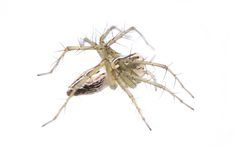
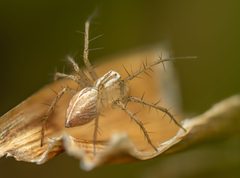
Distinguished from similar spiders by long spines on all legs, high creating elongated ',' and characteristic arrangement of lynx spiders. May be confused with slender crab spiders (Tibellus spp.) or wolf spiders, but differs in leg armature and body proportions. The combination of striped pattern, spiny legs, and elevated profile separates it from Philodromidae and Lycosidae.
Images
Appearance
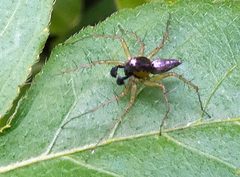
females range 5–6 mm in body length, males 4–5 mm, with legspan approximately 20 mm. Coloration varies from orange through cream to brown. Females typically display stripes on both and , with abdominal stripes usually more pronounced. A diamond-shaped cardiac mark is generally present on the abdomen. Legs I–IV are covered with macrosetae (long spines). The is broad, creating a high 'forehead' appearance. Males possess reflective on the abdomen producing an iridescent appearance.
Habitat
Grasses and leafy vegetation, particularly grassy and weedy fields. Favors tall grass meadows and moist grasslands over shortgrass prairies. Common in row crops and agricultural fields dominated by brome grasses. Found in disturbed including vacant lots and urban grasslands.
Distribution
Eastern United States from Massachusetts and Iowa south to Florida and Texas; along Mexican border and north along Pacific coast to Oregon. Widespread through Mexico, Central America, and South America to northern Argentina and Chile. Caribbean distribution including Bahamas, Cuba, Dominican Republic, Jamaica, and Saint Kitts. Introduced and established on Hawaiian Islands (Big Island and Maui).
Seasonality
Immatures overwinter, reaching adulthood in late spring or early summer. Mature specimens active from spring through summer months.
Diet
Active of insects. Documented prey includes agricultural pests: Tarnished Plant Bug (Lygus lineolaris), Rapid Plant Bug (Adelphocoris rapidus), Cotton Fleahopper (Pseudatomoscilis seriatus), Tobacco Budworm (Heliothis virescens), Cotton Bollworm (Helicoverpa armigera), and mosquitoes (Aedes sp.). Also preys on beneficial insects including bees and other .
Life Cycle
Females attach sacs to grass stems using minimal silk threads, then guard until spiderlings hatch. Spiderlings emerge from guarded egg sacs. stages overwinter, developing to adulthood the following spring or summer.
Behavior
Hunts by waiting in ambush on vegetation or actively stalking and pouncing on prey— likened to cat-like hunting. Assumes a somewhat scrunched posture when waiting in ambush on grass stems. Males perform ; these displays have been observed to be disrupted by sublethal exposure to certain (bifenthrin, carbaryl). No observed instances of or on other spiders.
Ecological Role
Significant in agricultural , contributing to natural suppression of crop pest . Role as biocontrol agent is moderated by non-target on beneficial insects.
Human Relevance
Evaluated for of agricultural pests in cotton and other crops. Mass releases have demonstrated reductions in pest damage, though effectiveness is limited by on . Subject of impact studies due to its importance in agroecosystems.
Similar Taxa
- Tibellus spp. (slender crab spiders)Similar striped pattern and grass-dwelling habit, but Tibellus has more flattened body, different arrangement, and lacks long leg spines.
- Pisaurina mira (nursery web spider)Shares and resting posture, but larger, more robust, hairier, with different arrangement.
- Thanatus spp.Similar size and striping, but more robust, hunts primarily on ground rather than on stems and leaves.
- Wolf spiders (Lycosidae)Similar ground-dwelling habit and hunting , but differ in body shape, arrangement, and lack the distinctive spiny legs and high of lynx spiders.
More Details
Taxonomic Note
Oxyopes m-fasciatus Piza, 1938 and Oxyopes nigrolineatus Mello-Leitão, 1941 have been synonymized under O. salticus based on examination of morphological variation.
Pesticide Sensitivity
Laboratory studies demonstrate that sublethal residues of bifenthrin and carbaryl significantly reduce male courtship and duration, with potential implications for in treated agricultural fields.
Sources and further reading
- BugGuide
- Wikipedia
- GBIF taxonomy match
- iNaturalist taxon
- NCBI Taxonomy
- Catalogue of Life
- Bug Eric: Spider Sunday: Striped Lynx Spider
- Bug Eric: Spider Sunday: Slender Crab Spiders (and their look-a-likes)
- Bug Eric: Book Review: Dr. Eleanor's Book of Common Spiders
- Bug Eric: Thoh-Dah Prairie Bioblitz
- Bug Eric: Zebra Jumper
- Bug Eric: Spider Sunday: Sassacus
- The jumping lynx spider Oxyopes salticus Hentz, 1845 and its Neotropical relatives (Araneae: Oxyopidae)
- Sublethal pesticide exposure disrupts courtship in the striped lynx spider, Oxyopes salticus (Araneae: Oxyopidae)