
Brunneria borealis
Scudder, 1896
Northern Grass Mantis, Brunner's Mantis, Brunner's Stick Mantis
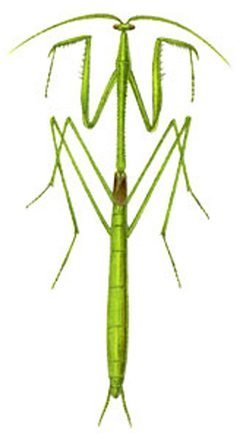
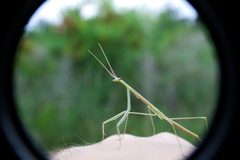
Brunneria borealis is a slender green mantis native to the southern United States, notable as the only mantis known to reproduce exclusively through . All individuals are female; no males have been documented. reach approximately 77 mm in length and possess reduced wings that likely preclude . The species inhabits grassland and exhibits stick-like camouflage .
Pronunciation
How to pronounce Brunneria borealis: //bruːˈnɪəriə bɔːˈreɪəlɪs//
These audio files are automatically generated. While they are not always 100% accurate, they are a good starting point.
Identification
Distinguished from other mantids by its exclusively female, parthenogenetic . The reduced wing size in separates it from fully winged . Its slender, stick-like body form and green coloration resemble phasmids, but the forelegs confirm it as a mantid. The combination of small geographic range in the southern U.S., grassland , and flightless adult females aids identification.
Images
Appearance
Habitat
Grassland meadows, particularly those dominated by little bluestem grass (Schizachyrium scoparium). Found on flowering plants including slender aster (Symphyotrichum subulatum). Occupies low vegetation approximately one foot above ground, climbing higher when disturbed. Nocturnally active in meadows, often unnoticeable by day.
Distribution
Native to the southern United States. Documented in North Carolina, South Carolina, Georgia, Florida, Alabama, Louisiana, Mississippi, Arkansas, Oklahoma, and Texas. Within Texas, confirmed in Bell, Brazos, Comanche, Erath, Montgomery, Tarrant, and Parker counties. Disjunct local likely present across range.
Diet
Predatory; specific prey preferences poorly documented. Has been observed feeding on grass-dwelling (stick insects). Likely captures grasshoppers and other suitable prey based on size. No detailed dietary studies available.
Life Cycle
Behavior
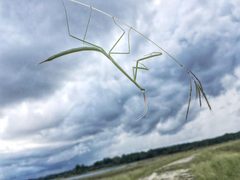
Nocturnally active, found in grasses at night approximately one foot above ground. When disturbed, climbs higher into vegetation. Exhibits stick-insect-like : sways or stiffens when disturbed to resemble vegetation. concealment makes individuals difficult to detect during daylight hours.
Ecological Role
in grassland . Specific ecological impacts unstudied. Likely contributes to regulation of herbivorous insect including grasshoppers and .
Human Relevance
Similar Taxa
- Phasmatodea (stick insects)Similar slender green body and swaying when disturbed; distinguished by forelegs and structure of mantids
- Other Brunneria species share slender form but have different geographic distributions; B. borealis distinguished by exclusive U.S. southern range and
- Tenodera sinensis (Chinese mantis)Introduced overlapping in some range; distinguished by larger size, fully developed wings in both sexes, and
More Details
Parthenogenesis
The only confirmed obligate parthenogenetic mantis . All studied consist exclusively of females; male specimens have never been documented. Genetic mechanisms underlying this mode remain uncharacterized.
Taxonomic history
Originally described by Scudder in 1896. placement has varied; currently classified in Coptopterygidae though some sources list Mantidae.