
Brunneria
Saussure, 1869
stick mantis, Brunner's stick mantis
Species Guides
1- Brunneria borealis(Northern Grass Mantis)
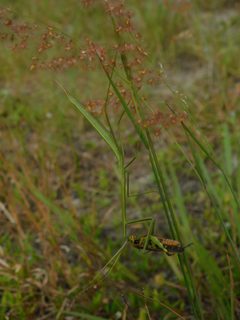
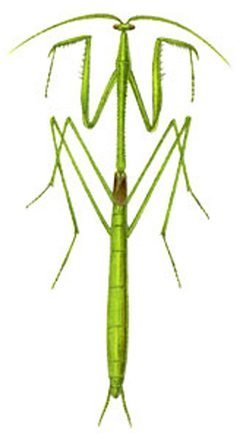
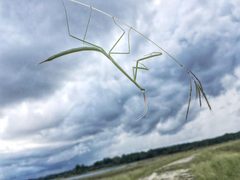
Brunneria is a of slender, stick-like praying mantises native to the Americas. The genus contains six recognized , with B. borealis being particularly notable as the only known obligate parthenogenetic praying mantis—reproducing exclusively asexually with no males ever observed. This species has spread across more than 2,400 km of coastal North America from a hypothesized single female introduction. Other species in the genus, all South American, reproduce facultatively with both sexes present.
Pronunciation
How to pronounce Brunneria: //ˈbɹʌ.nə.ɹi.ə//
These audio files are automatically generated. While they are not always 100% accurate, they are a good starting point.
Identification
Distinguished from other mantids by extreme elongation of the body and appendages, creating a stick-like silhouette rather than the broader, flattened form of many mantids. B. borealis can be separated from other Brunneria by its complete winglessness and geographic range (North America vs. South America). The unique of rising up in grass to investigate disturbance after netting is diagnostic for B. borealis.
Images
Habitat
Clumped, warm-season grasses in coastal and near-coastal environments. B. borealis occupies grassy fields along the Gulf and Atlantic Coasts from eastern Texas to central North Carolina.
Distribution
Native to the Americas. B. borealis: introduced and established in southeastern United States (Texas to North Carolina). Other : South America (Brazil, Uruguay, and elsewhere).
Diet
Predatory on arthropods; specific prey records for the are limited, but mantids in this genus likely capture grass-dwelling insects.
Life Cycle
In B. borealis, are laid in distinctive with a single terminal opening. Nymphs emerge sequentially over up to four months, with staggered reducing competition and starvation risk. Early-emerging nymphs may reach adulthood before later siblings hatch.
Behavior
B. borealis exhibits a unique investigative : after vegetation is swept with a net, individuals rise up in the grass to examine the disturbance site upon return. This facilitates collection. The is flightless and disperses slowly, likely through passive transport of on vehicles or objects.
Ecological Role
in grassland . The extended period of B. borealis nymphs may provide consistent pressure across the growing season.
Human Relevance
B. borealis is of scientific interest as the only known obligate parthenogenetic mantis, with research focusing on its origin, genetic uniformity, and unusual reproductive . Not commonly kept in captivity compared to other .
Similar Taxa
- ThesprotiaAlso extremely slender and stick-like; may require examination of specific morphological characters to distinguish.
- OligonicellaGrass-dwelling slender mantids with similar preferences; differ in details of body proportions and wing development.
More Details
Parthenogenesis
B. borealis is the only known obligate parthenogen (thelytokous) in Mantodea. All other parthenogenetic mantids are facultative, reproducing sexually when males are present. The complete absence of males in B. borealis is unique.
Genetic uniformity
A 2019 study found zero mitochondrial variation (COI gene) across 24 individuals from nine sites in seven U.S. states, supporting a recent origin from a single founder female.
Oothecal structure
Unlike the ridged of most mantids with emergent hatching lines, B. borealis oothecae have a single terminal exit pore, enabling the months-long sequential .
Sources and further reading
- BugGuide
- Wikipedia
- GBIF taxonomy match
- iNaturalist taxon
- NCBI Taxonomy
- Catalogue of Life
- Meet 'Mantis Master Keeper' Andrew Pfeifer | Bug Squad
- Brunneria borealis - Entomology Today
- Brunneria borealis - Entomology Today
- Brunneria borealis Archives - Entomology Today
- Did One Praying Mantis Give Rise to an All-Female Species?