
Clepsis anderslaneyii
Dombroskie & Brown, 2009
Clepsis anderslaneyii is a small tortricid described in 2009 from montane regions of southeastern Arizona. The is known from three mountain ranges at elevations between 1,490 and 1,770 meters. fly during summer months, with records from July to August. The species name honors the marriage of Sara Anderson and Malcolm Slaney.
Pronunciation
How to pronounce Clepsis anderslaneyii: /ˈklɛpsɪs ændərsˈleɪnijaɪ/
These audio files are automatically generated. While they are not always 100% accurate, they are a good starting point.
Identification
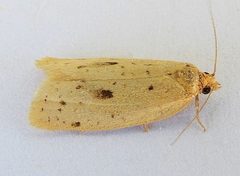
Distinguished from other Clepsis by combination of small size, straw yellow forewing ground color with dark brown speckling, white hindwings, and restricted montane distribution in southeastern Arizona. The specific pattern of dark speckling on pale yellow forewings and the white hindwings with possible light brown marginal suffusion are key visual characters. Genitalia examination may be required for definitive identification from similar .
Images
Appearance
Small with forewings 8.5–9 mm in males and 8–9.5 mm in females. Forewing ground color straw yellow with dark brown speckling. Hindwings white, sometimes suffused with light brown on outer margins.
Habitat
Montane forests in the Chiricahua, Huachuca, and Santa Rita mountains of southeastern Arizona. Recorded at elevations from 1,490 to 1,770 meters, suggesting association with mixed conifer or pine-oak woodland zones typical of these sky island ranges.
Distribution
to three mountain ranges in southeastern Arizona, United States: Chiricahua Mountains, Huachuca Mountains, and Santa Rita Mountains. No records from other regions.
Seasonality
active from July to August, probably in one per year. period coincides with summer monsoon season in the region.
Life Cycle
Complete with , larva, pupa, and stages. Larval unknown; other Clepsis are leafrollers that use silk to bind leaves for shelter and feeding.
Behavior
are and attracted to light. Single suggested by restricted adult period.
Ecological Role
Presumed herbivore in larval stage based on characteristics; specific role in montane unknown.
Human Relevance
No known economic or agricultural significance. name commemorates a marriage, representing a personal rather than scientific naming convention.
Similar Taxa
- Clepsis peritanaSimilar size and yellowish forewing coloration, but C. peritana has broader distribution across western North America and different forewing pattern with more distinct markings rather than diffuse speckling
- Other Clepsis speciesMany share general tortricid ; precise identification requires examination of genitalia and attention to specific color pattern details and geographic range
More Details
Etymology
Named in honor of the marriage of Sara Anderson and Malcolm Slaney, with the specific epithet combining elements of both surnames
Conservation Status
Known from only three mountain ranges with limited elevational band; potentially vulnerable to climate change effects on montane , though no formal assessment has been conducted
Sources and further reading
- BugGuide
- Wikipedia
- GBIF taxonomy match
- iNaturalist taxon
- NCBI Taxonomy
- Catalogue of Life
- Blacklighting at the Bohart: They Saw the Light | Bug Squad
- What Will You See at Bohart Museum Open House | Bug Squad
- Oh, What a (Moth) Night! | Bug Squad
- Mark Your Calendar for 'Moth Night' at Bohart Museum: July 30 | Bug Squad
- A Night at the Bohart Museum: Moth Night on Saturday, July 22 | Bug Squad
- Bug Eric: National Moth Week Recap for Colorado Springs