
Clepsis peritana
(Clemens, 1860)
garden tortrix, strawberry garden tortrix
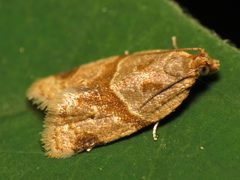
Clepsis peritana is a small tortricid commonly known as the garden tortrix or strawberry garden tortrix. It occurs across North America from southern Canada through the United States, with additional in Spain and Cuba. The is multivoltine, with active from March through September. Its larvae are leafrollers that feed on a diverse range of plants including strawberries, citrus, and various ornamental and weedy species.


Pronunciation
How to pronounce Clepsis peritana: /ˈklɛpsɪs ˌpɛrɪˈtɑːnə/
These audio files are automatically generated. While they are not always 100% accurate, they are a good starting point.
Identification
Distinguished from similar Clepsis by combination of size, forewing pattern, and geographic range. Most reliably identified by genitalia examination or . In the western United States, may occur with Clepsis fucana and Clepsis melaleucana, from which it differs in forewing coloration and pattern details. The "garden tortrix" is shared with related species; confirmation requires dissection or molecular analysis.
Images
Habitat
Occurs in diverse including agricultural fields, gardens, orchards, and disturbed areas. Associated with areas where plants are present, including strawberry plantings, citrus groves, and weedy field margins. In Colorado, has been recorded from cottonwood groves with nearby wetlands in prairie habitats.
Distribution
Native to North America, recorded from southern Canada throughout the United States. Introduced or native also present in Spain and Cuba. GBIF records indicate presence in Belgium, though status there requires verification.
Seasonality
active March through September in North America. Multiple per year (multivoltine). Peak activity varies by region and climate.
Diet
Larvae feed on leaves of: Chrysanthemum, Cynara cardunculus (cardoon), Senecio jacobaea (tansy ragwort), Stachys, Fragaria (strawberry), Citrus, Scrophularia californica (California figwort), and Solanum torvum (turkey berry). on herbaceous plants and shrubs.
Host Associations
- Fragaria - larval food plantstrawberry
- Citrus - larval food plant
- Chrysanthemum - larval food plant
- Senecio jacobaea - larval food planttansy ragwort
- Cynara cardunculus - larval food plantcardoon
- Stachys - larval food plant
- Scrophularia californica - larval food plantCalifornia figwort
- Solanum torvum - larval food plantturkey berry
Life Cycle
Holometabolous with complete . laid on plants. Larvae feed within rolled leaves, using silk to bind leaf edges together for shelter. occurs within the larval shelter. Multiple per year; stage not definitively established in published sources but likely as larva or pupa in leaf litter or soil.
Behavior
are and attracted to ultraviolet light sources. Larvae are leafrollers: they fold or roll leaves using silk, feeding from within this protected microhabitat. This conceals larvae from and .
Ecological Role
Herbivore that functions as a folivore on diverse plants. Larval leaf-rolling creates microhabitats that may be used by other small after . Serves as prey for and generalist .
Human Relevance
Minor agricultural pest of strawberry and citrus. Larvae damage leaves but rarely cause economically significant injury. Frequently encountered by entomologists and citizen scientists during surveys and National Moth Week events. Used as an example in public outreach for tortricid moth diversity.
Similar Taxa
- Clepsis fucanaOverlapping western North American range; similar size and general appearance; requires genitalia examination for reliable separation.
- Clepsis melaleucanaSympatric in parts of range; forewing pattern differences subtle; dissection often needed for confirmation.
- Platynota stultanaCo-occurs at light traps and in agricultural settings; larger size and different forewing pattern with more distinct markings.
More Details
Taxonomic History
Originally described as Smicrotes peritana by Clemens in 1860; later transferred to Clepsis.
Research and Monitoring
Regularly recorded in long-term monitoring programs, including 37-year blacklighting study by John De Benedictis in California. Documented at Moth Night events at the Bohart Museum of Entomology, UC Davis.
Sources and further reading
- BugGuide
- Wikipedia
- GBIF taxonomy match
- iNaturalist taxon
- NCBI Taxonomy
- Catalogue of Life
- Blacklighting at the Bohart: They Saw the Light | Bug Squad
- What Will You See at Bohart Museum Open House | Bug Squad
- Oh, What a (Moth) Night! | Bug Squad
- Mark Your Calendar for 'Moth Night' at Bohart Museum: July 30 | Bug Squad
- A Night at the Bohart Museum: Moth Night on Saturday, July 22 | Bug Squad
- Bug Eric: National Moth Week Recap for Colorado Springs