
Platynota stultana
Walsingham, 1884
Omnivorous Leafroller, Omnivorous Leafroller Moth
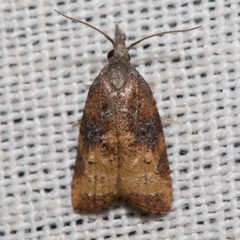
Platynota stultana, the leafroller, is a highly tortricid native to northwestern Mexico and the southwestern United States. It has become an established pest in Hawaii, Spain, Italy, and multiple other European countries. are small with wingspans around 14 mm and are active year-round in warm climates. The completes four to six annually in California and produces severe economic damage in vineyards, greenhouses, and nursery operations. Larval feeding on grape berries causes skin breakage that leads to fungal rot and crop losses up to 80%.

Pronunciation
How to pronounce Platynota stultana: /ˌplætɪˈnoʊtə stʊlˈtɑːnə/
These audio files are automatically generated. While they are not always 100% accurate, they are a good starting point.
Identification
are small with wingspans of approximately 14 mm. Forewing lengths range 4.5–7.0 mm in males and 6.5–9.0 mm in females. in wing size is present. The can be distinguished from similar tortricids by its consistent association with rolled or folded leaf shelters constructed by larvae. trapping using components E11-14Ac, Z11-14Ac, E11-14OH, and Z11-14OH is effective for detection and monitoring.
Images
Habitat
Greenhouses, vineyards, agricultural fields, and nursery environments. Development occurs at temperatures above 8.9°C. In northern Europe, outdoor establishment is unlikely, but greenhouse production remains vulnerable.
Distribution
Native to northwestern Mexico and southwestern United States (California, Arizona, Texas, Florida). Established in Hawaii since the mid-1980s. in Europe: first detected in Spain (2009), Italy (2020, Apulia; subsequently Liguria, Tuscany, Lazio, Campania, Sicily), France, Portugal, Germany, Greece, Switzerland, and Malta. Intercepted in United Kingdom (2004), Netherlands, Germany (2018), and Canada (Ontario) but not established.
Seasonality
are on wing year-round in warm climates. In southern California, first adults appear in March with five or more overlapping annually. In Almeria, Spain, peaks occur in March, July, and September indicating approximately three generations per year.
Diet
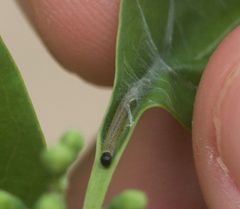
Highly ; larvae feed on over 100 plant across 30+ . Documented include grapes (Vitis), citrus, peppers (Capsicum), cotton, alfalfa, corn, peaches, pears, pomegranates, roses, carnations, chrysanthemums, aubergines, basil, and numerous ornamental and wild plants. Young larvae feed within buds or between leaves; later instars feed inside rolled or folded leaf shelters constructed with silk webbing. In peppers, larvae tunnel from stems and feed internally around seeds.
Host Associations
- Vitis - larval feeding in ripening bunches causes skin breakage and rot
- Citrus - larval pest of citrus in
- Capsicum annuum - larval larvae tunnel from stem and feed internally around seeds
- Gossypium - larval documented in California
- Medicago sativa - larval documented plant
- Zea mays - larval documented plant
- Prunus persica - larval documented plant
- Pyrus - larval documented plant
- Punica granatum - larval documented plant
- Rosa - larval documented plant
- Dianthus caryophyllus - larval documented plant
- Chrysanthemum - larval documented plant
- Solanum melongena - larval documented plant
- Ocimum - larval documented plant
Life Cycle
are small, flattened, disk-shaped, and greenish, laid in masses of 50–100 on leaf surfaces; females produce over 300 eggs during their average 10.5-day lifespan. Eggs hatch in approximately one week. Newly hatched larvae crawl to the top of plants and feed within buds or between two leaves; they may disperse by ballooning on silk threads. Larvae complete five to six instars, feeding within shelters of rolled or folded leaves constructed with webbing. occurs inside rolled leaves. No true is known.
Behavior
Larvae construct protective shelters from silk webbing in rolled or folded leaves or dead leaves, remaining hidden during feeding. Young larvae may balloon on silk threads to disperse to other . can fly but are not migratory; no long-distance has been recorded. Natural ability is limited; rapid range expansion occurs primarily through human-mediated transport via international trade in plants and plant products including nursery stock, cut flowers, branches, and fruits.
Ecological Role
Agricultural pest causing significant economic damage to multiple crop systems. In grapes, larval feeding damage facilitates secondary fungal leading to bunch rot and raisining. Potential threat to wild plants in the EPPO region through generalized herbivory.
Human Relevance
Major economic pest of vineyards, greenhouses, and nursery operations. In California vineyards, larval feeding on grape berries causes skin breakage that leads to bunch rot, with reported crop losses up to 80%. Considered a serious pest of greenhouse plants and ornamentals. Subject to phytosanitary regulation and monitoring in Europe due to potential. trapping is used for detection and management.
Similar Taxa
- Clepsis peritanaboth tortricids attracted to blacklight and found in similar agricultural ; C. peritana lacks the extreme polyphagy and does not construct the extensive leaf-rolling shelters characteristic of P. stultana
- Cydia latiferreana (filbertworm)both tortricid pests of orchard and vineyard crops; C. latiferreana is specifically associated with filberts and walnuts rather than the broad range of P. stultana
- Ephestiodes gilvescentellaboth small attracted to blacklight in similar California ; E. gilvescentella is a pyralid with larvae feeding on dried fruits and stored products rather than living plant tissue
Sources and further reading
- BugGuide
- Wikipedia
- GBIF taxonomy match
- iNaturalist taxon
- NCBI Taxonomy
- Catalogue of Life
- What Will You See at Bohart Museum Open House | Bug Squad
- Oh, What a (Moth) Night! | Bug Squad
- Blacklighting at the Bohart: They Saw the Light | Bug Squad
- Like a Moth to a Flame... | Bug Squad
- Mark Your Calendar for 'Moth Night' at Bohart Museum: July 30 | Bug Squad
- A Night at the Bohart Museum: Moth Night on Saturday, July 22 | Bug Squad
- Observations on The Life History of Platynota Stultana WLSM. on Greenhouse Rose
- PLATYNOTA STULTANA WALSINGHAM, 1884 (LEPIDOPTERA TORTRICIDAE) FOUND IN ITALY, INVASIVE PEST IN EUROPE
- THE INVASIVE PLATYNOTA STULTANA WALSINGHAM INCREASES ITS SPREAD IN EUROPE (LEPIDOPTERA TORTRICIDAE)
- Notes on the Biology, Ecology, and Damage of Platynota stultana on Grapes1
- The “Omnivorous Leaf Roller,” Platynota Stultana Wlshm., on Cotton in California: Nomenclature, Life History, and Bionomics12 (Lepidoptera, Tortricidae)
- Spatial Distribution of Infestations of Platynota stultana (Lepidoptera: Tortricidae) in California Vineyards and a Plan for Sequential Sampling
- Establecimiento y ampliación de la distribución en España de la especie invasora Platynota stultana (Staudinger, 1901) (Lepidoptera, Tortricidae, Sparganothini)
- The Invasive Nearctic Pest Platynota stultana Walsingham (Lepidoptera: Tortricidae) Is Established in Southern Italy.