
Ephestiodes gilvescentella
Ragonot, 1887
Dusky Raisin Moth
A small pyralid native to western North America, commonly encountered at blacklighting stations. The has been introduced to Hawaii through commercial activity. Its larvae feed on dried fruits and nuts, earning the 'dusky raisin moth.' The species is considered the most common moth in Davis, California, based on long-term blacklighting records.
Pronunciation
How to pronounce Ephestiodes gilvescentella: /ɛfɛstiˈoʊdiːz gɪlvɛsɛnˈtɛlə/
These audio files are automatically generated. While they are not always 100% accurate, they are a good starting point.
Identification
Small size (12–16 mm wingspan) distinguishes it from larger pyralid moths. The dusky coloration and association with dried fruit products may aid identification where other Ephestiodes occur. Confirmation typically requires genitalia dissection or molecular analysis.
Images
Appearance
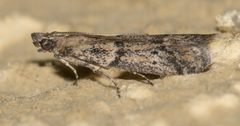
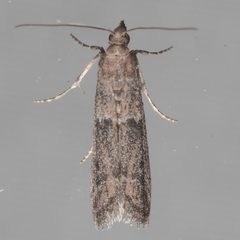
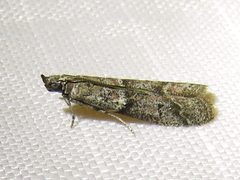
Small with wingspan of 12–16 mm. Overall coloration dusky or grayish-brown, consistent with the . Specific wing pattern details are not well documented in available sources.
Habitat
Urban and suburban environments where dried fruit and nut products are stored or processed. Attracted to ultraviolet light at night.
Distribution
Native to western North America: recorded from California, Arizona, Oklahoma, Utah, Montana, Alberta, and British Columbia. Introduced to Hawaii.
Seasonality
Active year-round in suitable environments; attracted to blacklights during summer months in Davis, California, with records from July and August.
Diet
Larvae feed on raisins, prunes, walnuts, cones, and yeast.
Behavior
Strongly attracted to ultraviolet light; commonly collected at blacklighting displays. activity.
Ecological Role
Decomposer of dried plant material; minor pest of stored dried fruits and nuts.
Human Relevance
Minor pest of stored food products, particularly dried fruits and nuts. Frequently encountered by entomologists and citizen scientists during -watching events.
Similar Taxa
- Cadra figuliellaAlso in Pyralidae, frequently collected at same blacklighting stations; differs in larval preferences and subtle morphological features
- Other Ephestiodes species-level identification requires examination of genitalia or molecular markers
Sources and further reading
- BugGuide
- Wikipedia
- GBIF taxonomy match
- iNaturalist taxon
- NCBI Taxonomy
- Catalogue of Life
- Blacklighting at the Bohart: They Saw the Light | Bug Squad
- What Will You See at Bohart Museum Open House | Bug Squad
- Oh, What a (Moth) Night! | Bug Squad
- Mark Your Calendar for 'Moth Night' at Bohart Museum: July 30 | Bug Squad
- A Night at the Bohart Museum: Moth Night on Saturday, July 22 | Bug Squad
- Bohart Open House: Like a Moth to a Flame | Bug Squad