
Ephestiodes
Ragonot, 1887
snout moths
Species Guides
5- Ephestiodes erythrella
- Ephestiodes gilvescentella(Dusky Raisin Moth)
- Ephestiodes infimella(Reddish Ephestiodes Moth)
- Ephestiodes mignonella
- Ephestiodes monticolus
Ephestiodes is a of snout moths in the Pyralidae, described by Émile Louis Ragonot in 1887. The genus includes approximately eight described , with Ephestiodes gilvescentella (dusky raisin ) being the most frequently encountered and well-documented. Species in this genus are primarily found in North America and are commonly attracted to ultraviolet light during surveys.
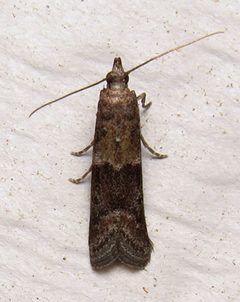
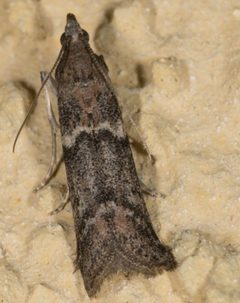
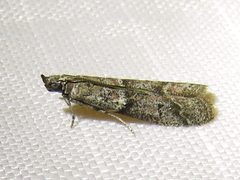
Pronunciation
How to pronounce Ephestiodes: /ˌɛfɛstiˈoʊdiːz/
These audio files are automatically generated. While they are not always 100% accurate, they are a good starting point.
Identification
Members of Ephestiodes can be recognized as small pyralid moths with the characteristic snout-like projection formed by elongated labial palps typical of the . -level identification requires examination of genitalia and wing pattern details. Ephestiodes gilvescentella is distinguished by its dusky, grayish-brown coloration and association with dried fruit and nut .
Images
Habitat
include areas where dried fruits, nuts, and stored food products occur. Ephestiodes gilvescentella has been recorded in urban and suburban environments, particularly where raisins, prunes, walnuts, and similar materials are present. The also occurs in natural settings including montane regions (E. monticolus) and various North American localities from California to British Columbia.
Distribution
North America, with records from California, Arizona, Oklahoma, Utah, Montana, Alberta, and British Columbia. The shows highest abundance in the western United States, particularly in the Central Valley of California where E. gilvescentella has been described as "the most common in Davis."
Seasonality
are active during summer months, with peak abundance in July and August. Blacklighting records from Davis, California indicate consistent presence during late summer evenings.
Diet
Larvae feed on dried fruits (raisins, prunes), nuts (walnuts), yeast, and related stored organic materials. The "dusky raisin " for E. gilvescentella reflects this specialized feeding habit.
Behavior
are and strongly attracted to ultraviolet light. They are frequently collected at blacklighting stations. activity occurs during evening hours, with peak visitation to light traps between approximately 9:15 p.m. and 11 p.m.
Human Relevance
Ephestiodes gilvescentella is a minor pest of stored dried fruits and nuts. It is not considered a major agricultural pest but may cause damage to stored raisins, prunes, and walnuts. The is commonly encountered in domestic settings and during surveys, serving as an for insect diversity assessments.
Similar Taxa
More Details
Taxonomic history
The was established by Ragonot in 1887 with E. erythrella as the type . Additional species were described by Heinrich (1956), Dyar (1908, 1914), and Neunzig (1990).
Research significance
Ephestiodes gilvescentella has been extensively documented by entomologist John De Benedictis during 37 years of blacklighting surveys in California, contributing to long-term biodiversity monitoring datasets.
Sources and further reading
- BugGuide
- Wikipedia
- GBIF taxonomy match
- iNaturalist taxon
- NCBI Taxonomy
- Catalogue of Life
- Blacklighting at the Bohart: They Saw the Light | Bug Squad
- What Will You See at Bohart Museum Open House | Bug Squad
- Oh, What a (Moth) Night! | Bug Squad
- Mark Your Calendar for 'Moth Night' at Bohart Museum: July 30 | Bug Squad
- A Night at the Bohart Museum: Moth Night on Saturday, July 22 | Bug Squad
- Bohart Open House: Like a Moth to a Flame | Bug Squad