
Sparganothini
Druce, 1912
Genus Guides
9- Amorbia(leafroller moths)
- Cenopis
- Coelostathma
- Niasoma
- Platynota(leafroller moths)
- Sparganothis(Sparganothis fruitworm)
- Sparganothoides
- Synalocha
- Synnoma(rabbitbrush webbing moth)
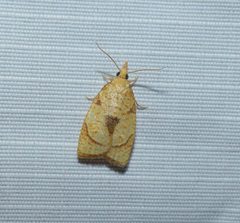
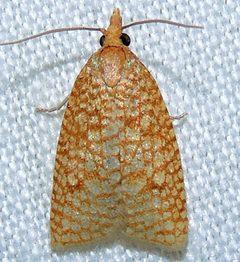
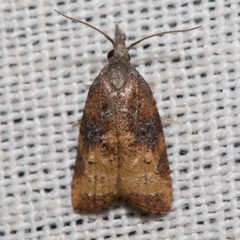
Sparganothini is a tribe of tortrix moths (Lepidoptera: Tortricidae: Tortricinae) containing approximately 20 distributed primarily in the New World. The tribe includes economically significant and has been the subject of multiple systematic revisions. Greatest occurs at middle elevations (500–1500 m) in Central and South America. Several genera have been extensively studied, including Amorbia (29 species), Sparganothoides (32 species), and Amorbimorpha (at least 12 species, with 2 formally described).
Pronunciation
How to pronounce Sparganothini: //ˌspɑːrɡəˈnɒθɪnaɪ//
These audio files are automatically generated. While they are not always 100% accurate, they are a good starting point.
Identification
Members of Sparganothini are distinguished from other tortricine tribes by genitalic characters, particularly features of the male genitalia. Systematic revisions within the tribe rely heavily on male genitalic for -level identification. The tribe includes with diverse external morphology; some species exhibit characteristic "shaggy" scaling. Formal identification requires dissection and examination of genitalic structures.
Images
Habitat
Middle elevations (500–1500 m) in Central and South America support the greatest . such as Amorbimorpha occur at middle to upper elevations of central Mexico. The tribe occupies diverse across its range from the mid-Atlantic and southern United States through Central America to Venezuela and Brazil.
Distribution
Primarily New World distribution: mid-Atlantic and southern United States, Mexico, Central America, Caribbean, and South America (Brazil, Venezuela). The Platynota stultana has established in Spain. Individual show varying ranges: Amorbia extends to northeastern and southwestern Canada; Sparganothoides ranges from the United States to Venezuela; Amorbimorpha occurs from Texas to Veracruz, Mexico.
Life Cycle
Laboratory rearings from deposited by confined females have been documented for multiple . Eight of Sparganothoides representing five of six species groups, and Amorbia powelliana, have been reared in captivity. stages are known for 12 Amorbia species.
Human Relevance
Platynota stultana is documented as an in Spain, with established and expanding . Several likely function as agricultural or horticultural pests given the tribe's placement within Tortricidae, though specific pest status requires verification for individual species.
Similar Taxa
- Other Tortricinae tribesSparganothini is distinguished by male genitalic characters; other tribes such as Archipini and Cnephasiini share the Tortricinae but differ in genitalic and geographic distribution patterns.
More Details
Systematic research
The tribe has been subject to intensive taxonomic revision. Recent systematic treatments include comprehensive revisions of Amorbia (2007), Sparganothoides (2009), and description of the new Amorbimorpha (2012). These works have clarified phylogenetic relationships and established informal groups based on morphological characters.
Undescribed diversity
Significant undescribed diversity exists within the tribe. At least ten additional remain to be described in Amorbimorpha alone. The Sparganothis, historically associated with this tribe, and the fossil genus †Spatalistiforma indicate ongoing systematic complexity.
Sources and further reading
- BugGuide
- Wikipedia
- iNaturalist taxon
- NCBI Taxonomy
- Catalogue of Life
- Systematics of Sparganothoides Lambert and Powell, 1986 (Lepidoptera: Tortricidae: Sparganothini)
- Phylogenetic relationships, systematics, and biology of the species of Amorbia Clemens (Lepidoptera: Tortricidae: Sparganothini)
- Description of Amorbimorpha Kruse, new genus, from Mexico and the southern United States (Lepidoptera: Tortricidae: Sparganothini)
- Establecimiento y ampliación de la distribución en España de la especie invasora Platynota stultana (Staudinger, 1901) (Lepidoptera, Tortricidae, Sparganothini)